| Elasticity | Correlation | Elasticity | Correlation | |
|---|---|---|---|---|
| Denmark | 0.071 | 0.089 | 0.034 | 0.045 |
| Finland | 0.173 | 0.157 | 0.080 | 0.074 |
| Norway | 0.155 | 0.138 | 0.114 | 0.084 |
| Sweden | 0.258 | 0.141 | 0.191 | 0.102 |
| UK | 0.306 | 0.198 | 0.331 | 0.141 |
| US | 0.517 | 0.357 | 0.283 | 0.160 |
Source: Table 2
KAT.TAL.322 Advanced Course in Labour Economics
Do children “inherit” their outcomes from parents?
Maximise intergenerational utility (Cobb-Douglas)
\[ \max_{I_{t - 1}, C_{t - 1}} \left(1 - \alpha\right) \log C_{t - 1} + \alpha \log y_t \]
\(E_t\) are non-investment determinants (randomness?) that is known to the parent
The first-order condition for \(I_{t - 1}\) implies
\[ I_{t - 1} = \alpha y_{t - 1} - \frac{(1 - \alpha) E_t}{1 + r} \]
Plug it back to the investment technology equation:
\[ y_t = \alpha(1 + r) y_{t - 1} + \alpha E_t \]
If \(E_t \perp y_{t - 1}\) and \(Var(y_t) = Var(y_{t - 1}) \Rightarrow \text{Corr}(y_t, y_{t - 1}) = \alpha (1 + r)\)
Suppose \(E_t = e_t + u_t\), where \(e_t\) is endowment and \(u_t\) is randomness.
Endowment is passed down the generations: \(e_t = \lambda e_{t - 1} + v_t\)
\[ y_t = \alpha(1 + r) y_{t - 1} + \alpha e_t + \alpha u_t \]
Assuming \(y_t\) is stationary,
\[\text{Corr}(y_t, y_{t - 1}) = \delta \alpha(1 + r) + (1 - \delta) \frac{\alpha(1 + r) + \lambda}{1 + \alpha(1 + r) \lambda}\]
where \(\delta = \frac{\alpha^2 \sigma_u^2}{(1 - \alpha^2 (1 + r)^2)\sigma_y^2}\).
Together with explanations on the next slide, point out different components and build story.
Even the simple model highlights important channels:
Importance \(\alpha\) of child’s future earnings on parent’s utility
Return to investments \(r\) (e.g., returns to education)
Strength of intergenerational transmission of endowments \(\lambda\)
Magnitude of market luck relative to endowment luck \(\delta\)
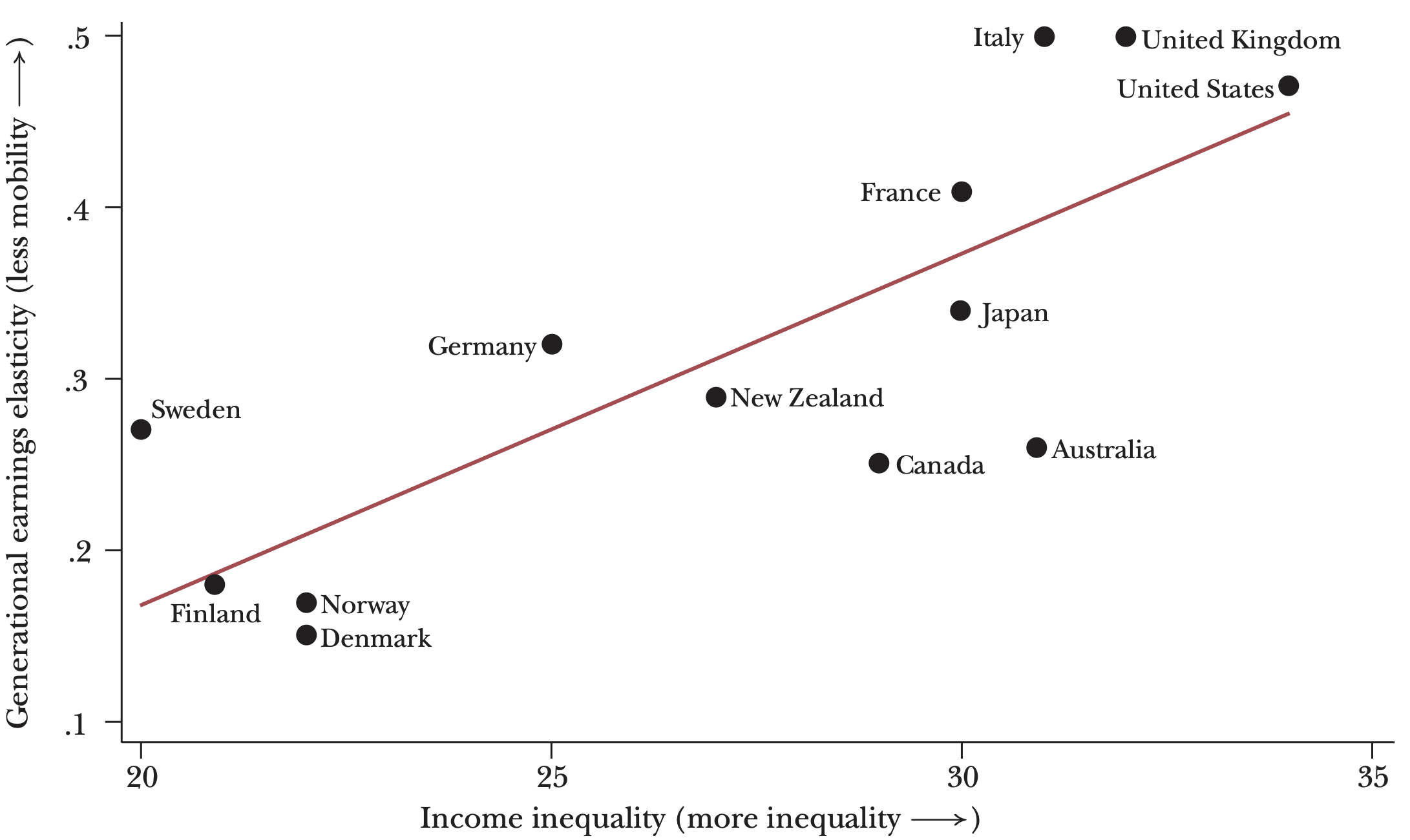
Notice \(\uparrow r\) (a measure of income inequality) implies higher correlation between generations, or lower mobility.
This relationship is captured by the Great Gatsby curve.
Ignores transfer of assets (revisited Becker and Tomes 1986)
Single parent \(\Rightarrow\) ignores assortative mating
Single child \(\Rightarrow\) ignores intrahousehold allocation
Arbitrary functional forms
Simple regression (ignoring process on endowments)
\[ y_t = \beta y_{t - 1} + \varepsilon \]
where \(y_t\) and \(y_{t - 1}\) are log earnings and \(\beta\) is IGE elasticity.

Using father’s education as an instrument for father’s single-year earnings
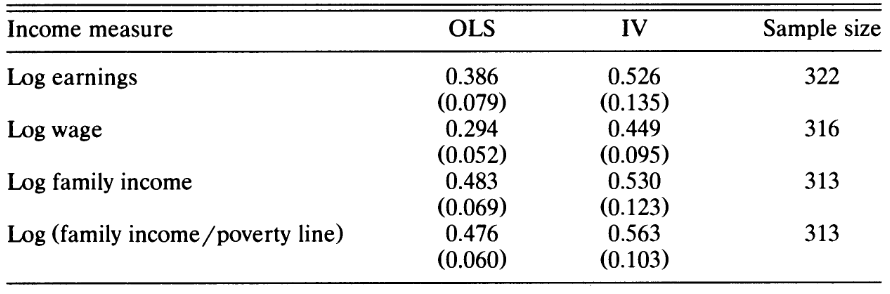
So, the idea is that by using an instrument, they can also approximate lifetime earnings potential even when using single-year measures
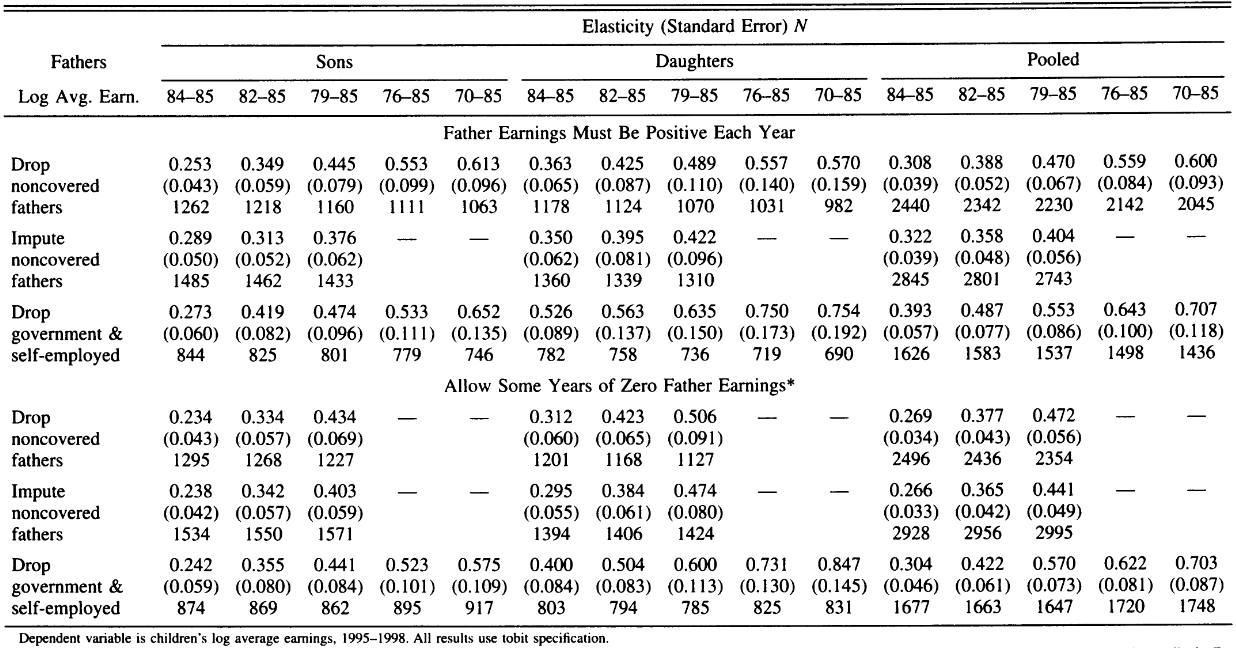
\[ \begin{align} y^\text{parent}_a &= \mu_a y^\text{parent} + v \\ y^\text{child}_a &= \lambda_a y^\text{child} + u \end{align} \]
In this case, IGE elasticity estimator \(\hat{\beta}\) is inconsistent:
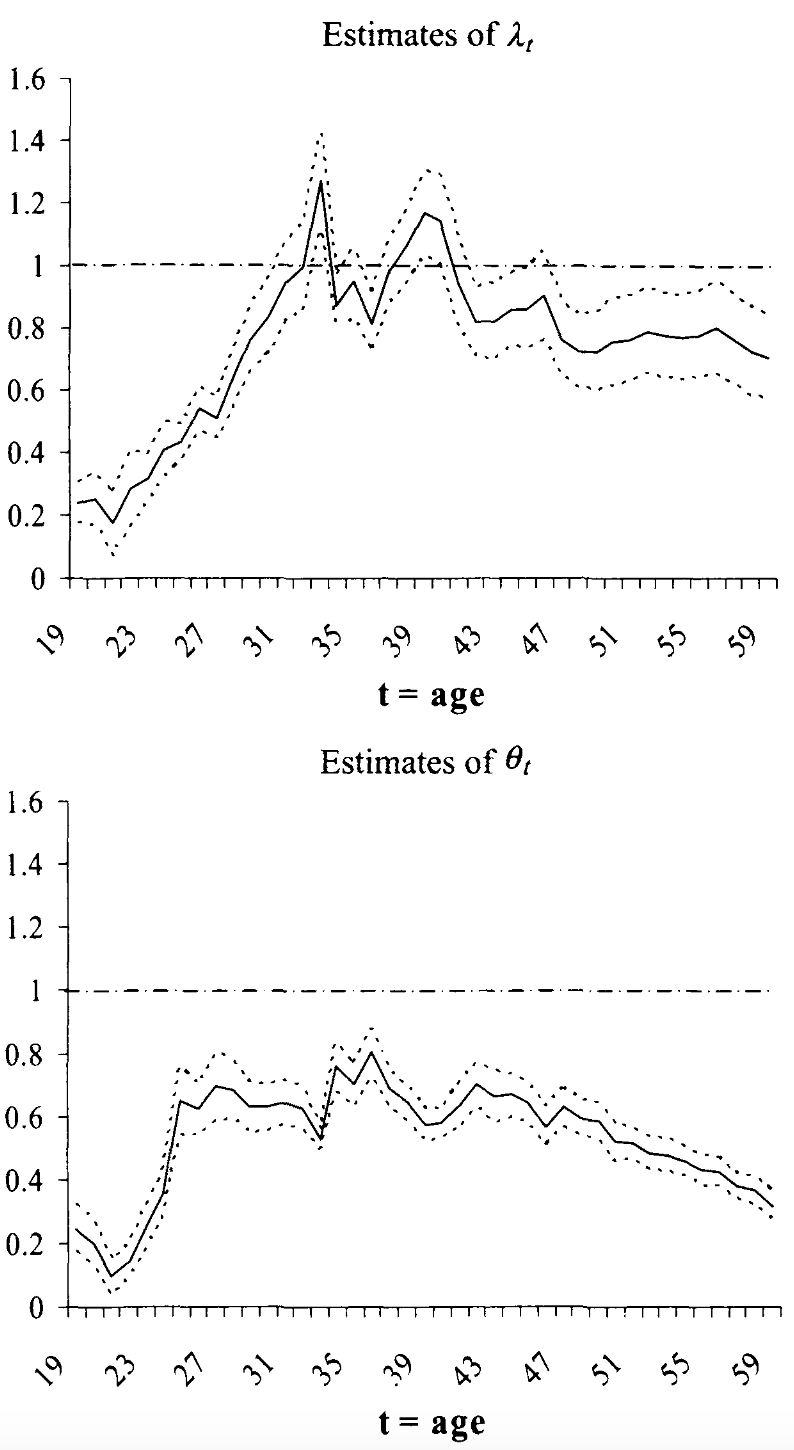
\[ \text{plim}~\hat{\beta} = \beta \lambda_a \theta_a \]
where \(\theta_a = \frac{\mu_a \text{Var}(y^\text{parent})}{\mu_a^2 \text{Var}(y^\text{parent}) + \text{Var}(v)}\)
| Elasticity | Correlation | Elasticity | Correlation | |
|---|---|---|---|---|
| Denmark | 0.071 | 0.089 | 0.034 | 0.045 |
| Finland | 0.173 | 0.157 | 0.080 | 0.074 |
| Norway | 0.155 | 0.138 | 0.114 | 0.084 |
| Sweden | 0.258 | 0.141 | 0.191 | 0.102 |
| UK | 0.306 | 0.198 | 0.331 | 0.141 |
| US | 0.517 | 0.357 | 0.283 | 0.160 |
Source: Table 2
Black and Devereux (2011): recent studies focus on causal mechanisms
What is the “optimal” amount of intergenerational mobility?
High \(H\) parent invest more in child’s \(H \Rightarrow\) high IG correlation
Type of policy depends on channel:
School reform in Finland 1972-77: selective \(\rightarrow\) comprehensive

The reforms also
increased academic content of curriculum (more math and sciences)
one foreign language became compulsory
\(\Rightarrow\) new curriculum is
more demanding for those who would have stayed in vocational track
less demanding than in old secondary school! (because more heterogeneous students)
Plus, abolished private schools and imposed centralized control.
Standard IGE elasticity regression
\[ \log(y_\text{son}) = a + b_{jt} \log(y_\text{father}) + e \tag{1}\]
Effect of reform on IGE elasticity
\[ b_{jt} = b_0 + \delta R_{jt} + \Omega D_j + \Psi D_t \tag{2}\]
where \(R_{jt}\) indicates if reform in municipality \(j\) affected cohort \(t\).

Write out the full regression equation
\[ \begin{align} \log(y_\text{son}) = &a + b_0 \log(y_\text{father}) + \\ & + \delta R_{jt} \log(y_\text{father}) + \left(\Omega D_j + \Psi D_t\right)\log(y_\text{father}) + \\ & + \Phi D_t + \Pi D_j + \gamma R_{jt} + e_{ijt} \end{align} \]
| (1) | (2) | (3) | (4) | |
|---|---|---|---|---|
| Father’s earnings | 0.277 | 0.297 | 0.298 | 0.296 |
| (0.014) | (0.011) | (0.010) | (0.014) | |
| Reform | −0.063 | −0.019 | ||
| (0.012) | (0.021) | |||
| Father’s earnings \(\times\) reform | −0.055 | −0.069 | −0.066 | |
| (0.009) | (0.022) | (0.031) | ||
| Obs. | 20 824 | 20 824 | 20 824 | 20 824 |
| \(R^2\) | 0.05 | 0.05 | 0.05 | 0.06 |
| Cohort FE | Yes | Yes | ||
| Father’s earnings \(\times\) cohort FE | Yes | Yes | ||
| Region FE | Yes | Yes | ||
| Father’s earnings \(\times\) region FE | Yes | Yes | ||
| Cohort FE \(\times\) region FE | Yes | |||
| Region-specific trend | Yes |
Source: Table 3
Last column add fully interacted FEs \(\Rightarrow\) main effect of the reform is no longer identified
BUT interaction is still identified and is consistent with other columns!
Improving access to education promotes intergenerational mobility
Do educational reforms have spillover effects on children?
School reform in Norway in 1960-71: compulsory edu 7 \(\rightarrow\) 9 years
IV approach
\[ \begin{align} E &= \beta E^p + \gamma X + \gamma_p X^p + \epsilon \\ E^p &= \alpha {REFORM}^p + \delta X + \delta_p X^p + v \end{align} \]
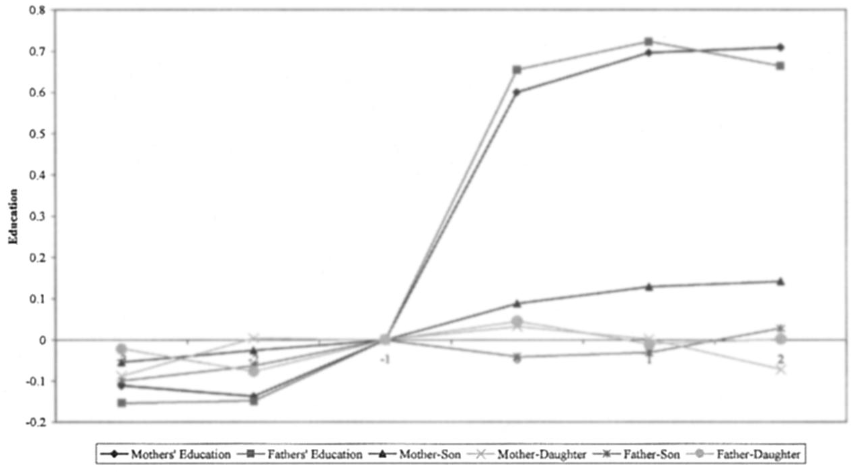
Limited IG spillover of school reform at the bottom
Expansion of Finnish university system in 1955-75

The third map shows 1995 (mostly expansion in student numbers)
University access measures based on distance from municipality of birth
Event study and IV approach
\[ \begin{align} E^c_{ijmc} &= \beta_0 + \beta_1 E^p_{ijmc} + \beta_2 X_{ijmc} + \theta_m + \mu_c + \varepsilon_{ijmc} \\ E^p_{ijmc} &= \alpha_0 + \alpha_1 {UniAccess}_{ijmc} + \alpha_2 X_{ijmc} + \gamma_m + \delta_c + \vartheta_{ijmc} \end{align} \]
\(i\) - child, \(j\) - parent, \(m\) - parent birth municipality, \(c\) - parent birth cohort.
| Child's years of education | ||||
|---|---|---|---|---|
| Full sample | Grandparent nonmissing | |||
| OLS | IV | |||
| (1) | (2) | (3) | (4) | |
| Mother's years of education | 0.345*** | 0.522*** | 0.540*** | 0.697*** |
| (0.004) | (0.133) | (0.143) | (0.120) | |
| F-stat (IV) | 4.1 | 14.2 | 21.3 | |
| Obs. | 1 239 331 | 1 239 331 | 1 239 331 | 628 230 |
| Father's years of education | 0.305*** | 0.400** | 0.535*** | 0.612*** |
| (0.003) | (0.161) | (0.171) | (0.143) | |
| F-stat (IV) | 3.7 | 12.7 | 19.6 | |
| Obs. | 1 195 008 | 1 195 008 | 1 195 008 | 710 677 |
| Additional controls | Yes | Yes | ||
Source: Table 7
1 extra year of mother education leads to 0.5-0.6 year of child education
1 extra year of father education leads to 0.4-0.5 year of child education
the complier parents are mainly low-income and low-educated \(\Rightarrow\) IG spillovers could lead to higher mobility of their children as well
Strong positive spillover from parent’s to child’s education
Suggestive evidence that
assortative mating between parents can account for >50% of effects
higher parental income could also contribute to the results
IG transmission present in pre-uni school outcomes
Important for mobility discussion: complier parents mainly from low-educated and low-income families
IGE mobility varies geographically (Chetty et al. 2014)
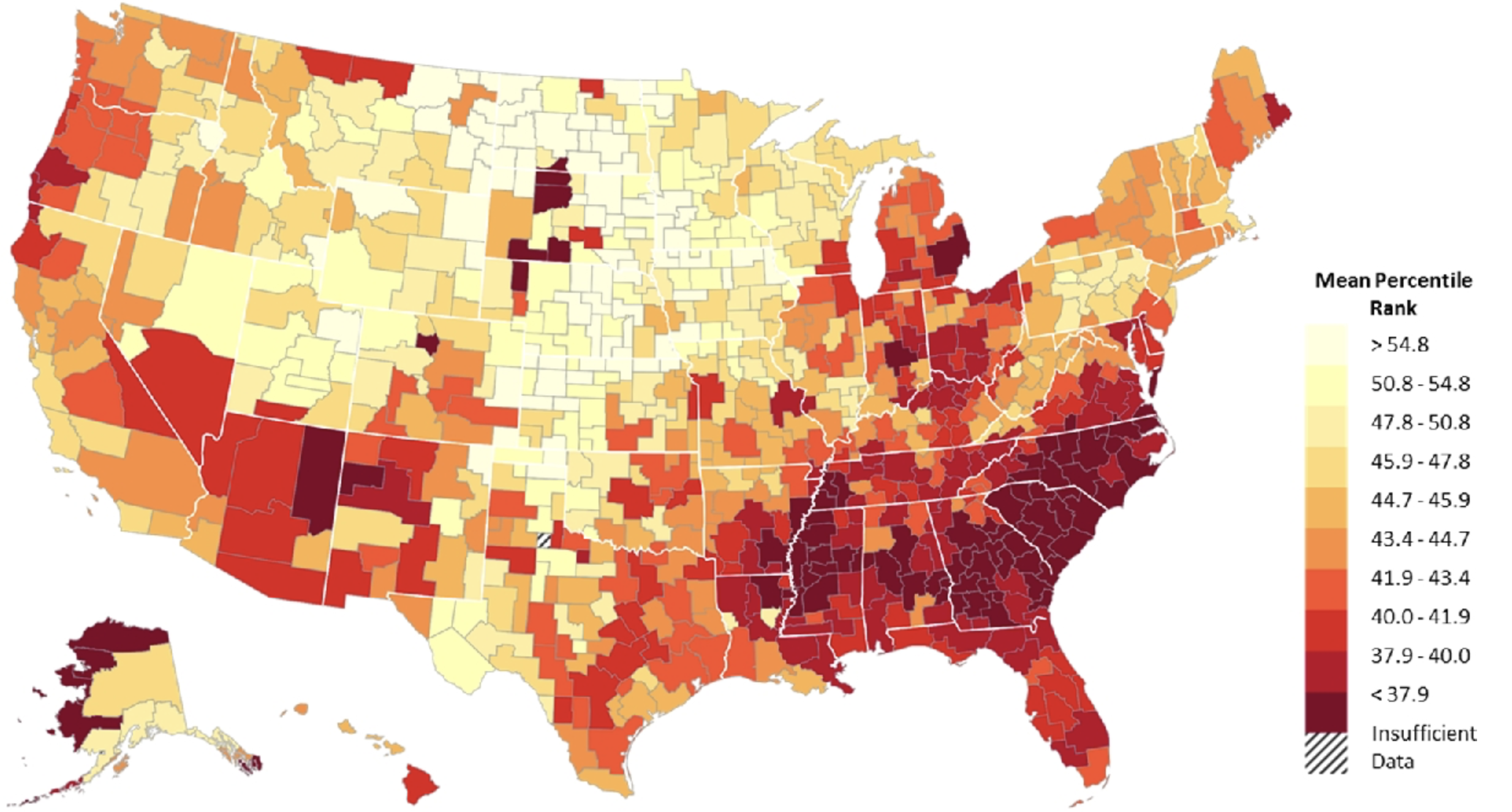
Geographic variation in IGE mobility may stem from:
selection into neighbourhoods
causal effect of neighbourhoods
Do children moving to higher mobility area have better outcomes?
Endogenous moving \(\Rightarrow\) exploit timing of move
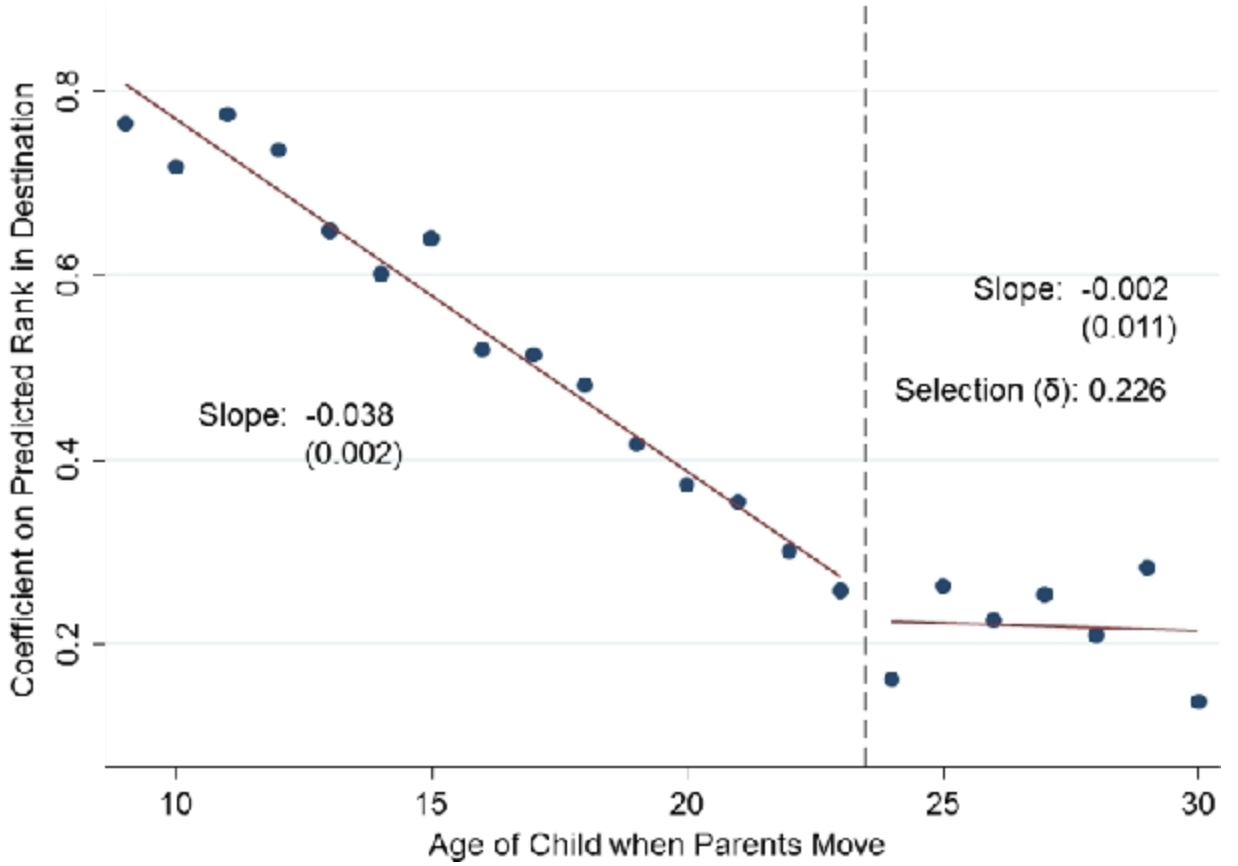
Moving to a more mobile place improves success in proportion to exposure!
children who move at age 9 would pick up 56% of the observed difference in permanent residents’ outcomes between their origin and destination CZs
extrapolating: being born in a better area - pick up about 80% of the difference!
What makes neighbourhoods generate good outcomes?
Together explain 58% of variation in CZ causal effect
Social capital = participation in civic organiziations, bowling centers, golf clubs, fitness centers, sports organizations, religious organizations, political organizations, labour, business and professional organizations.
How much of IGE elasticity driven by nature vs nurture?
Extension of standard model:
genetic transmission and assortative mating
skill transmission: genetic factors, parental investments, family environment and idiosyncratic events
Minnesota Twin Family Study (income, skills, genotypes + parents)
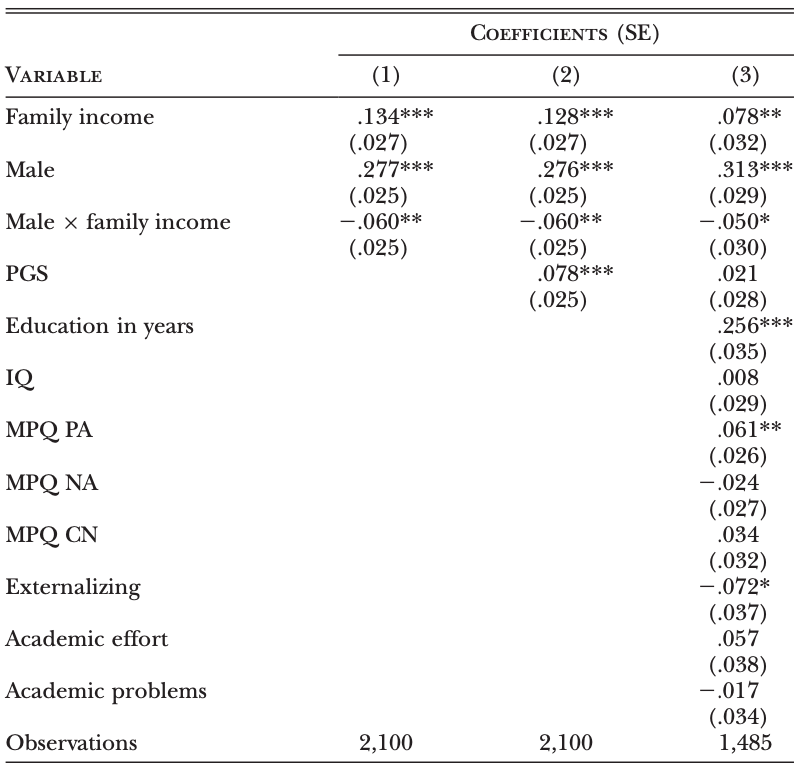
PGS as measure of genetic endowment affects significantly the income
hence endowment plays an important role
most of the PGS effect is mediated via education variables
so, it is possible that PGS determines the investments they get
also part of the PGS effect carries the weight of assortative mating
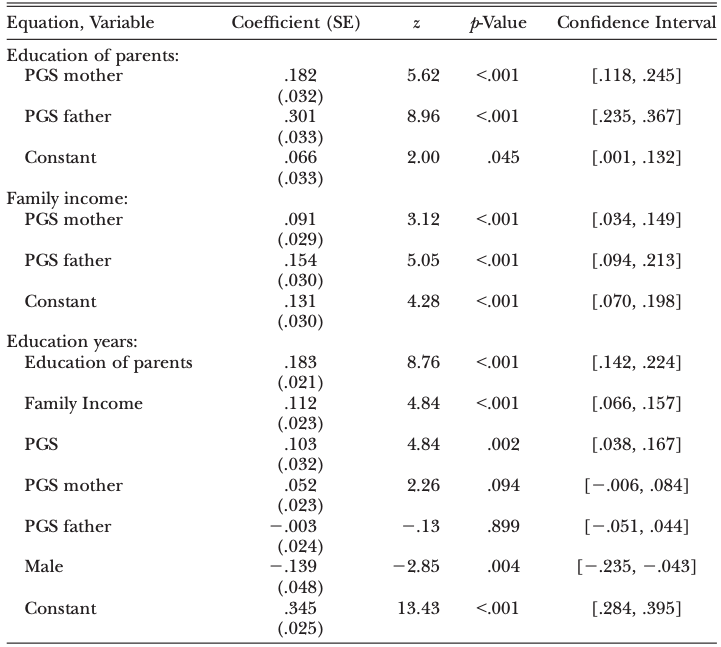
The last panel (equation of education years of children) shows that
PGS of parents completely mediated through family environment variables such as parent education and family income
PGS of child remains highly significant and large, so genetic endowment continue to play an important role
Typical regression of parent-child pairs
\[ \ln y^\text{child} = \beta_{-1} \ln y^\text{parent} + \varepsilon \]
Similar estimation across \(k\) generations
\[ \ln y^\text{child} = \beta_{-k} \ln y^{k \text{ ancestor}} + \vartheta \]
Iterated regression fallacy: \(\beta_{-k} \neq \left(\beta_{-1}\right)^k\)

Possible explanations of iterated regression fallacy:
Current individuals in Florence \(\leftrightarrow\) ancestors in 1427 based on surnames
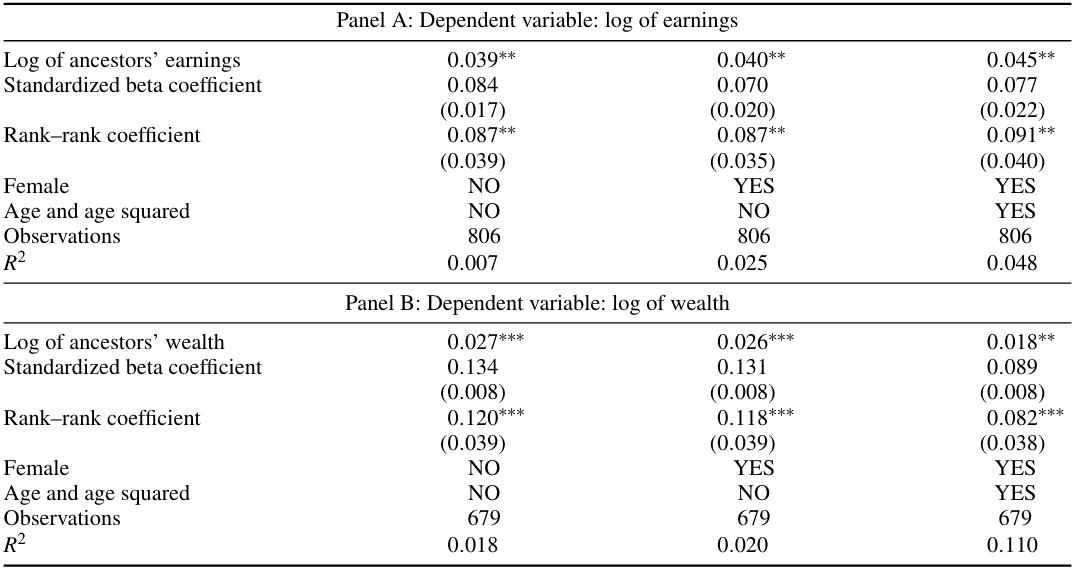
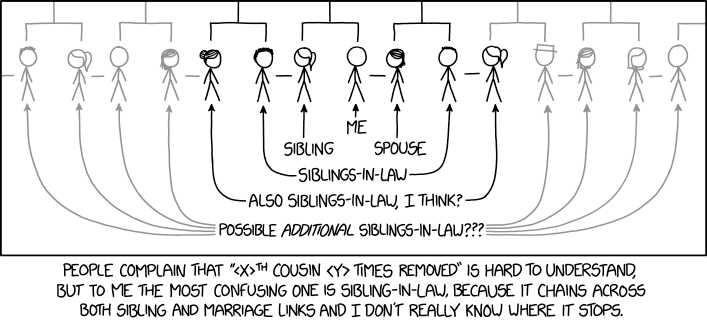
Horizontal approach: Grandparent-grandchild \(\rightarrow\) cousin-cousin
blood relationships: intergenerational processes
in-law relationships: assortative processes
Swedish registry: “up to 141 distinct kinship moments”
\[ \begin{align} y_t &= \beta \tilde{y}_{t - 1} + \gamma \tilde{z}_{t - 1} + e_t + v_t + x_t + u_t \\ \tilde{y}_{t - 1} &= \alpha_y y_{t - 1}^m + \left(1 - \alpha_y\right) y_{t - 1}^f \\ \tilde{z}_{t - 1} &= \alpha_z z_{t - 1}^m + \left(1 - \alpha_z\right) z_{t - 1}^f \end{align} \]
\(\beta\) and \(\alpha_y\) measure direct transmission
\(\gamma\) and \(\alpha_z\) measure indirect transmission
\(u_t\) is white noise (market luck)
\(v_t\) is white noise in latent factor (endowment luck)
\(x_t\) is shared sibling component
\(e_t\) is latent sibling component
| \(\beta\) | \(\gamma\) | \(\alpha_y\) | \(\alpha_z\) | \(\sigma_y^2\) | \(\sigma_u^2\) | \(\sigma_z^2\) | \(\sigma_x^2\) | \(\sigma_e^2\) | |
|---|---|---|---|---|---|---|---|---|---|
| Men | 0.144 | 0.664 | 0.389 | 0.660 | 4.648 | 1.975 | 2.072 | 0.180 | 0.657 |
| Women | 0.129 | 0.566 | 0.018 | 0.775 | 4.465 | 2.333 | 1.559 | 0.244 | 0.712 |
Vast literature on intergenerational mobility
Improving access to education promotes mobility
Geographic variation in mobility; largely causal
Genetic endowment and assortative mating important components
Multigenerational mobility slower than predicted
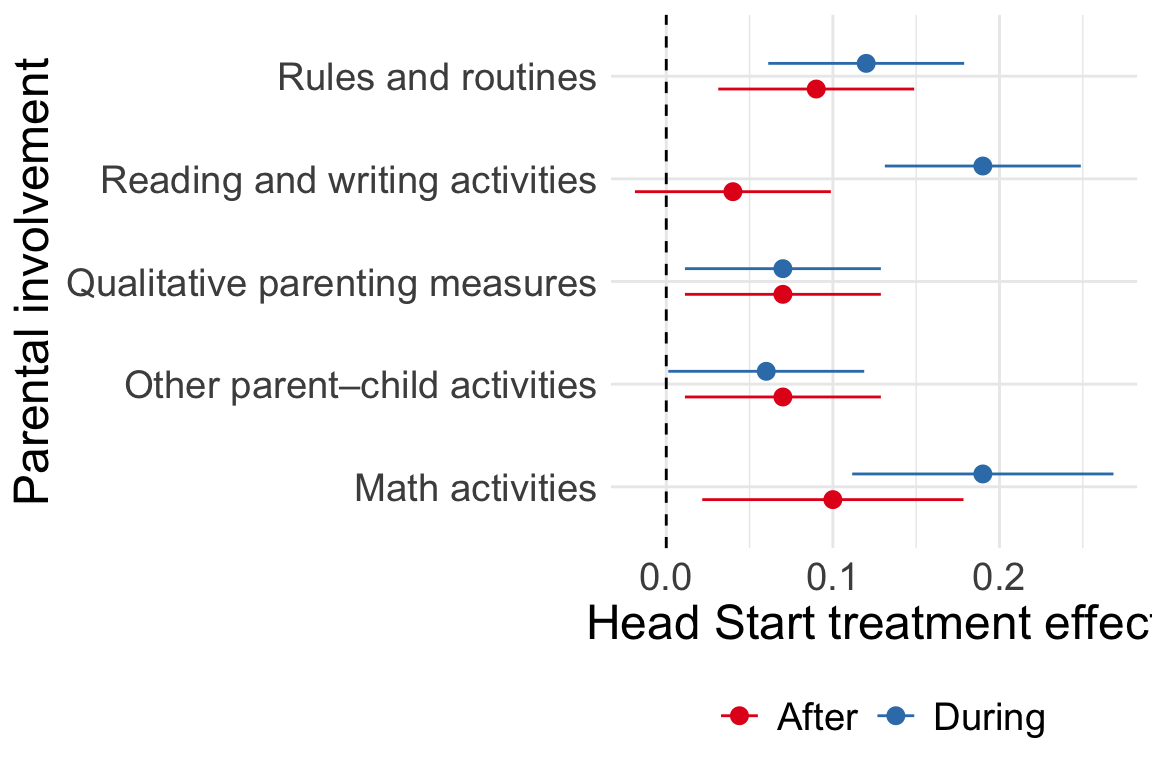
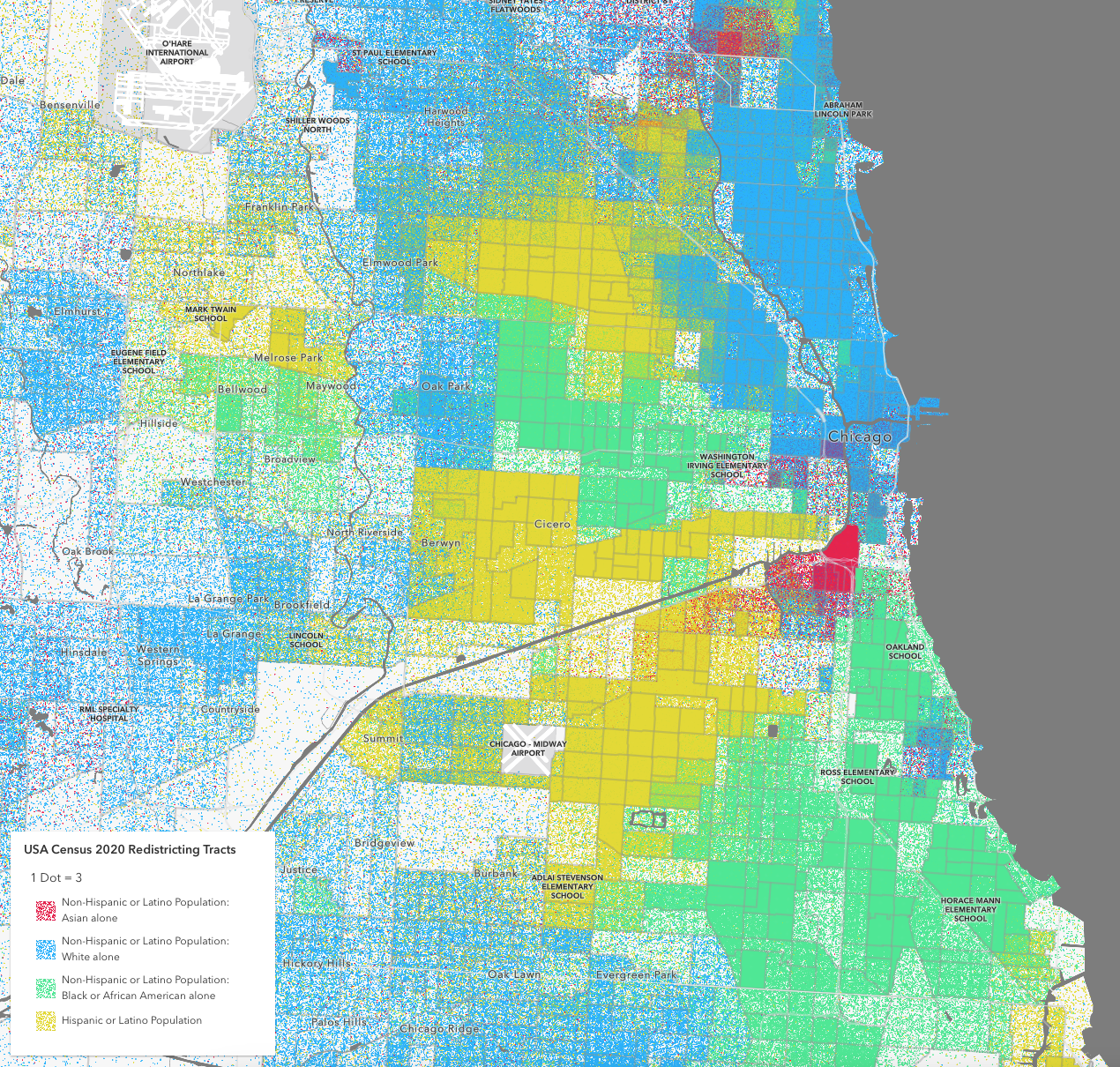
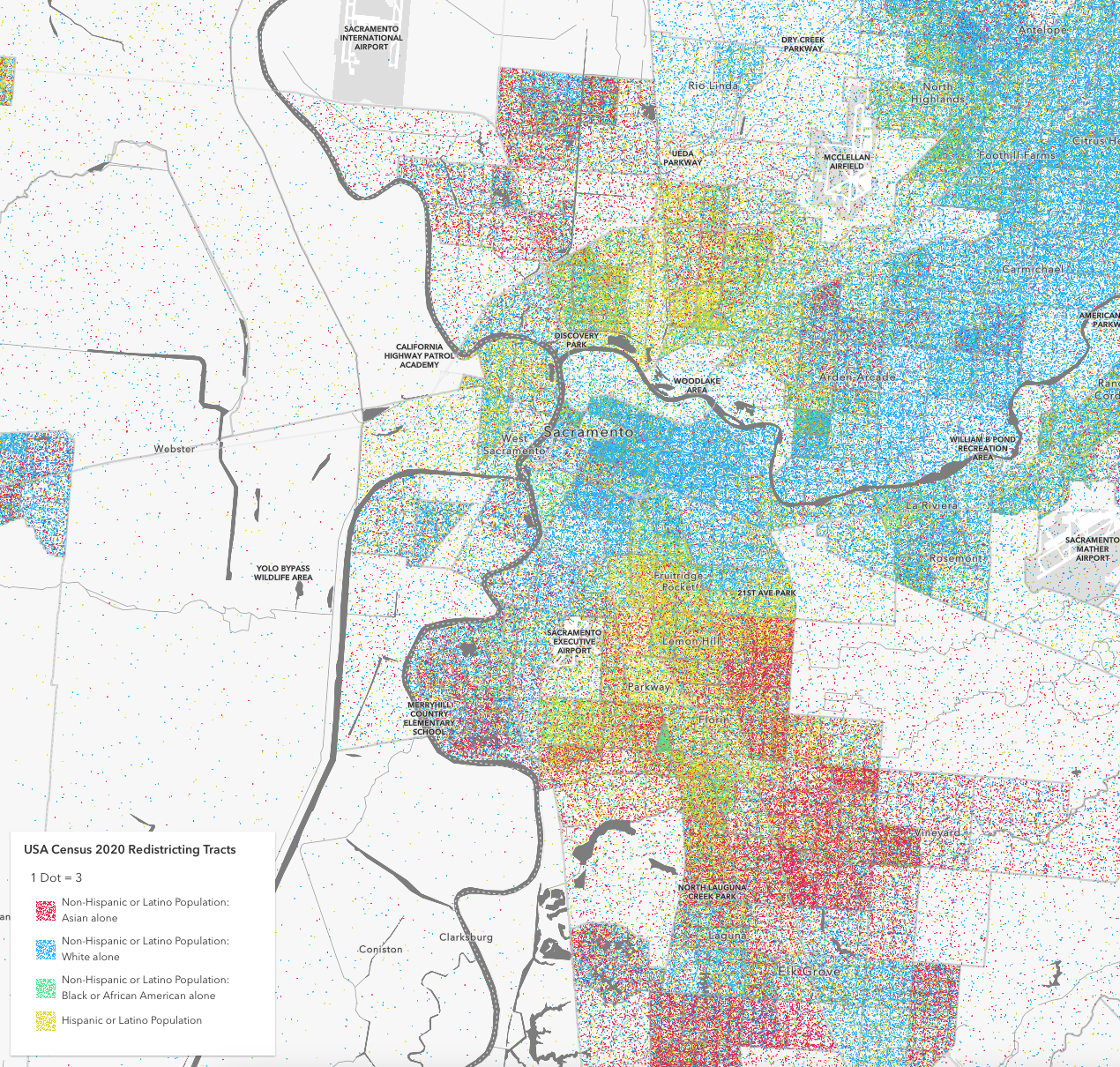
White - blue
Black - green
Asian - red
Hispanic - yellow