KAT.TAL.322 Advanced Course in Labour Economics
September 17, 2025


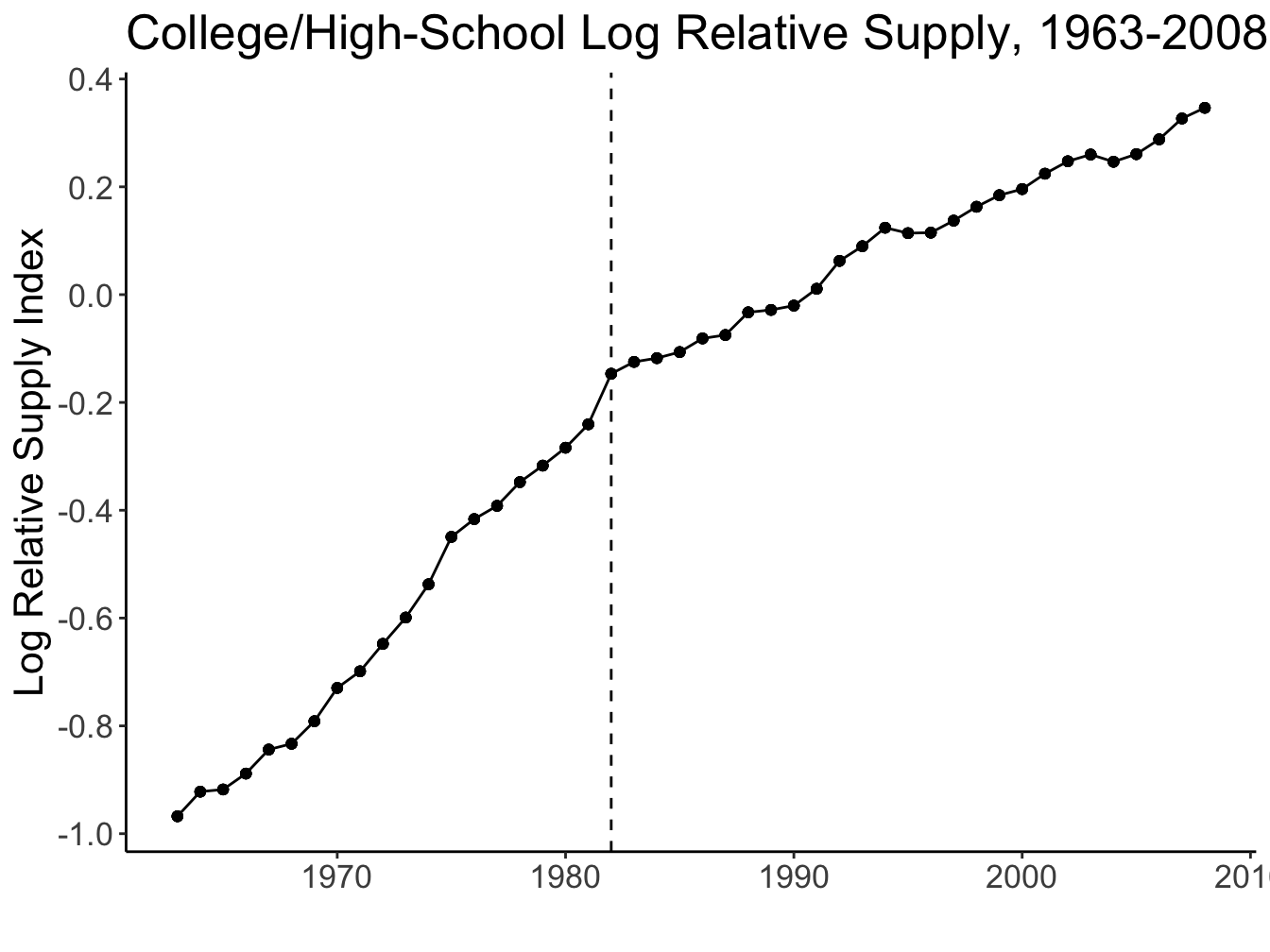
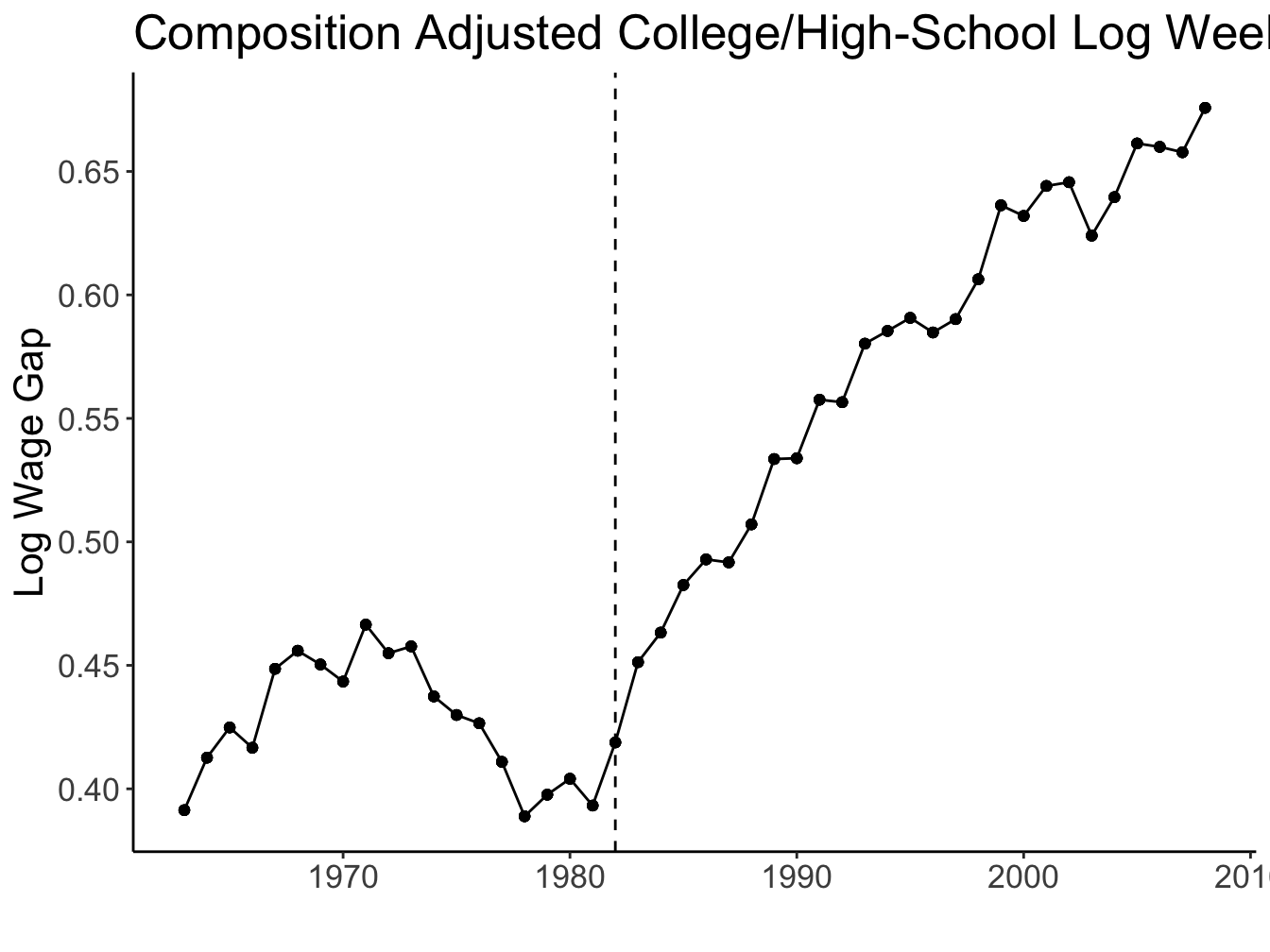
Source: Figures 1 and 2 (Acemoglu and Autor 2011)
Two types of labour: high- and low-skill
Typically, high edu and low edu (can be relaxed)
Skill-biased technological change (SBTC)
New technology disproportionately \(\uparrow\) high-skill labour productivity
High- and low-skill are imperfectly substitutable
Typically, CES production function with elasticity of substitution \(\sigma\)
Competitive labour market
\[ Y = \left[\left(A_L L\right)^\frac{\sigma - 1}{\sigma} + \left(A_H H\right)^\frac{\sigma - 1}{\sigma}\right]^\frac{\sigma}{\sigma - 1} \]
\(A_L\) and \(A_H\) are factor-augmenting technology terms
\(\sigma \in [0, \infty)\) is the elasticity of substitution
Supply of \(H\) and \(L\) assumed inelastic \(\Rightarrow\) study only firm side
\[ \begin{align} w_L &= A_L^\frac{\sigma - 1}{\sigma} \left[A_L^\frac{\sigma - 1}{\sigma} + A_H^\frac{\sigma - 1}{\sigma}\left(\frac{H}{L}\right)^\frac{\sigma - 1}{\sigma}\right]^\frac{1}{\sigma - 1}\\ w_H &= A_H^\frac{\sigma - 1}{\sigma} \left[A_L^\frac{\sigma - 1}{\sigma}\left(\frac{H}{L}\right)^{-\frac{\sigma - 1}{\sigma}} + A_H^\frac{\sigma - 1}{\sigma}\right]^\frac{1}{\sigma - 1} \end{align} \]
Comparative statics:
\[ \frac{w_H}{w_L} = \left(\frac{A_H}{A_L}\right)^\frac{\sigma - 1}{\sigma} \left(\frac{H}{L}\right)^{-\frac{1}{\sigma}} \]
\(\Delta\) relative supply
\[ \frac{\partial \ln \frac{w_H}{w_L}}{\partial \ln \frac{H}{L}} = -\frac{1}{\sigma} < 0 \]
\(\Delta\) technology
\[ \frac{\partial \ln\frac{w_H}{w_L}}{\partial \ln\frac{A_H}{A_L}} = \frac{\sigma - 1}{\sigma} \lessgtr 0 \]
The log-equation of skill premium is extremely attractive for empirical analysis
\[ \ln\frac{w_{H, t}}{w_{L, t}} = \frac{\sigma - 1}{\sigma} \ln\left(\frac{A_{H, t}}{A_{L, t}}\right) -\frac{1}{\sigma} \ln \left(\frac{H_t}{L_t}\right) \]
Assume a log-linear trend in relative productivities
\[ \ln \left(\frac{A_{H, t}}{A_{L, t}}\right) = \alpha_0 + \alpha_1 t \]
and plug it into the log skill premium equation:
\[ \ln\frac{w_{H, t}}{w_{L, t}} = \frac{\sigma - 1}{\sigma}\alpha_0 + \frac{\sigma - 1}{\sigma} \alpha_1 t -\frac{1}{\sigma} \ln\left(\frac{H_t}{L_t}\right) \]
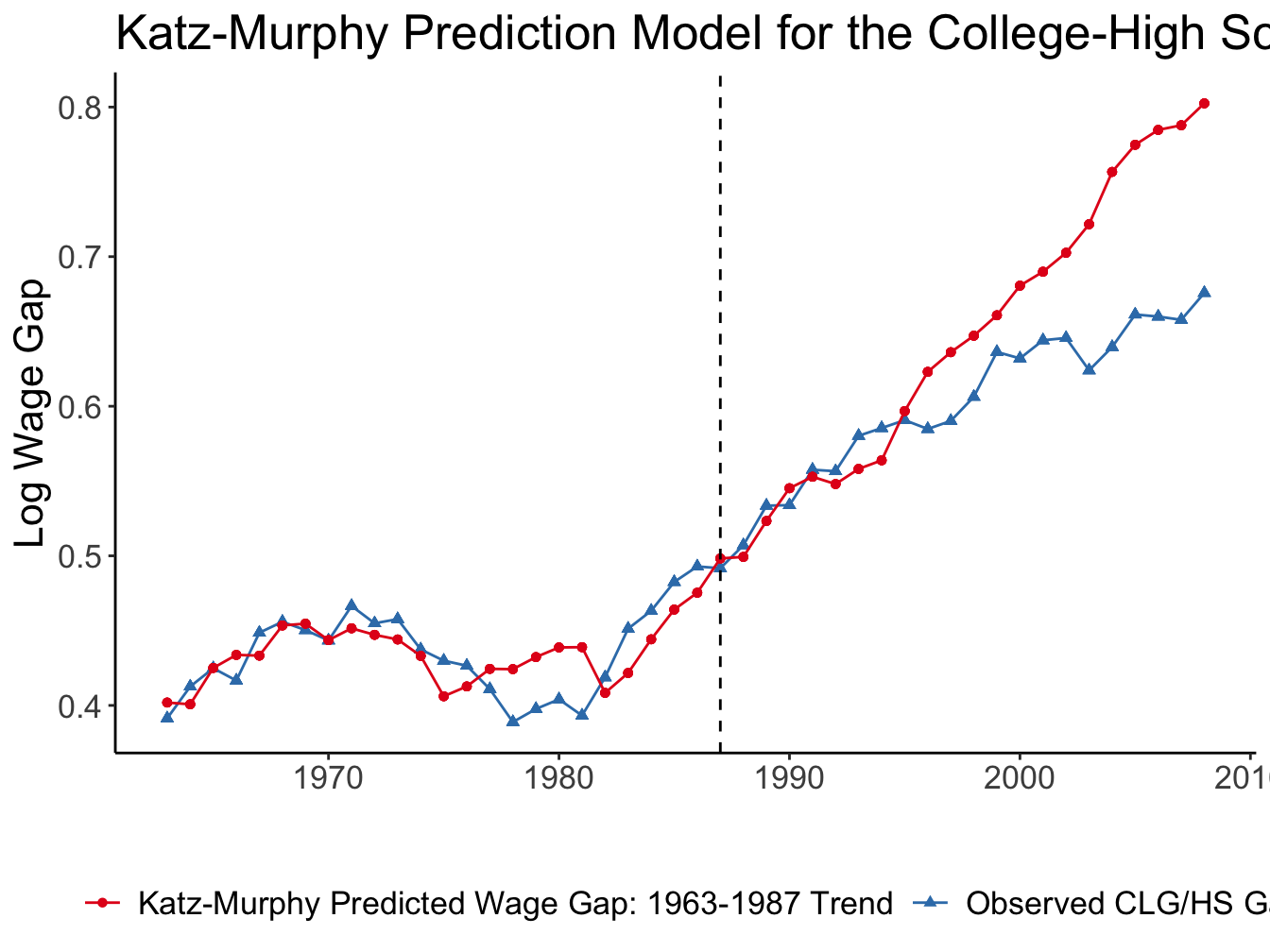
Estimated the skill premium equation using the US data in 1963-87 \[ \ln \omega_t = \text{cons} + \underset{(0.005)}{0.027} \times t - \underset{(0.128)}{0.612} \times \ln\left(\frac{H_t}{L_t}\right) \]
Implies elasticity of substitution \(\sigma \approx \frac{1}{0.612} =\) 1.63
Agrees with other estimates that place \(\sigma\) between 1.4 and 2 (Acemoglu and Autor 2011)

Very close fit up to mid-1990s, diverge later
Fit up to 2008 implies \(\sigma \approx\) 2.95
Accounting for divergence:
non-linear time trend in \(\ln\frac{A_H}{A_L}\)
brings \(\sigma\) back to 1.8, but implies \(\frac{A_H}{A_L}\) slowed down
differentiate labour by age/experience as well
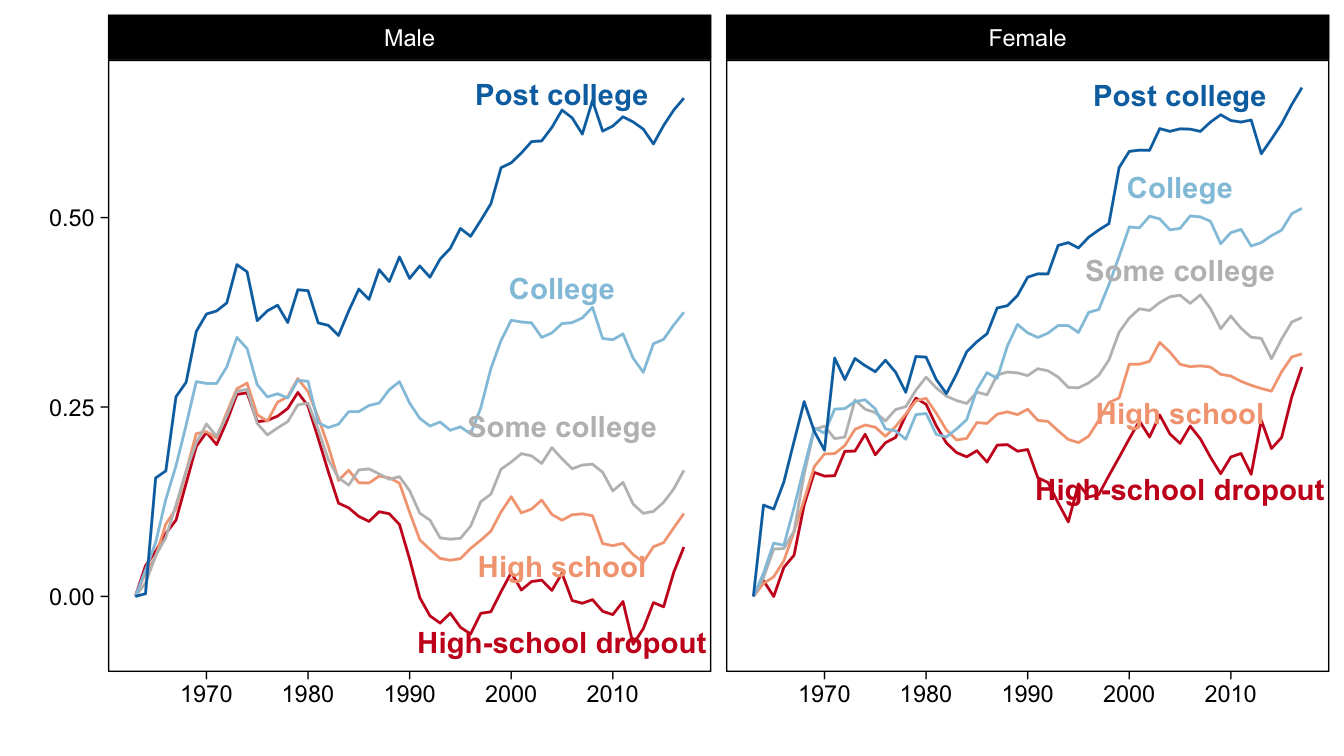
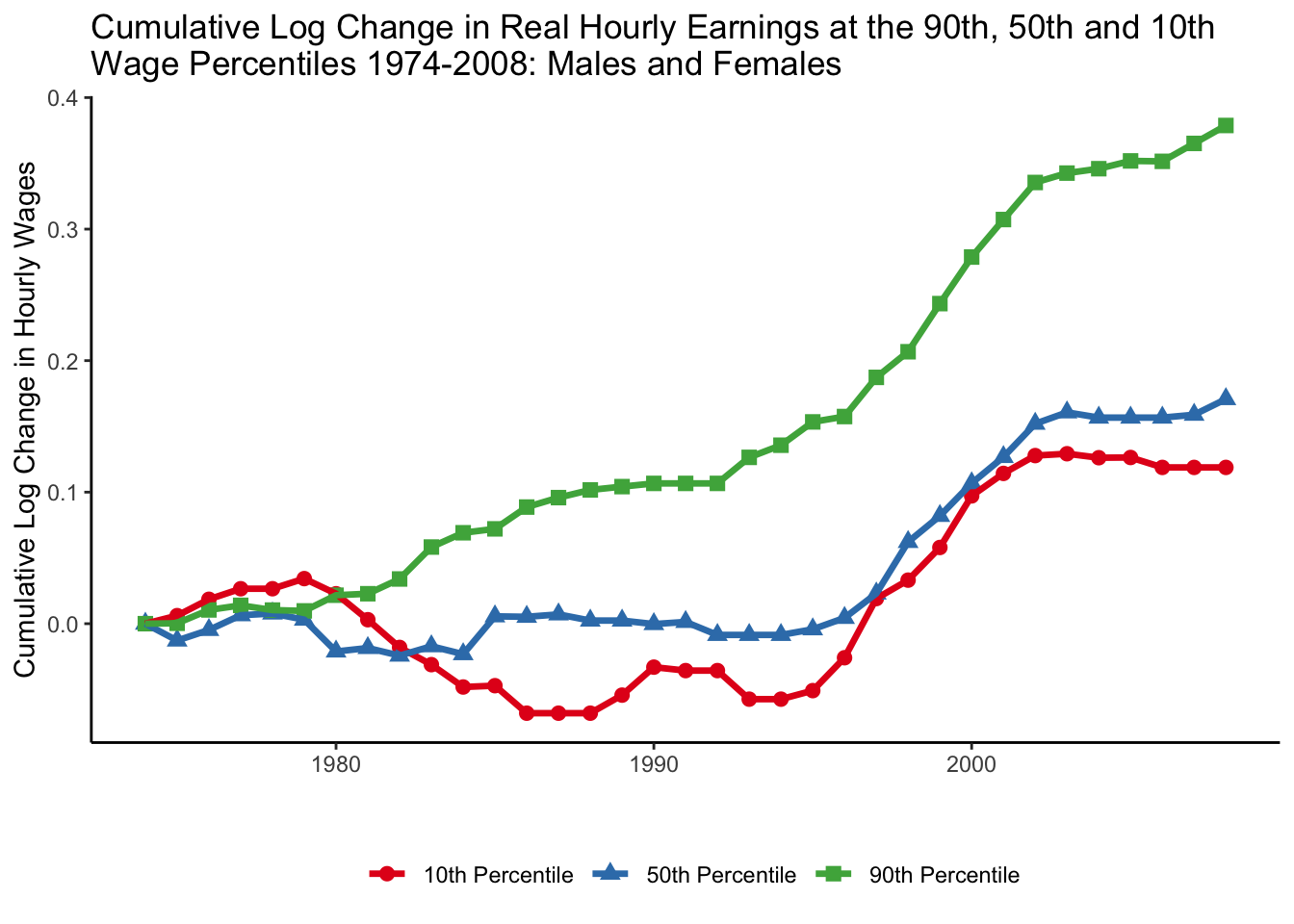
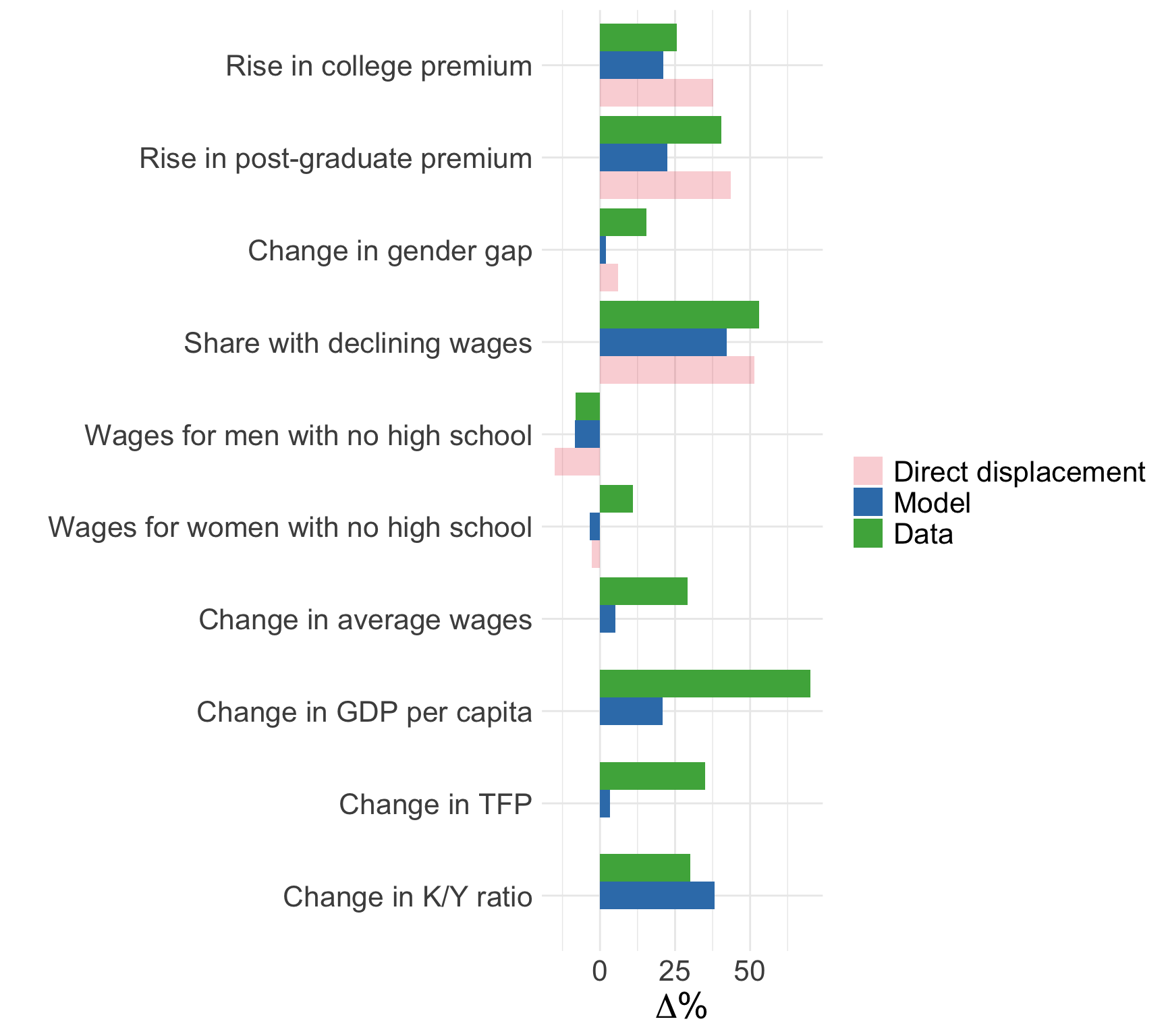
However, the model cannot explain other trends observed in the data:
Also silent about endogeneous adoption or labour-replacing technology.
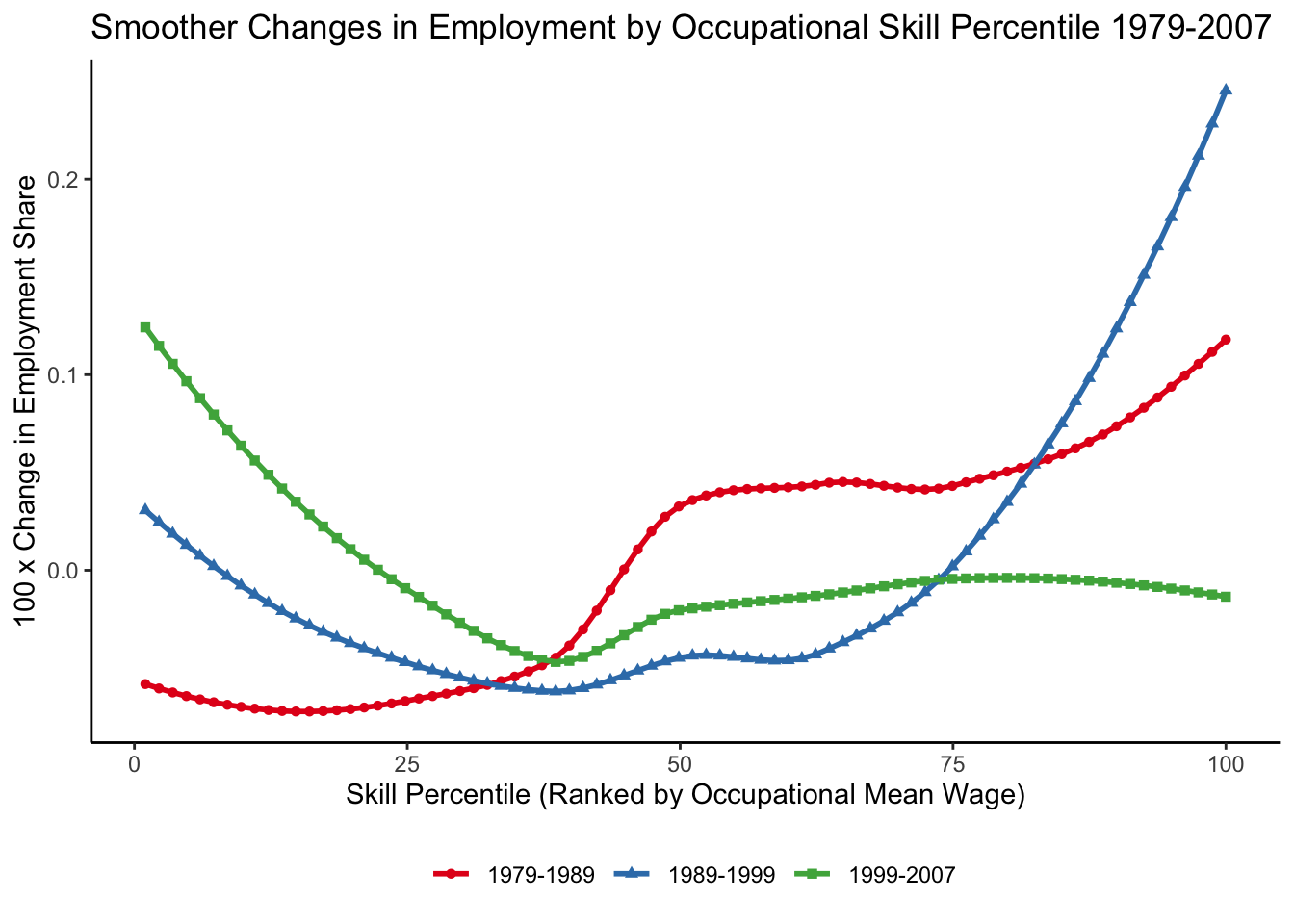
Source: Figure 1 (Autor 2019)
Source: Figure 8 (Acemoglu and Autor 2011)
Source: Figure 10 (Acemoglu and Autor 2011)
Task is a unit of work activity that produces output
Skill is a worker’s endowment of capabilities for performing tasks
Key features:
Unique final good \(Y\) produced by continuum of tasks \(i \in [0, 1]\)
\[ Y = \exp \left[\int_0^1 \ln y(i) \text{d}i\right] \]
Three types of labour: \(H\), \(M\) and \(L\) supplied inelastically.
\[ y(i) = A_L \alpha_L(i) l(i) + A_M \alpha_M(i) m(i) + A_H \alpha_H(i) h(i) + A_K \alpha_K(i) k(i) \]
\(A_L, A_M, A_H, A_K\) are factor-augmenting technologies
\(\alpha_L(i), \alpha_M(i), \alpha_H(i), \alpha_K(i)\) are task productivity schedules
\(l(i), m(i), h(i), k(i)\) are production inputs allocated to task \(i\)
Comparative advantage assumption
\(\alpha_L(i)/\alpha_M(i)\) and \(\alpha_M(i)/\alpha_H(i)\) are continuously differentiable and strictly decreasing.
Market clearing conditions
\[ \int_0^1 l(i) \text{d}i \leq L \qquad \int_0^1 m(i) \text{d}i \leq M \qquad \int_0^1 h(i) \text{d}i \leq H \]
Lemma 1
Given comparative advantage assumption, there exist \(I_L\) and \(I_H\) such that

Note that boundaries \(I_L\) and \(I_H\) are endogenous
This gives rise to the substitution of skills across tasks
Output price is normalised to 1 \(\Rightarrow \exp\left[\int_0^1 \ln p(i) \text{d}i\right] = 1\)
All tasks employing a given skill pay corresponding wage
\[\begin{align} w_L &= p(i) A_L \alpha_L(i), \qquad \forall i \in [0, I_L] \\ w_M &= p(i)A_M \alpha_M(i), \qquad \forall i \in (I_L, I_H] \\ w_H &= p(i)A_H \alpha_H(i), \qquad \forall i \in (I_H, 1] \end{align}\]
Given the law of one wage, we can show that
\[\begin{align*} l(i) &= l\left(i^\prime\right) &\Rightarrow& \quad l(i) = \frac{L}{I_L} \forall i \in [0, I_L] \\ m(i) &= m\left(i^\prime\right) &\Rightarrow& \quad m(i) = \frac{M}{I_H - I_L} \forall i \in (I_L, I_H] \\ h(i) &= h\left(i^\prime\right) &\Rightarrow& \quad h(i) = \frac{H}{1 - I_H} \forall i \in (I_H, 1] \\ \end{align*}\]
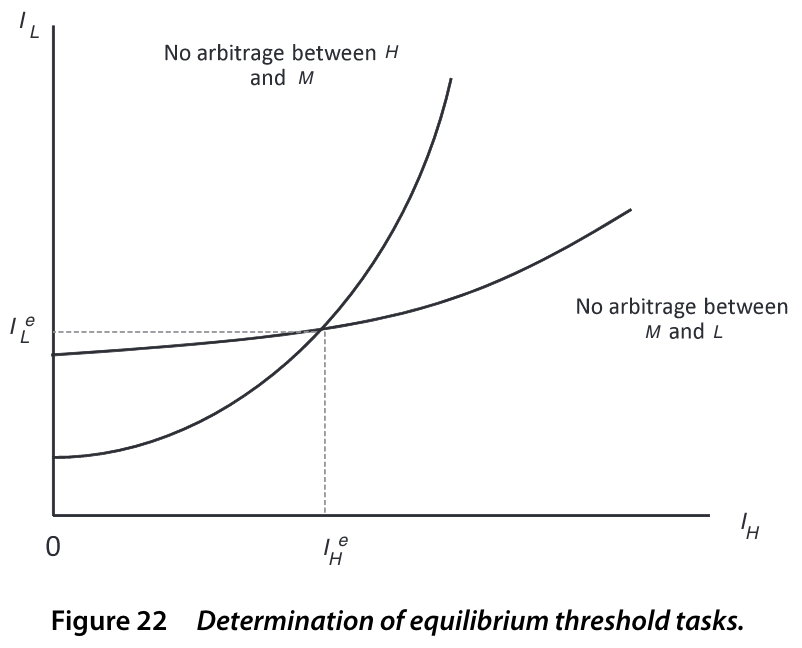
Threshold task \(I_H\): equally profitable to produce with either \(H\) or \(M\) skills
\[ \frac{A_M \alpha_M(I_H) M}{I_H - I_L} = \frac{A_H \alpha_H(I_H) H}{1 - I_H} \]
Similarly, for \(I_L\):
\[ \frac{A_L \alpha_L(I_L) L}{I_L} = \frac{A_M \alpha_M(I_L) M}{I_H - I_L} \]

\[ \begin{matrix} \frac{\text{d} \ln w_H / w_L}{\text{d}\ln A_H} > 0 & \frac{\text{d} \ln w_M / w_L}{\text{d}\ln A_H} < 0 & \frac{\text{d} \ln w_H / w_M}{\text{d}\ln A_H} > 0 \\ \frac{\text{d} \ln w_H / w_L}{\text{d}\ln A_M} \lesseqqgtr 0 & \frac{\text{d} \ln w_M / w_L}{\text{d}\ln A_M} > 0 & \frac{\text{d} \ln w_H / w_M}{\text{d}\ln A_M} < 0 \\ \frac{\text{d} \ln w_H / w_L}{\text{d}\ln A_L} < 0 & \frac{\text{d} \ln w_M / w_L}{\text{d}\ln A_L} < 0 & \frac{\text{d} \ln w_H / w_M}{\text{d}\ln A_L} > 0 \end{matrix} \]
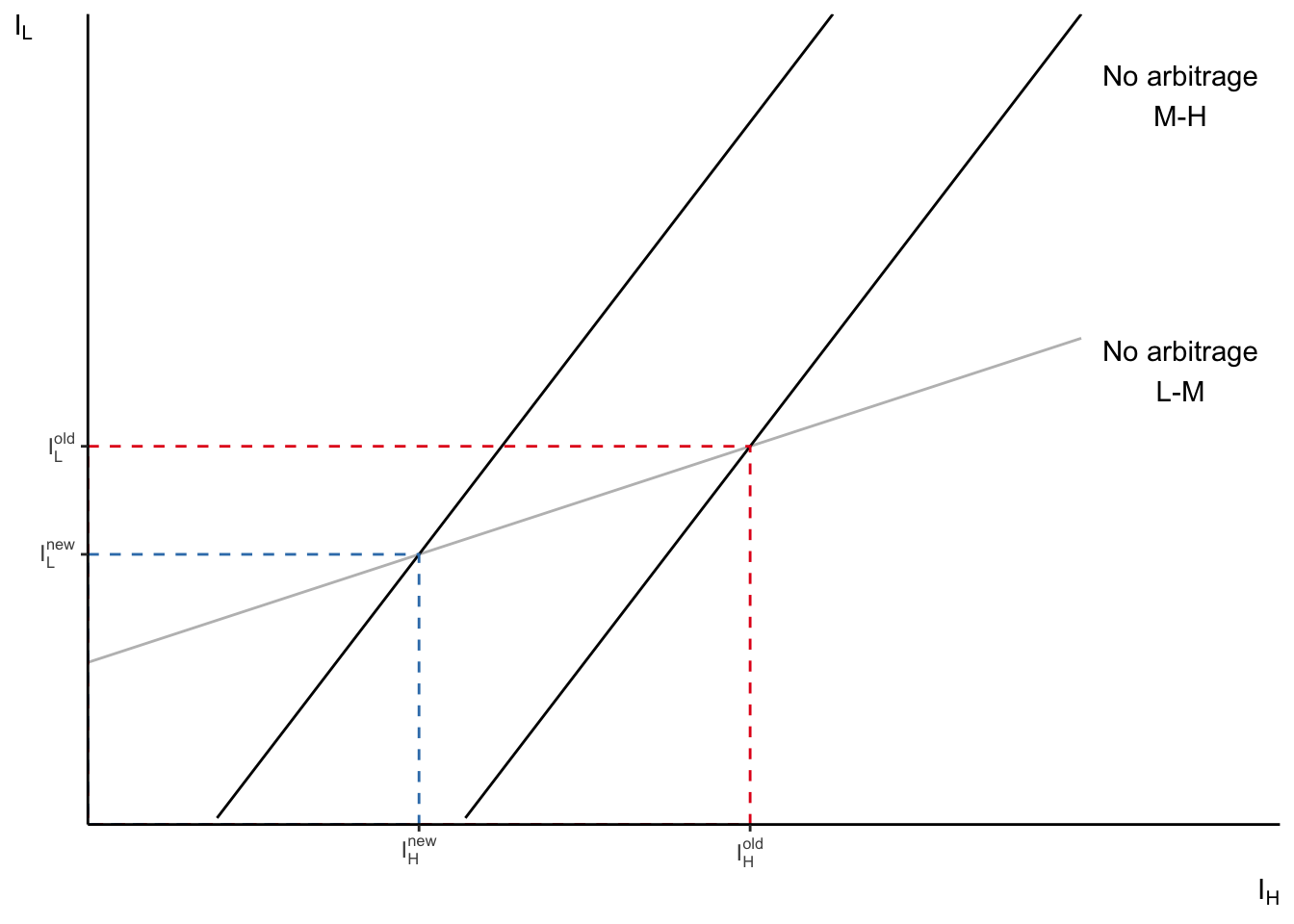
Source: Figure 25 (Acemoglu and Autor 2011)
Start from initial equilibrium without machines

Assume in \([\underline{I}, \bar{I}] \subset [I_L, I_H]\) machines outperform \(M\). Otherwise, \(\alpha_K(i) = 0\).

How does it change the equilibrium?

Assume comparative advantage of \(H\) over \(M\) stronger than \(M\) over \(L\)

Each worker \(j\) is endowed with some amount of each skill \(l^j, m^j, h^j\)
Workers allocate time to each skill given
\[ \begin{align} &t_l^j + t_m^j + t_h^j \leq 1 \\ &w_L t_l^j l^j + w_M t_m^j m^j + w_H t_h^j h^j \end{align} \]
Comparative advantage: \(\frac{h^j}{m^j}\) and \(\frac{m^j}{l^j}\) are decreasing in \(j\)
Then, there exist \(J^\star\left(\frac{w_H}{w_M}\right)\) and \(J^{\star\star}\left(\frac{w_M}{w_L}\right)\)

Suppose \(\uparrow A_H \Rightarrow \uparrow \frac{w_H}{w_M}, \downarrow \frac{w_M}{w_L}\).
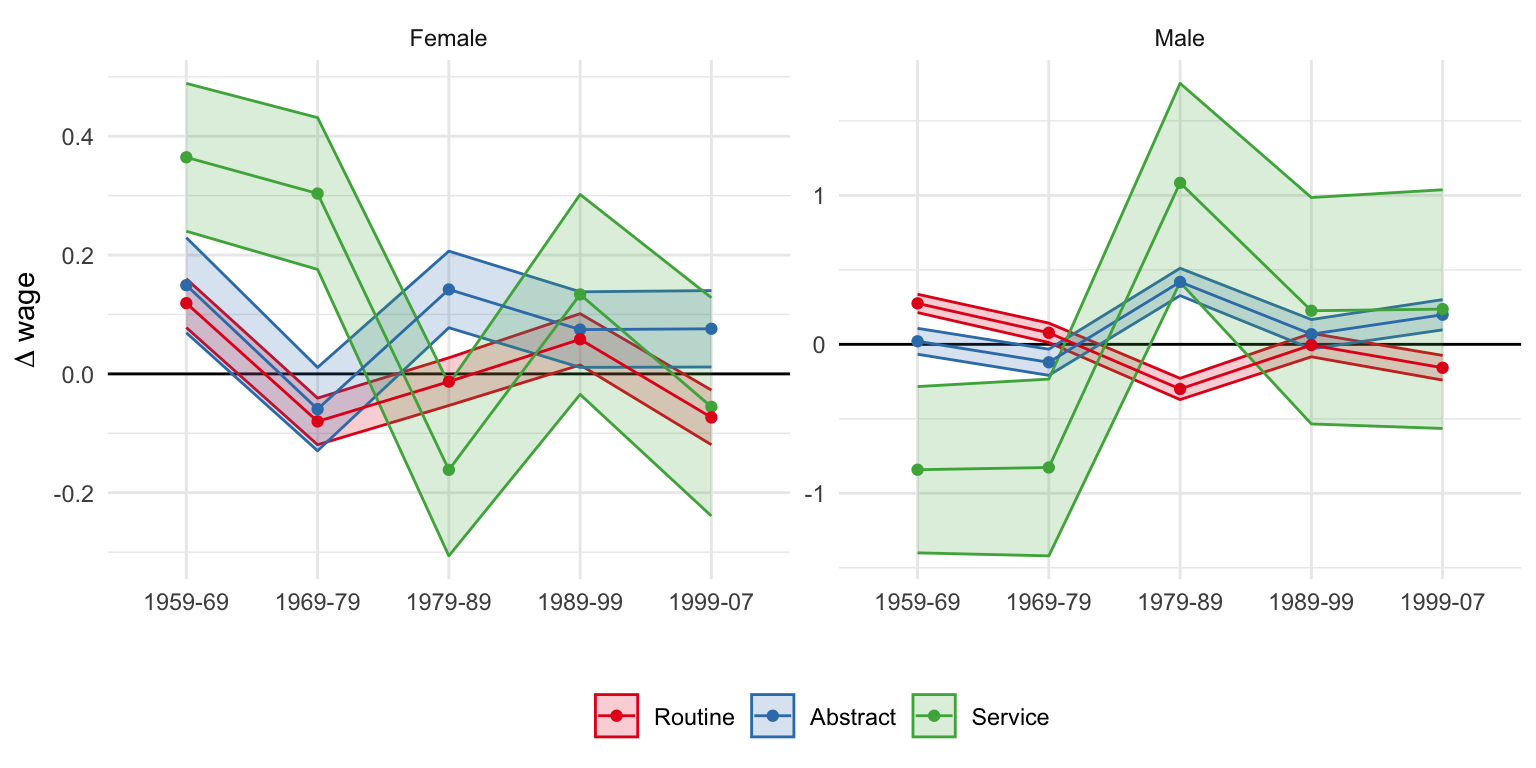
Use occupational specialization at some \(t = 0\) as comparative advantage.
\[ \Delta w_{sejk\tau} = \sum_t \left[\beta_t^H \gamma_{sejk}^H + \beta_t^L \gamma_{sejk}^L\right] 1\{\tau = t\} + \delta_\tau + \phi_e + \lambda_j + \pi_k + e_{sejk\tau} \]
Descriptive regression informed by the model!
Source: Table 10 (Acemoglu and Autor 2011)
Multi-sector model with imperfect substitution between inputs
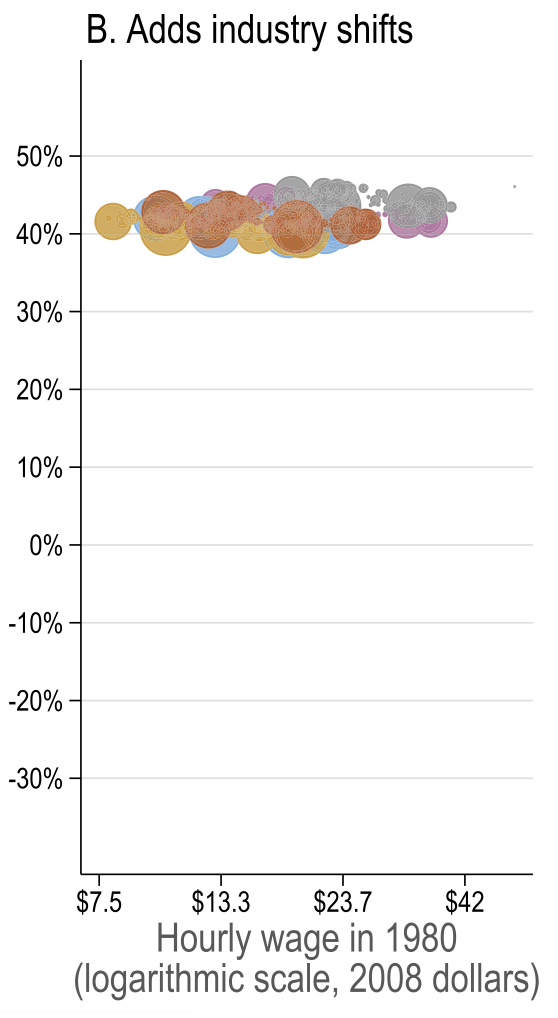
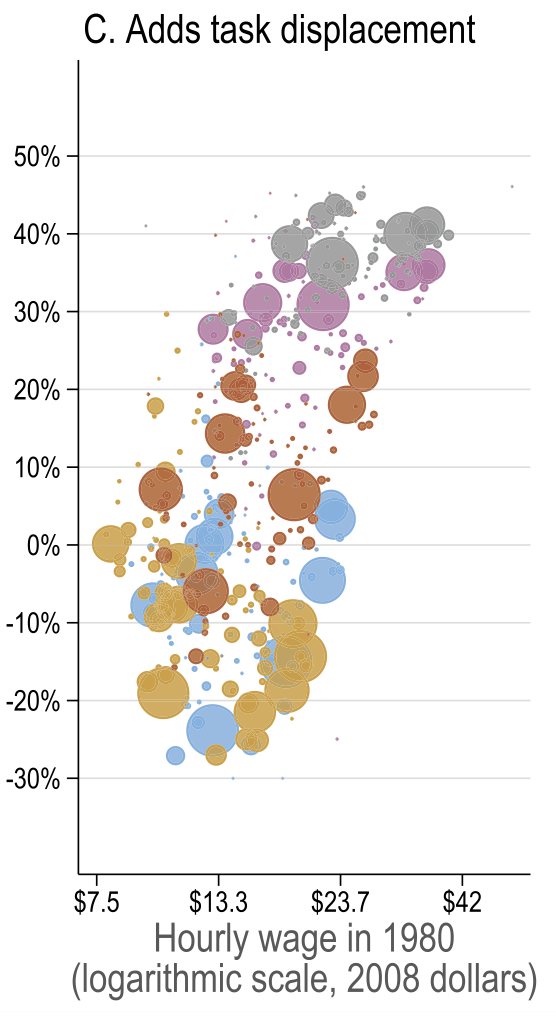
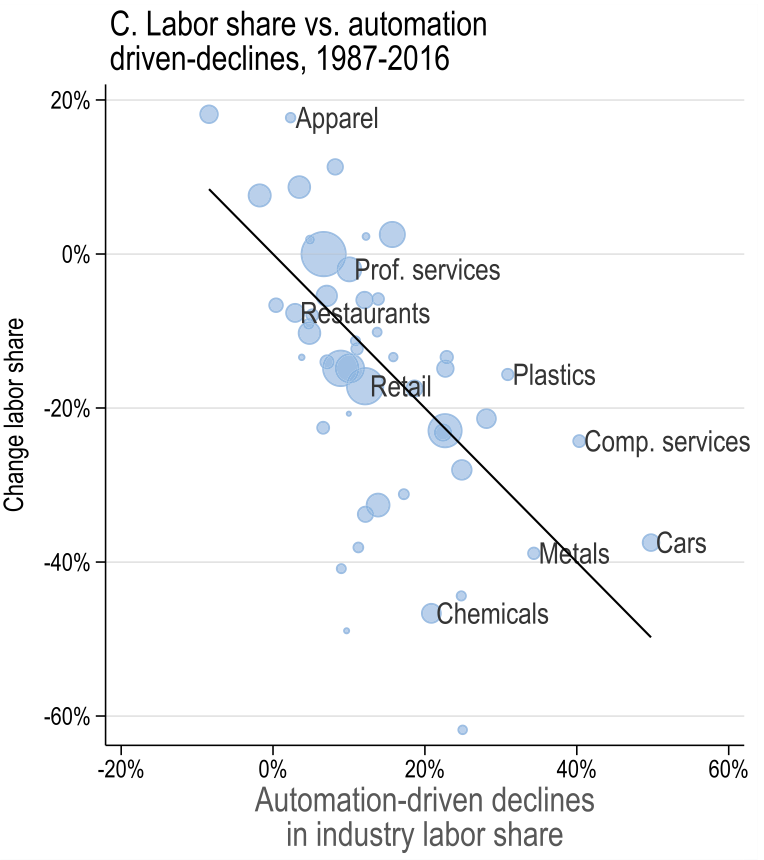
\[ \text{Task displacement}_g^\text{direct} = \sum_{i \in \mathcal{I}} \omega_g^i \frac{\omega_{gi}^R}{\omega_i^R} \left(-d \ln s_i^{L, \text{auto}}\right) \]
\(\omega_g^i\) - share of wages earned by worker group \(g\) in industry \(i\)
(exposure to industry \(i\))at \(t=0\)
\(\frac{\omega_{gi}^R}{\omega_i^R}\) - specialization of group \(g\) in routine tasks \(R\) within industry \(i\) at \(t=0\)
\(-d \ln s_i^{L, \text{auto}}\) - % decline in industry \(i\)’s labour share due to automation
attribute 100% of the decline to automation
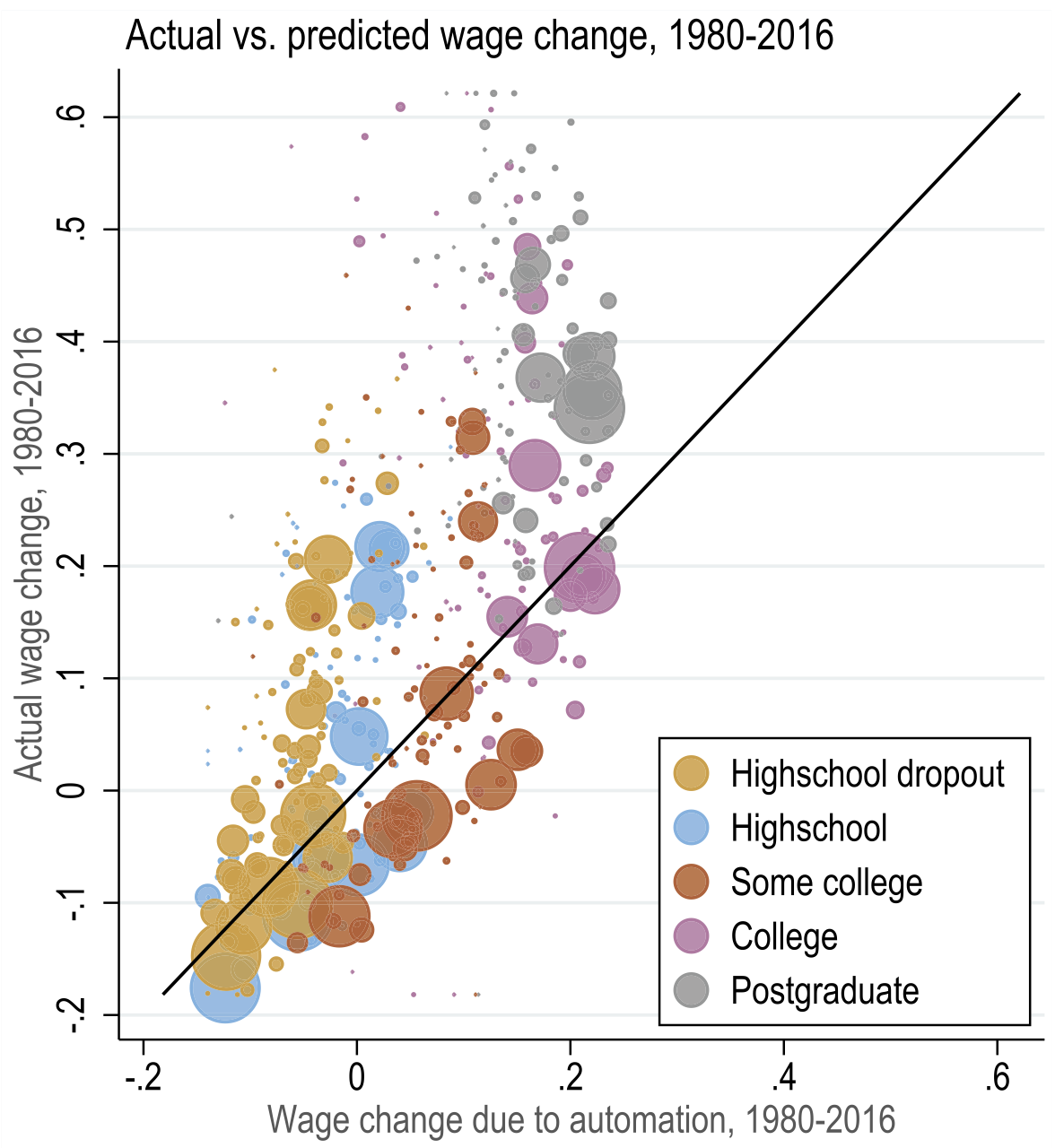
predict given industry adoption of automation technology
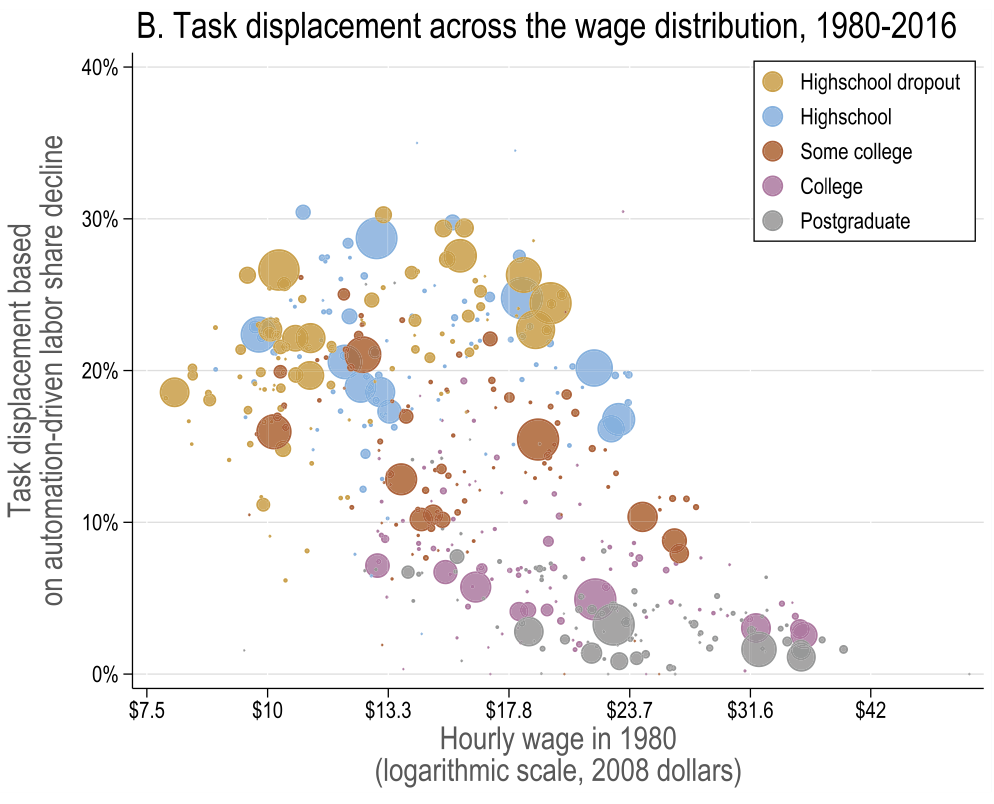
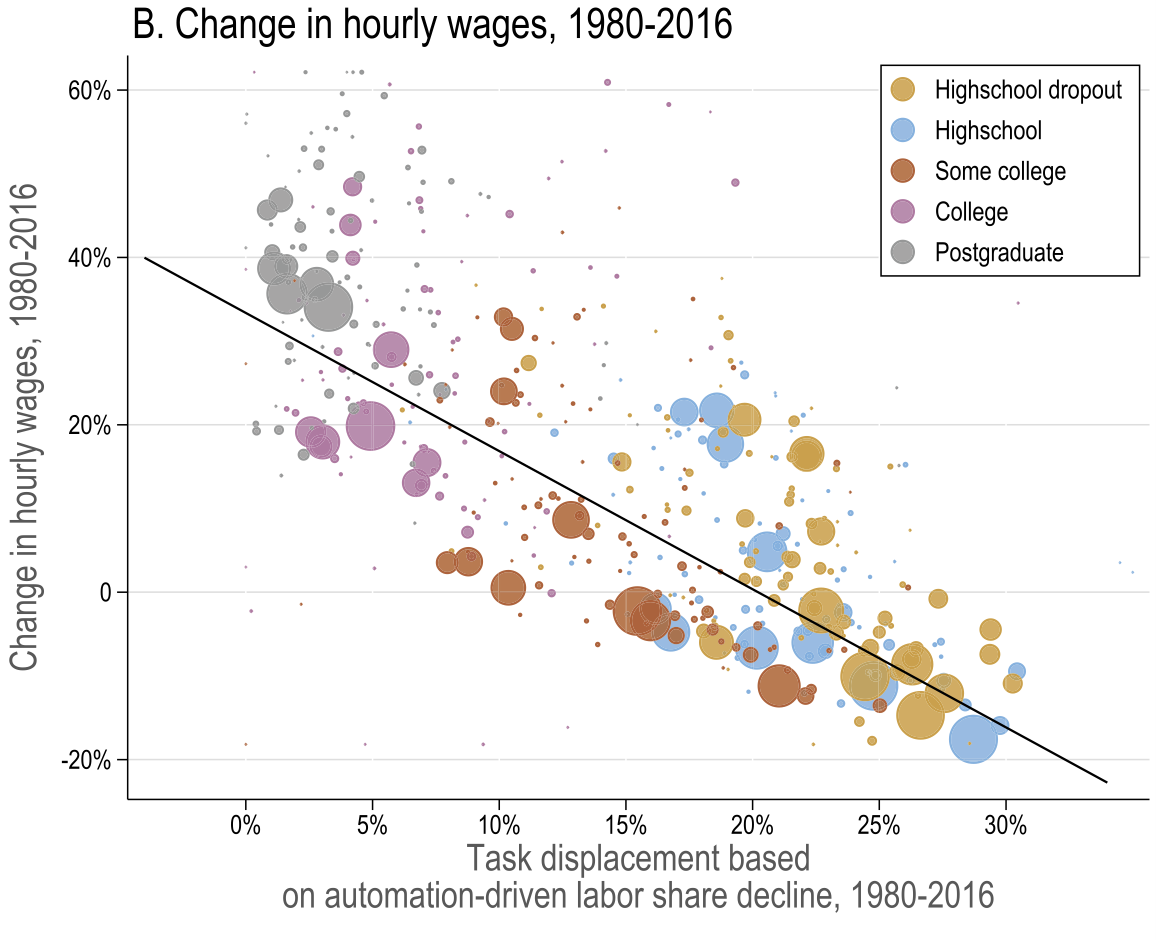
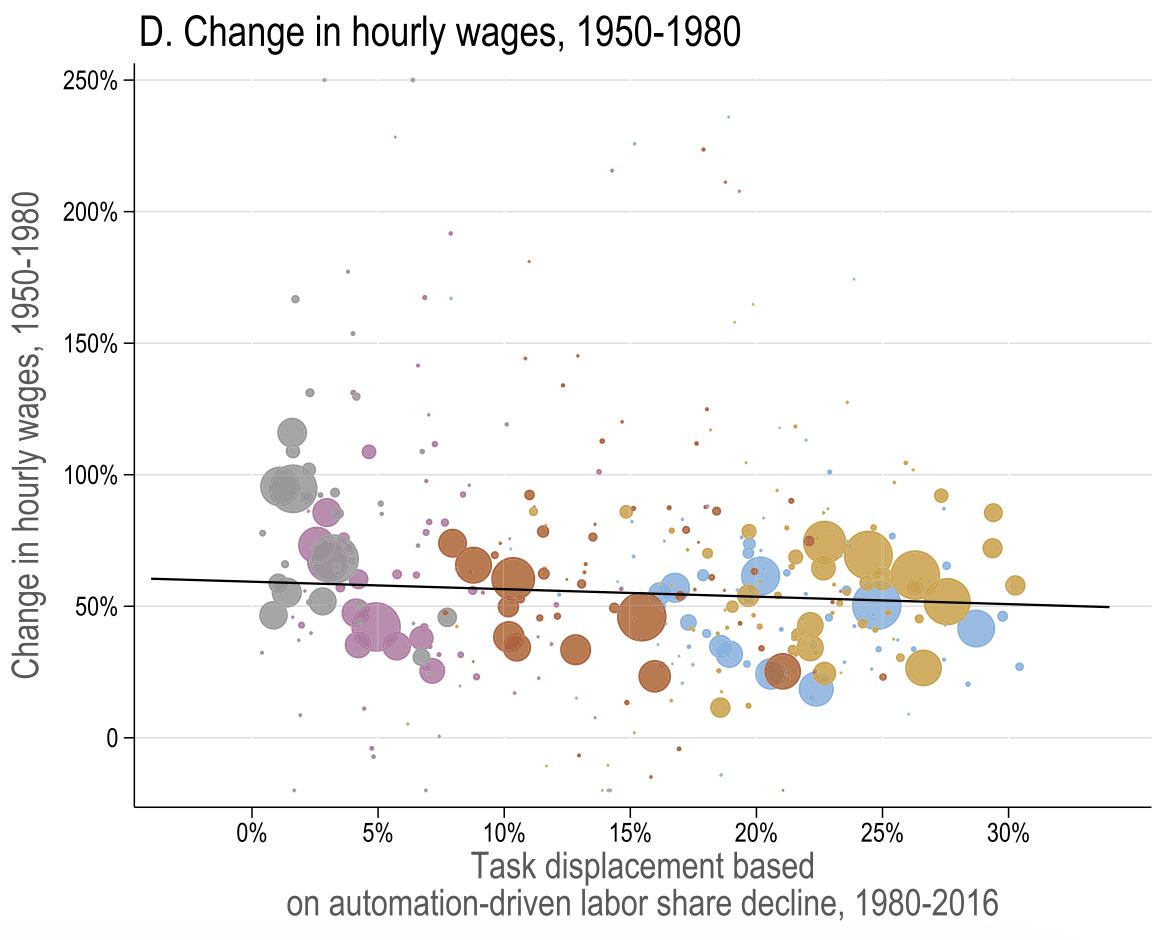
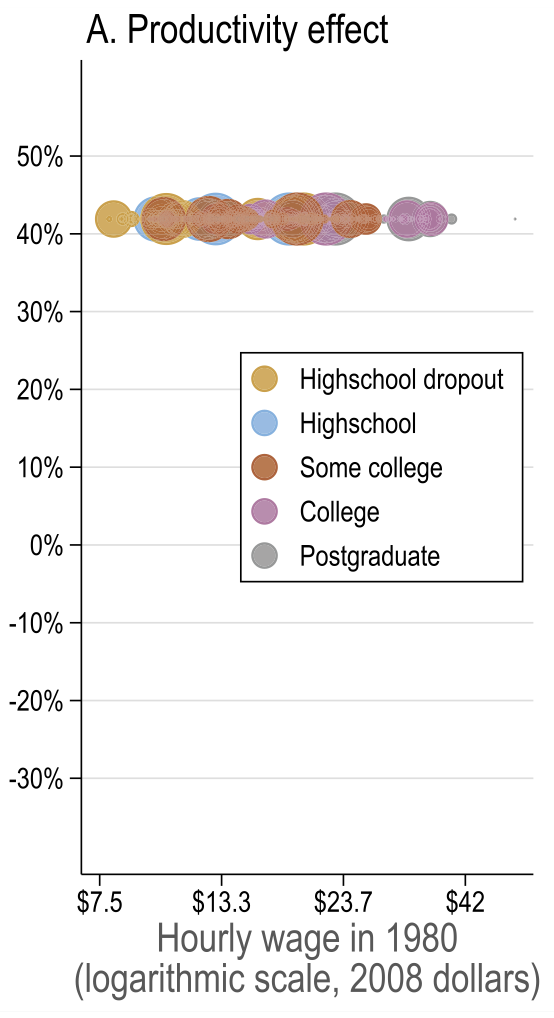
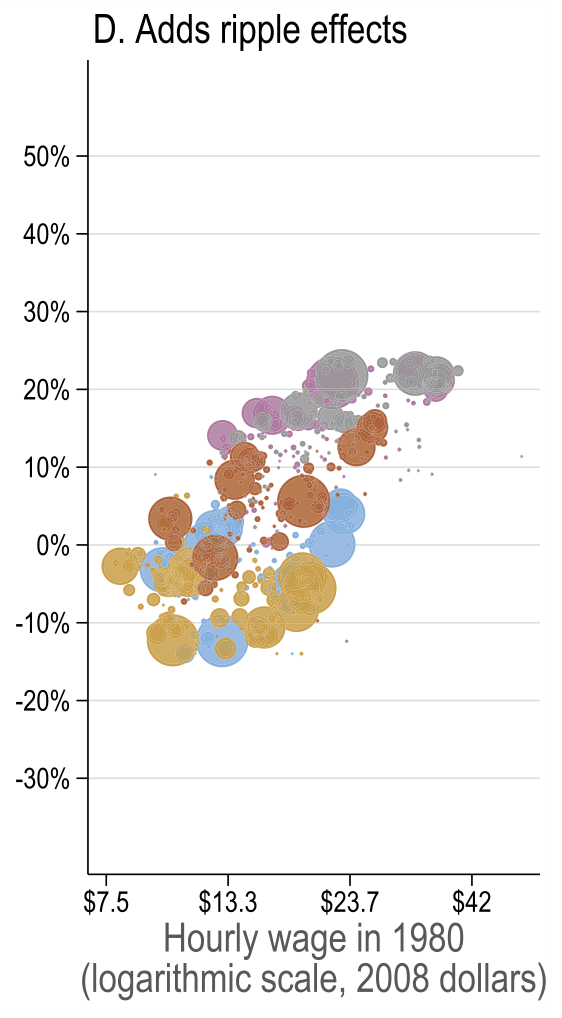
Source: Figure 5


Source: Figure 7 (Acemoglu and Restrepo 2022)


Two theories linking technological advancements and labour markets
Canonical model (SBTC)
Task-based model (automation)
Next lecture: Labour market discrimination on 22 Sep
The firm problem is to choose entire schedules \(\left(l(i), m(i), h(i)\right)_{i=0}^1\) to
\[ \max_{\left(l(i), m(i), h(i)\right)_{i=0}^1} PY - w_L L - w_M M - w_H H \]
We normalised \(P=1\). Consider FOC wrt \(l(i)\):
\[ \frac{Y}{y(i)} A_L \alpha_L(i) = w_L, \qquad \forall i \in [0, I_L] \]
In equilibrium, all \(L\)-type workers must be paid same amount \(\Rightarrow\)
\[ p(i)A_L\alpha_L(i) = w_L, \qquad \forall i \in [0, I_L] \]
Similar argument for \(w_M\) and \(w_H\).
Given the law of one price (wage) we can also write that
\[ p(i)\alpha_L(i)l(i) = p\left(i^\prime\right) \alpha_L\left(i^\prime\right) l\left(i^\prime\right), \qquad \forall i, i^\prime \in [0, I_L] \]
Given the Appendix: derivation of wage equations, it implies that
\[ l(i) =l\left(i^\prime\right) = l, \qquad \forall i, i^\prime \in[0, I_L] \]
Plug it into the market clearing condition for \(L\)
\[ L = \int_0^{I_L} l(i) \text{d}i = l \cdot I_L \quad \Longrightarrow \quad l(i) = l = \frac{L}{I_L}, \forall i \in [0, I_L] \]
Similar argument for \(m(i) = \frac{M}{I_H - I_L}\) and \(h(i) = \frac{H}{1 - I_H}\).