| Grade 4 | Grade 5 | |||
|---|---|---|---|---|
| Reading | Math | Reading | Math | |
| Class size | -0.150 | 0.023 | -0.582 | -0.443 |
| (0.128) | (0.160) | (0.181) | (0.236) | |
| Mean score | 72.5 | 68.7 | 74.5 | 67.0 |
| SD score | 7.8 | 9.1 | 8.2 | 10.2 |
| Obs. | 415 | 415 | 471 | 471 |
7. Education Quality
KAT.TAL.322 Advanced Course in Labour Economics
Nurfatima Jandarova
September 15, 2025
Education quality
Knowledge/productivity doesn’t rise linearly with years of education.
Production process that takes inputs and develops skills.
Stylised facts
Education quantity vs quality
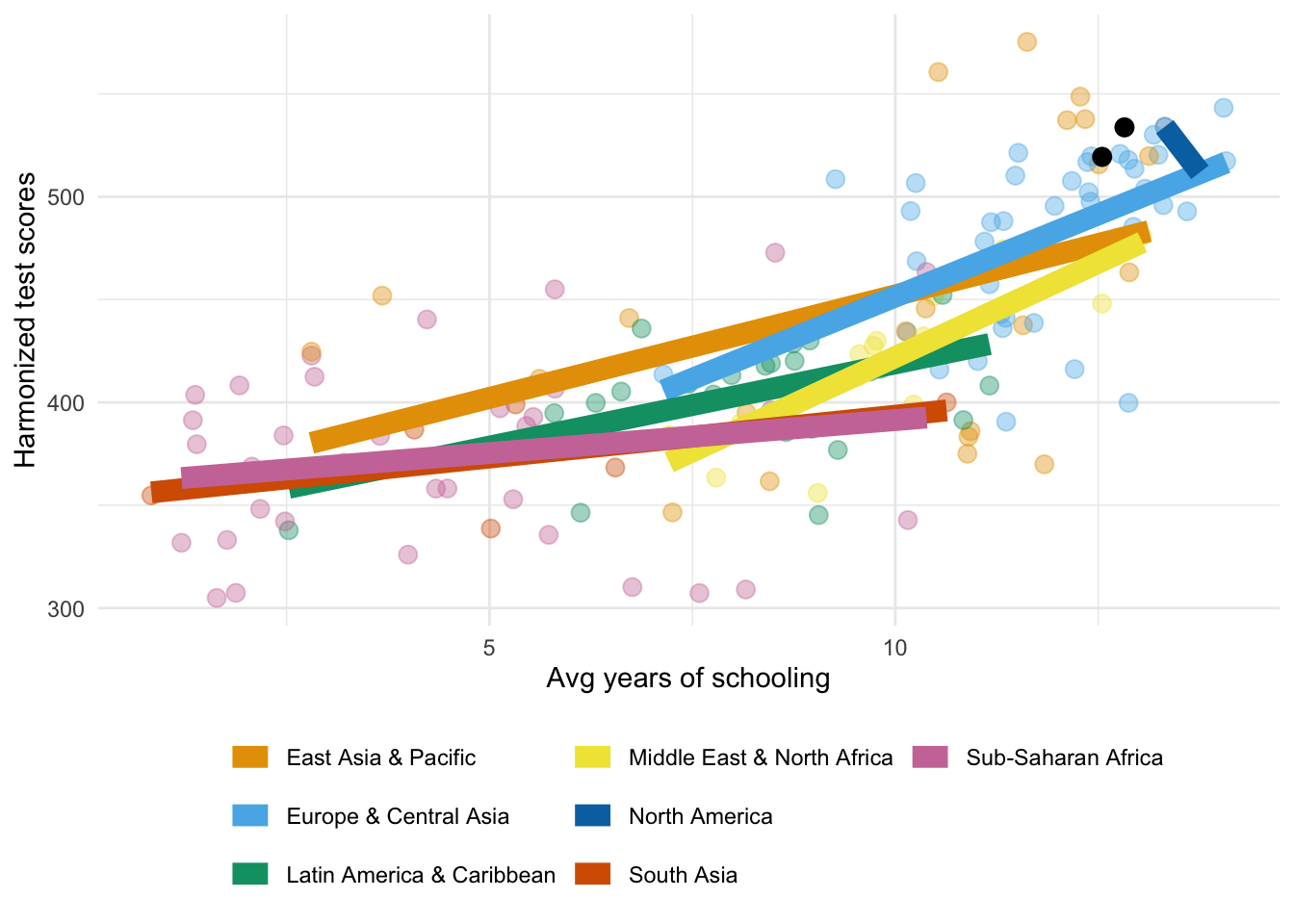
Source: World Bank
Education production function
Education production function
Simple framework
Education output of pupil \(i\) in school \(j\) in community \(k\)
\[ q_{ijk} = q(P_i, S_{ij}, C_{ik}) \]
where \(\begin{align}P_i &\quad \text{are pupil characteristics} \\ S_{ij} &\quad \text{are school inputs} \\ C_{ik} &\quad \text{are non-school inputs}\end{align}\)
Education production function
Measures
Output
Years of schooling, standardised test scores, noncognitive skills
Student inputs
Effort, patience, genetics, parental characteristics, family income, family size
School inputs
Teacher characteristics, class sizes, teacher-student ratio, school expenditures, school facilities
Non-school inputs
Peers, local economic conditions, national curricula, regulations, certification rules
Education production function
Todd and Wolpin (2003)
Achievement of student \(i\) in family \(j\) at age \(a\)
\[ q_{ija} = q_a\left(\mathbf{F}_{ij}(a), \mathbf{S}_{ij}(a), \mu_{ij0}, \varepsilon_{ija}\right) \]
\(\mathbf{F}_{ij}(a)\) history of family inputs up to age \(a\)
\(\mathbf{S}_{ij}(a)\) history of school inputs up to age \(a\)
\(\mu_{ij0}\) initial skill endowment
\(\varepsilon_{ija}\) measurement error in output
\(q_a(\cdot)\) age-dependent production function
Education production function
Todd and Wolpin (2003): Contemporaneous specification
\[ q_{ija} = q_a(F_{ija}, S_{ija}) + \nu_{ija} \]
Strong assumptions:
- Only current inputs are relevant OR inputs are stable over time
- Inputs are uncorrelated with \(\mu_{ij0}\) or \(\varepsilon_{ija}\)
Education production function
Todd and Wolpin (2003): Value-added specification
\[ q_{ija} = q_a\left(F_{ija}, S_{ija}, \color{#9a2515}{q_{a-1}\left[F_{ij}(a - 1), S_{ij}(a - 1), \mu_{ij0}, \varepsilon_{ij, a - 1}\right]}, \varepsilon_{ija}\right) \]
Typical empirical estimation assumes linear separability and \(q_a(\cdot) = q(\cdot)\):
\[ q_{ija} = F_{ija} \alpha_F + S_{ija} \alpha_S + \color{#9a2515}{\gamma q_{ij, a - 1}} + \nu_{ija} \]
Additional assumptions implied:
- Past input effects decay at the same rate \(\gamma\)
- Shocks \(\varepsilon_{ija}\) are serially correlated with persistence \(\gamma\)
Education production function
Todd and Wolpin (2003): Cumulative specification
Still assume linear separability:
\[ q_{ija} = \sum_{t = 1}^a X_{ijt} \alpha_{a - t + 1}^a + \beta_a \mu_{ij0} + \varepsilon_{ij}(a) \]
Estimation strategies:
- Within-child: \(q_{ija} - q_{ija^\prime}\) for ages \(a\) and \(a^\prime\)
- Within-family: \(q_{ija} - q_{i^\prime ja}\) for siblings \(i\) and \(i^\prime\)
Each with their own caveats
Early estimates of school inputs (prior to 1995)
“resources are not closely related to student performance” (Hanushek 2003)
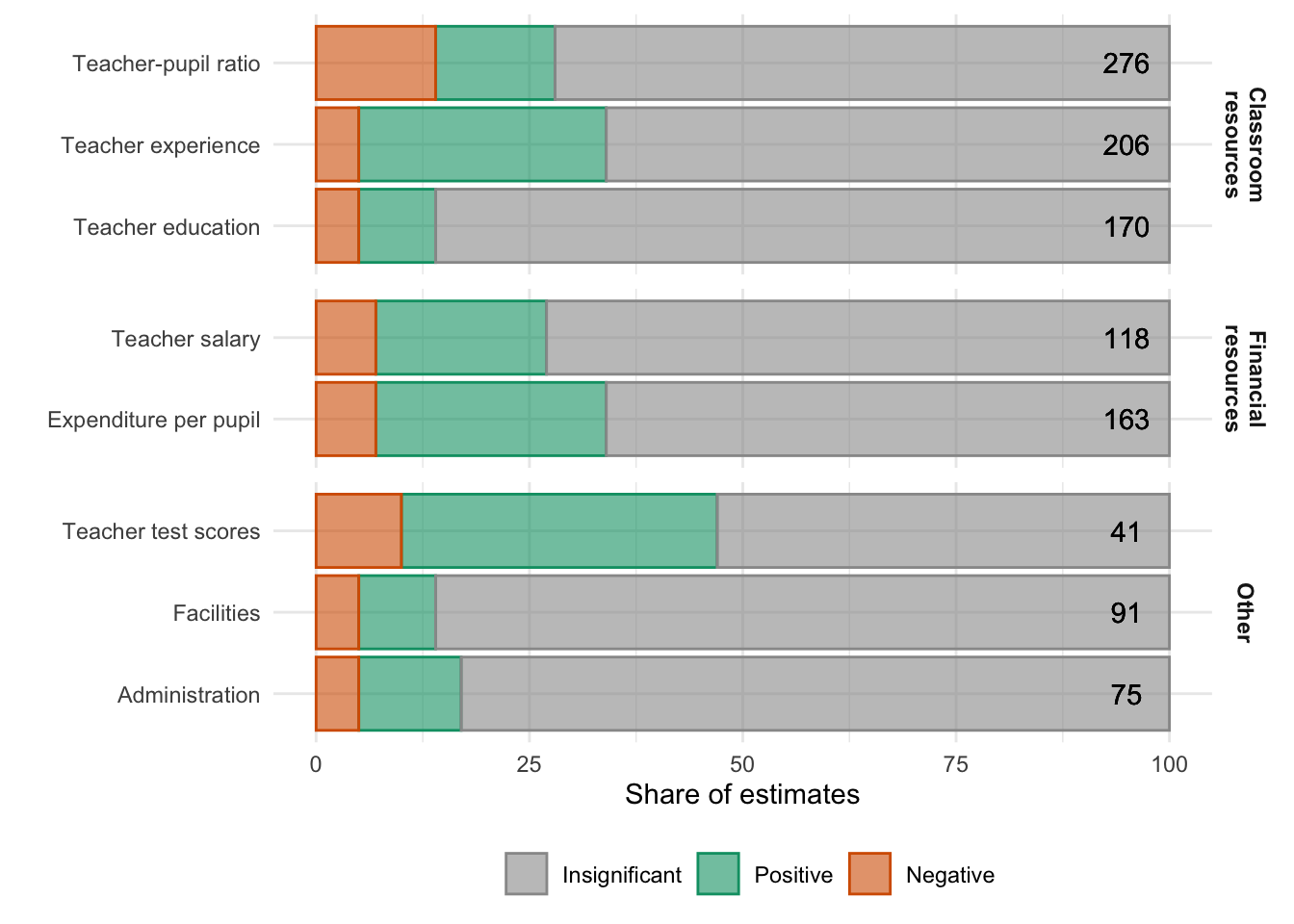
Source: Hanushek (2003), Table 3
Education production function
Non-experimental estimations
Require strong assumptions
- Some can be relaxed
Require rich data
Endogenous allocation of resources
Quasi-experimental estimations
May not recover structural parameters
Ignore general equilibrium
Issues with scaling List (2022)
(Quasi-)Experimental estimations
Productivity of student inputs
Student inputs: nature vs nurture
Twin models (ACDE)

Source: Neale and Maes (2004)
Student inputs: nature vs nurture
Twin models: Polderman et al. (2015)
Meta-analysis of >17,000 twin-analyses (>1,500 cognitive traits)
- 47% of variation due to genetic factors
- 18% of variation due to shared environment
Adoption studies
Productivity of school inputs
Productivity of school inputs
School expenditures: review by Handel and Hanushek (2023)
Exogenous variation due to court decisions or legislative action
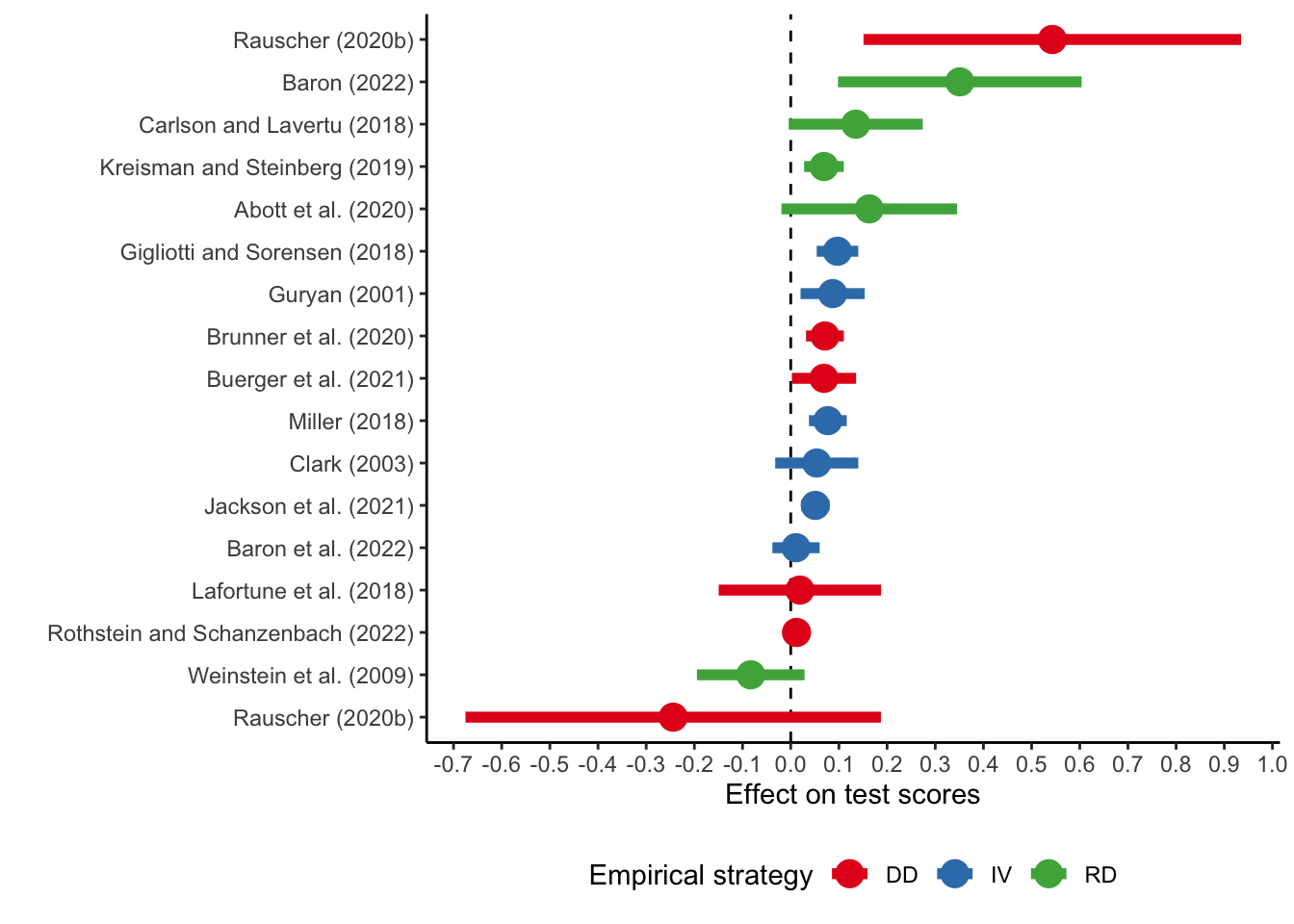
Source: Table 10 (Handel and Hanushek 2023)
Productivity of school inputs
School spending: review by Handel and Hanushek (2023)
Large variation of spending effects on test scores
Not clear how money was used
Role of differences in regulatory environments
Similar results for participation rates are all positive (mostly significant)
Productivity of school inputs
Class size: Joshua D. Angrist and Lavy (1999)
Quasi-experimental variation in Israel: Maimonides rule
Rule from Babylonian Talmud, interpreted by Maimonides in XII century:
If there are more than forty [students], two teachers must be appointed
Sharp drops in class sizes with 41, 81, … cohort sizes in schools
Regression discontinuity design (RDD)
Productivity of school inputs
Class size: Joshua D. Angrist and Lavy (1999)

Source: Figure I (Joshua D. Angrist and Lavy 1999)
Productivity of school inputs
Class size: Joshua D. Angrist and Lavy (1999)
Maimonides rule: \(f_{sc} = \frac{E_s}{\text{int}\left(\frac{E_s - 1}{40}\right) + 1}\)
“Fuzzy” RDD
First stage: \(n_{sc} = X_{sc} \pi_0 + f_{sc} \pi_1 + \xi_{sc}\)
Second stage: \(y_{sc} = X_{s}\beta + n_{sc}\alpha + \eta_s + \mu_c + \epsilon_{sc}\)
Productivity of school inputs
Class size
| Grade 5 | ||
|---|---|---|
| Reading | Math | |
| Class size | -0.006 | -0.062 |
| (0.066) | (0.088) | |
| Mean score | 72.1 | 68.1 |
| SD score | 17.4 | 20.6 |
| Obs. | 225 108 | 226 832 |
Productivity of school inputs
Class size: Krueger (1999), Chetty et al. (2011)
Project STAR: 79 schools, 6323 children in 1985-86 cohort in Tennessee
Randomly assigned students and teachers into
- small class (13-17 students)
- regular class (22-25 students)
- regular class + teacher’s aide (22-25 students)
\[ Y = \alpha + \beta_S SMALL + \beta_A AIDE + X\delta +\varepsilon \]
Randomization means students between classes are on average similar
\(\boldsymbol{\Rightarrow} \color{#9a2515}{\beta_S}\) and \(\color{#9a2515}{\beta_A}\) are causal
Productivity of school inputs
Class size
| Test scores | ||||
|---|---|---|---|---|
| Kindergarten | Grade 1 | Grade 2 | Grade 3 | |
| SMALL | 5.370 | 6.370 | 5.260 | 5.240 |
| (1.190) | (1.110) | (1.100) | (1.040) | |
| Test score, % | College by age 27, % | College quality, $ | Wage earnings, $ | |
|---|---|---|---|---|
| SMALL | 4.760 | 1.570 | 109.000 | -124.000 |
| (0.990) | (1.070) | (92.600) | (336.000) | |
| Avg dep var | 48.67 | 45.5 | 27 115 | 15 912 |
| Obs. | 9 939 | 10 992 | 10 992 | 10 992 |
Productivity of school inputs
Class quality: Chetty et al. (2011)
Notice: random assignments of peers (\(QUAL\))
| Test score, % | College by age 27, % | College quality, $ | Wage earnings, $ | |
|---|---|---|---|---|
| QUAL | 0.662 | 0.108 | 9.328 | 50.610 |
| (0.024) | (0.053) | (4.573) | (17.450) | |
| Obs. | 9 939 | 10 959 | 10 959 | 10 959 |
Productivity of school inputs
Class quality and noncognitive skills: Chetty et al. (2011)
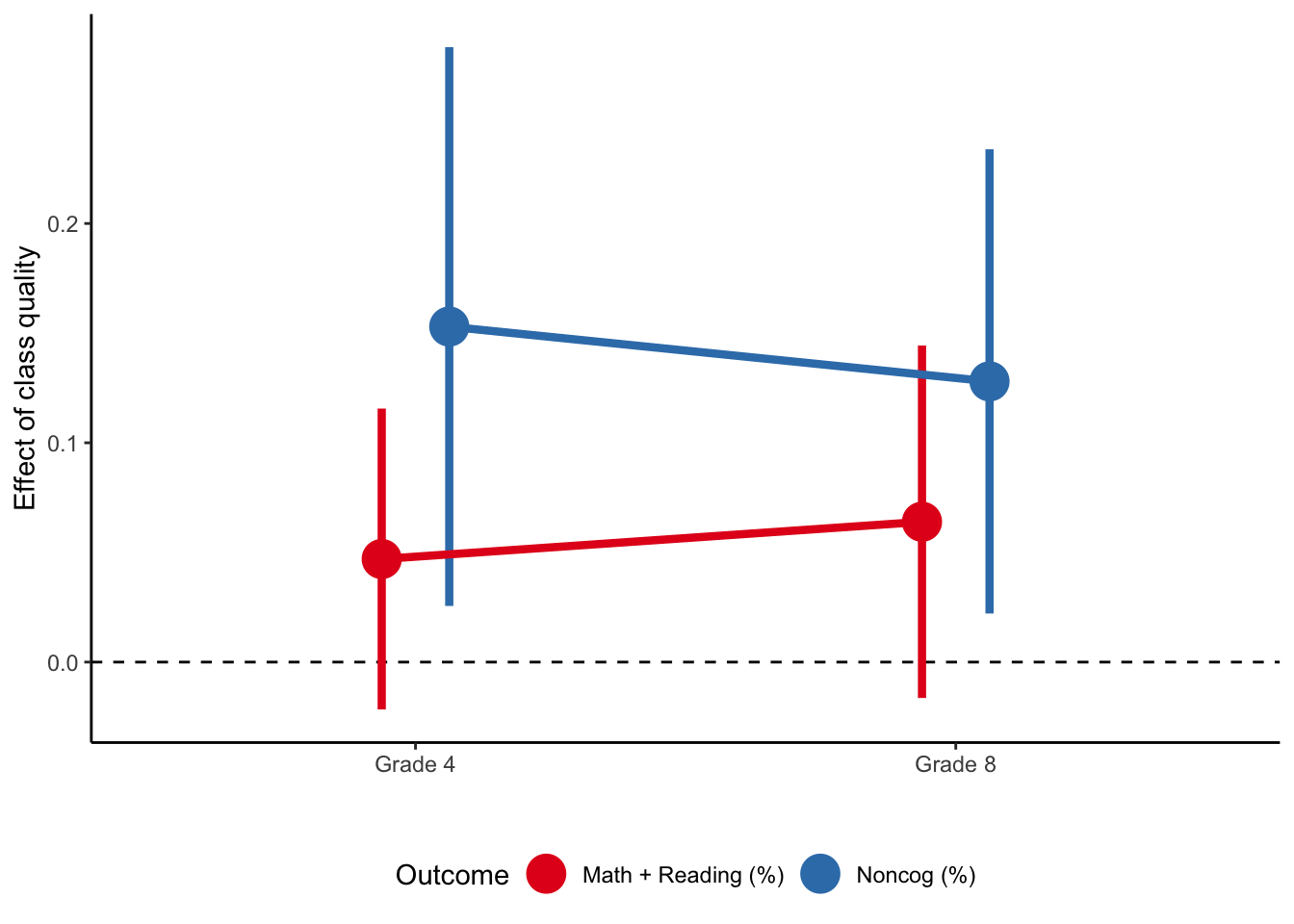
Source: Table IX (Chetty et al. 2011)
Productivity of school inputs
Teacher incentives: Fryer (2013)
2-year pilot program in 2007 among lowest-performing schools in NYC
- 438 eligible schools, 233 offered treatment, 198 accepted, 163 control
Relative rank of schools in each subscore
Bonus sizes:
- $3,000/teacher if 100% target
- $1,500/teacher if 75% target

Productivity of school inputs
Teacher incentives: Fryer (2013)
Instrumental variable approach (LATE = ATT):
\[ \begin{align} Y &= \alpha_2 + \beta_2 X + \pi_2 ~ \text{incentive} + \epsilon \\ \text{incentive} &= \alpha_1 + \beta_1 X + \pi_1 ~ \text{treatment} + \xi \end{align} \]
Productivity of school inputs
Teacher incentives: Fryer (2013)
| Elementary | Middle | High | |
|---|---|---|---|
| English | -0.010 (0.015) |
-0.026 (0.010) |
-0.003 (0.043) |
| Math | -0.014 (0.018) |
-0.040 (0.016) |
-0.018 (0.029) |
- Incentives too small and too complex
- Bonuses to schools (not teachers)
- Effort of existing teachers vs selection into teaching
Productivity of school inputs
Teacher incentives: Biasi (2021)
Change in teacher pay scheme in Wisconsin in 2011:
- seniority pay (SP): collective scheme based on seniority and quals
- flexible pay (FP): bargaining with individual teachers
Main results:
FP \(\uparrow\) salary of high-quality teachers relative to low-quality
high-quality teachers moved to FP districts (low-quality to SP)
teacher effort \(\uparrow\) in FP districts relative to SP
student test scores \(\uparrow 0.06\sigma\) (1/3 of effect of \(\downarrow\) class size by 5)
Productivity of non-school inputs
Peer effects: Abdulkadiroğlu, Angrist, and Pathak (2014)
Admission to elite high school in Boston

Peer math scores, Figure 2 (Abdulkadiroğlu, Angrist, and Pathak 2014)
Productivity of school inputs
Peer effects: Abdulkadiroğlu, Angrist, and Pathak (2014)
| Parametric | Nonparametric | |
|---|---|---|
| Attended any college | 0.010 | 0.031 |
| (0.032) | (0.019) | |
| Attended 4-year college | 0.003 | 0.013 |
| (0.041) | (0.026) | |
| Attended competitive college | -0.011 | -0.004 |
| (0.051) | (0.029) | |
| Attended highly competitive college | -0.009 | -0.014 |
| (0.032) | (0.017) |
Productivity of school inputs
Peer effects
Dale and Krueger (2002) study admission into selective colleges in the US
- No effect on average earnings
- \(\uparrow\) earnings of students from low-income families
Kanninen, Kortelainen, and Tervonen (2023): selective schools in Finland
- \(\uparrow\) university enrolment and graduation rates
- No impact on income
- Change edu preferences, not skills!
Pop-Eleches and Urquiola (2013): selective schools and tracks in Romania
- \(\uparrow\) university admission exam score
- \(\downarrow\) parental investments
- \(\uparrow\) marginalisation and negative interactions with peers
Productivity of non-school inputs
Productivity of non-school inputs
Curriculum: Alan, Boneva, and Ertac (2019)
RCT among schools in remote areas of Istanbul
Carefully designed curriculum promoting grit (\(\geq 2\)h/week for 12 weeks)
Treated students are more likely to
- set challenging goals
- exert effort to improve their skills
- accumulate more skills
- have higher standardised test scores
These effects persist 2.5 years after the intervention
Productivity of non-school inputs
Curriculum: other evidence
Squicciarini (2020): adoption of technical education in France in 1870-1914
- higher resistance in religious areas, led to lower economic development
Machin and McNally (2008): ‘literacy hour’ introduced in UK in 1998/99
highly structured framework for teaching
\(\uparrow\) English and reading skills of primary schoolchildren
Summary
Academic achievement is complex function of student, parent, school and non-school inputs
Measuring achievement can also be difficult
Genetic and environmental factors from twin studies almost 50/50
Large variation in school resource effects (from \(\ll 0\) to \(\gg 0\))
- How resources are used?
- Which resources are most effective?
Studies of class size, teacher incentives, peer effects and curricula
Another (often overlooked) step is scaling up to the population
Next lecture: Technological shift and labour markets on 17 Sep
References
Abdulkadiroğlu, Atila, Joshua Angrist, and Parag Pathak. 2014. “The Elite Illusion: Achievement Effects at Boston and New York Exam Schools.” Econometrica 82 (1): 137–96. https://doi.org/10.3982/ECTA10266.
Alan, Sule, Teodora Boneva, and Seda Ertac. 2019. “Ever Failed, Try Again, Succeed Better: Results from a Randomized Educational Intervention on Grit*.” The Quarterly Journal of Economics 134 (3): 1121–62. https://doi.org/10.1093/qje/qjz006.
Angrist, Joshua David, and Jörn-Steffen Pischke. 2009. Mostly Harmless Econometrics: An Empiricist’s Companion. Princeton: Princeton University Press.
Angrist, Joshua D., and Victor Lavy. 1999. “Using Maimonides’ Rule to Estimate the Effect of Class Size on Scholastic Achievement.” The Quarterly Journal of Economics 114 (2): 533–75. https://www.jstor.org/stable/2587016.
Angrist, Joshua D., Victor Lavy, Jetson Leder-Luis, and Adi Shany. 2019. “Maimonides’ Rule Redux.” American Economic Review: Insights 1 (3): 309–24. https://doi.org/10.1257/aeri.20180120.
Arold, Benjamin W, Paul Hufe, and Marc Stoeckli. forthcoming. “Genetic Endowments, Educational Outcomes, and the Moderating Influence of School Quality.” Journal of Political Economy: Microeconomics, forthcoming. https://www.paulhufe.net/_files/ugd/ff8cd2_0844e70fa85e409c866eb4b09f6af243.pdf.
Barcellos, Silvia H., Leandro S. Carvalho, and Patrick Turley. 2018. “Education Can Reduce Health Differences Related to Genetic Risk of Obesity.” Proceedings of the National Academy of Sciences 115 (42). https://doi.org/10.1073/pnas.1802909115.
Biasi, Barbara. 2021. “The Labor Market for Teachers Under Different Pay Schemes.” American Economic Journal: Economic Policy 13 (3): 63–102. https://doi.org/10.1257/pol.20200295.
Chetty, Raj, John N. Friedman, Nathaniel Hilger, Emmanuel Saez, Diane Whitmore Schanzenbach, and Danny Yagan. 2011. “How Does Your Kindergarten Classroom Affect Your Earnings? Evidence from Project Star *.” The Quarterly Journal of Economics 126 (4): 1593–1660. https://doi.org/10.1093/qje/qjr041.
Cunha, Flavio, and James Heckman. 2007. “The Technology of Skill Formation.” American Economic Review 97 (2): 31–47. https://doi.org/10.1257/aer.97.2.31.
Dale, Stacy Berg, and Alan B. Krueger. 2002. “Estimating the Payoff to Attending a More Selective College: An Application of Selection on Observables and Unobservables.” The Quarterly Journal of Economics 117 (4): 1491–1527. https://www.jstor.org/stable/4132484.
Fagereng, Andreas, Magne Mogstad, and Marte Rønning. 2021. “Why Do Wealthy Parents Have Wealthy Children?” Journal of Political Economy 129 (3): 703–56. https://doi.org/10.1086/712446.
Fryer, Roland G. 2013. “Teacher Incentives and Student Achievement: Evidence from New York City Public Schools.” Journal of Labor Economics 31 (2): 373–407. https://doi.org/10.1086/667757.
Handel, Danielle Victoria, and Eric A. Hanushek. 2023. “US School Finance: Resources and Outcomes.” In Handbook of the Economics of Education, 7:143–226. Elsevier. https://doi.org/10.1016/bs.hesedu.2023.03.003.
Hanushek, Eric A. 2003. “The Failure of Input‐based Schooling Policies.” The Economic Journal 113 (485): F64–98. https://doi.org/10.1111/1468-0297.00099.
Kanninen, Ohto, Mika Kortelainen, and Lassi Tervonen. 2023. “Long-Run Effects of Selective Schools on Educational and Labor Market Outcomes.” VATT Working Papers. Helsinki. December 2023. https://www.doria.fi/bitstream/handle/10024/188274/vatt-working-papers-161-long-run-effects-of-selective-schools-on-educational-and-labor-market-outcomes.pdf?sequence=1&isAllowed=y.
Krueger, Alan B. 1999. “Experimental Estimates of Education Production Functions.” The Quarterly Journal of Economics 114 (2): 497–532. https://www.jstor.org/stable/2587015.
List, John A. 2022. The Voltage Effect: How to Make Good Ideas Great and Great Ideas Scale. 1st ed. New York: Crown Currency.
Machin, Stephen, and Sandra McNally. 2008. “The Literacy Hour.” Journal of Public Economics 92 (5): 1441–62. https://doi.org/10.1016/j.jpubeco.2007.11.008.
Neale, Michael C., and Hermine H M Maes. 2004. Methodology for Genetic Studies of Twins and Families. Dordrecht, The Netherlands: Kluwer Academic Publishers B. V.
Polderman, Tinca J. C., Beben Benyamin, Christiaan A. de Leeuw, Patrick F. Sullivan, Arjen van Bochoven, Peter M. Visscher, and Danielle Posthuma. 2015. “Meta-Analysis of the Heritability of Human Traits Based on Fifty Years of Twin Studies.” Nature Genetics 47 (7): 702–9. https://doi.org/10.1038/ng.3285.
Pop-Eleches, Cristian, and Miguel Urquiola. 2013. “Going to a Better School: Effects and Behavioral Responses.” American Economic Review 103 (4): 1289–1324. https://doi.org/10.1257/aer.103.4.1289.
Rauscher, Emily. 2020. “Does Money Matter More in the Country? Education Funding Reductions and Achievement in Kansas, 2010–2018.” AERA Open 6 (4): 2332858420963685. https://doi.org/10.1177/2332858420963685.
Sacerdote, Bruce. 2007. “How Large Are the Effects from Changes in Family Environment? A Study of Korean American Adoptees*.” The Quarterly Journal of Economics 122 (1): 119–57. https://doi.org/10.1162/qjec.122.1.119.
Squicciarini, Mara P. 2020. “Devotion and Development: Religiosity, Education, and Economic Progress in Nineteenth-Century France.” American Economic Review 110 (11): 3454–91. https://doi.org/10.1257/aer.20191054.
Todd, Petra E., and Kenneth I. Wolpin. 2003. “On the Specification and Estimation of the Production Function for Cognitive Achievement.” The Economic Journal 113 (485): F3–33. https://www.jstor.org/stable/3590137.
Torvik, Fartein Ask, Espen Moen Eilertsen, Laurie J. Hannigan, Rosa Cheesman, Laurence J. Howe, Per Magnus, Ted Reichborn-Kjennerud, et al. 2022. “Modeling Assortative Mating and Genetic Similarities Between Partners, Siblings, and in-Laws.” Nature Communications 13 (1): 1108. https://doi.org/10.1038/s41467-022-28774-y.