| Employed | Unemployed | Not working | |
|---|---|---|---|
| Sleep | 8.2 | 8.6 | 8.6 |
| Personal care and eating | 1.7 | 1.8 | 1.8 |
| Home production, shopping, care of others | 3.0 | 3.4 | 3.1 |
| Leisure, travel, sports and socialising | 5.3 | 8.2 | 7.6 |
| Work | 4.2 | 0.1 | 0.1 |
| Study | 0.1 | 0.1 | 1.1 |
| Unspecified | 0.1 | 0.1 | 0.2 |
4. Job Search
KAT.TAL.322 Advanced Course in Labour Economics
Nurfatima Jandarova
September 3, 2025
- No unemployment and perfect information in classical models
- Job search theory
Stylised facts
Time use by employment status
Source: Official Statistics of Finland (OSF) (2025)
- Substitution effect: return on job search \(<\) wage \(\Rightarrow \downarrow\) time searching
- Income effect: income unemployed \(<\) employed \(\Rightarrow \uparrow\) time searching
Job search is correlated with unemployment benefits
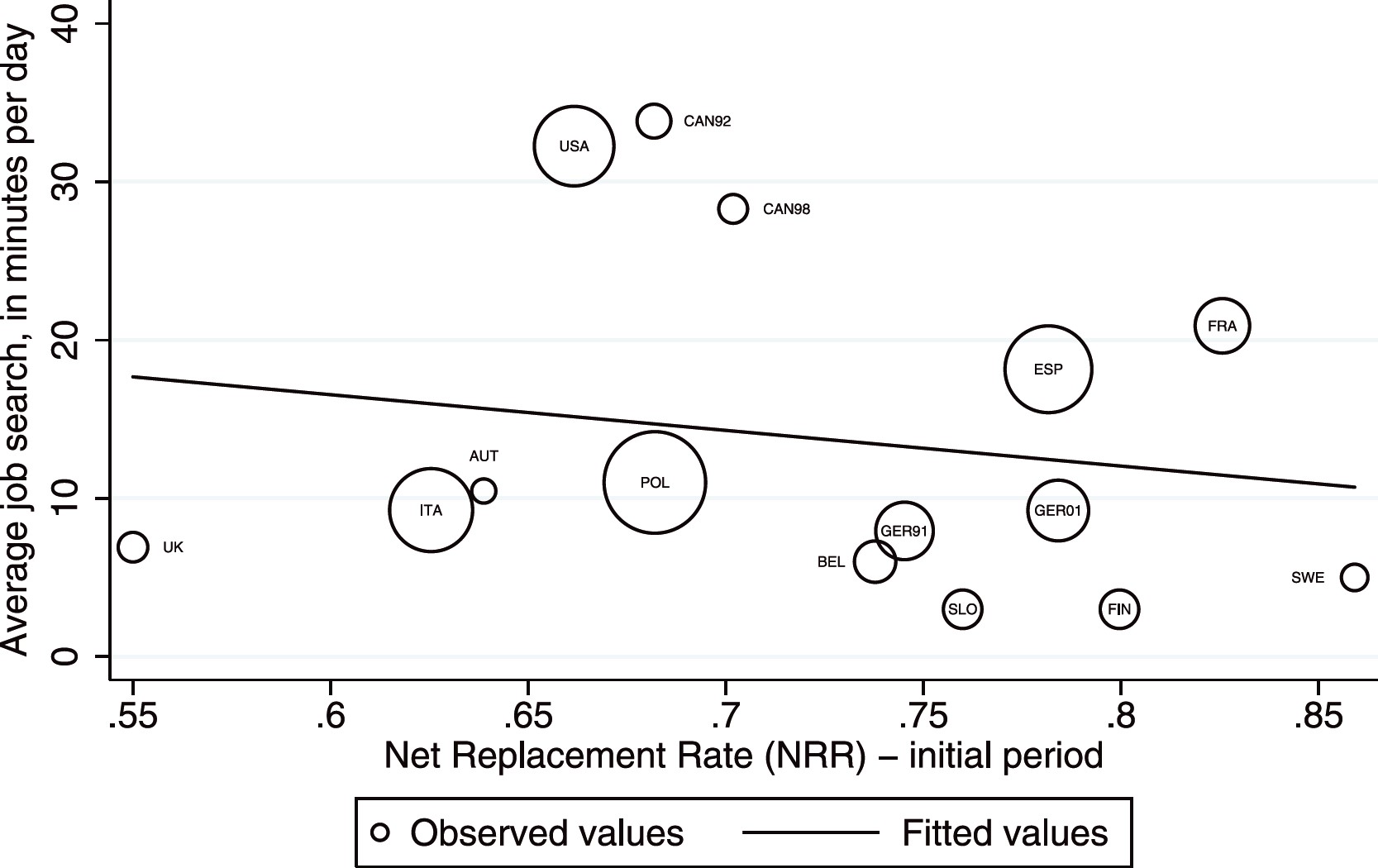
Source: Krueger and Mueller (2012)
Job search intensifies close to end of benefits

Source: Krueger and Mueller (2010)
Not all workers receive unemployment benefits
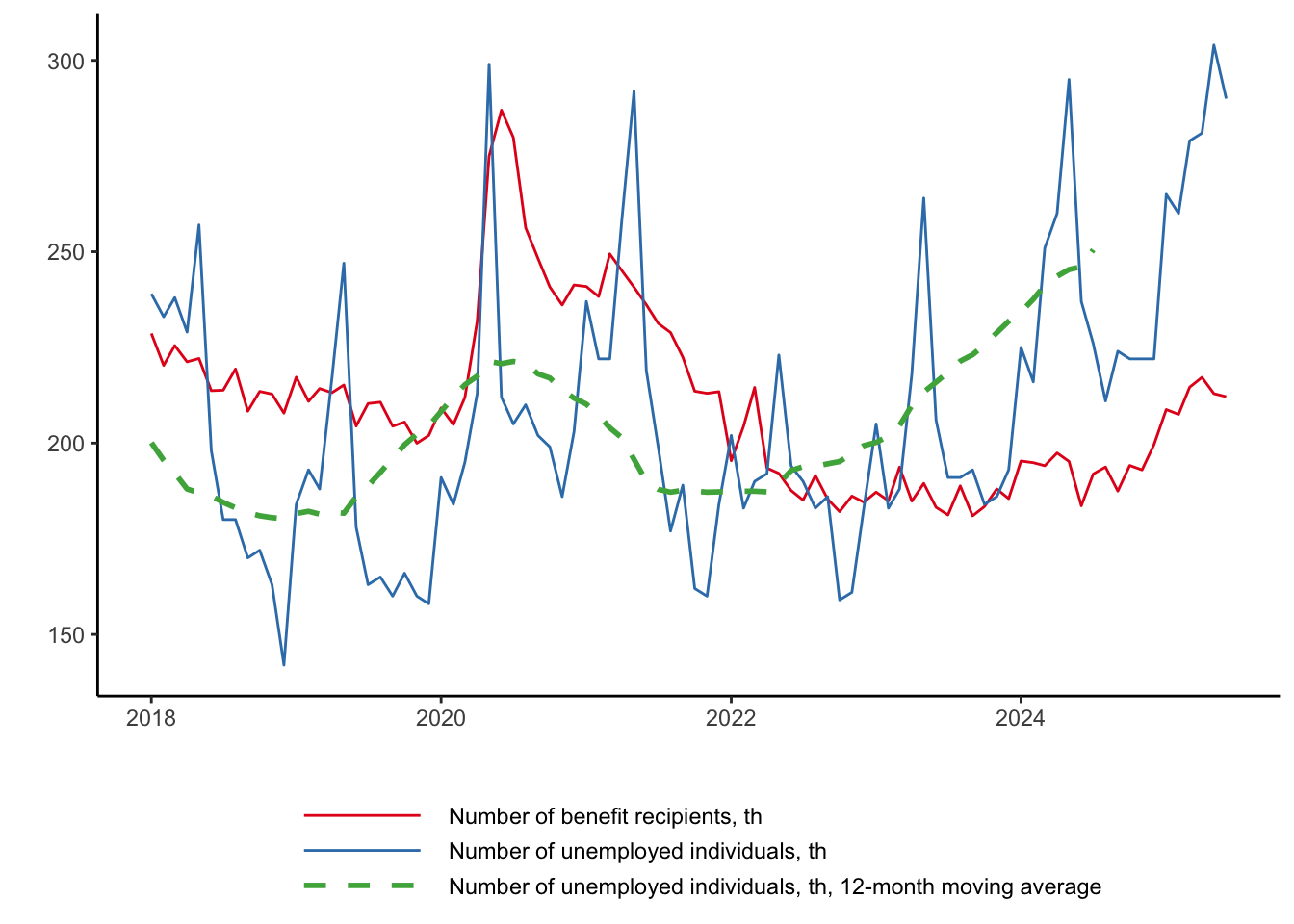
Source: Statistics Finland, KELA
Job search longer when unemployment is high …
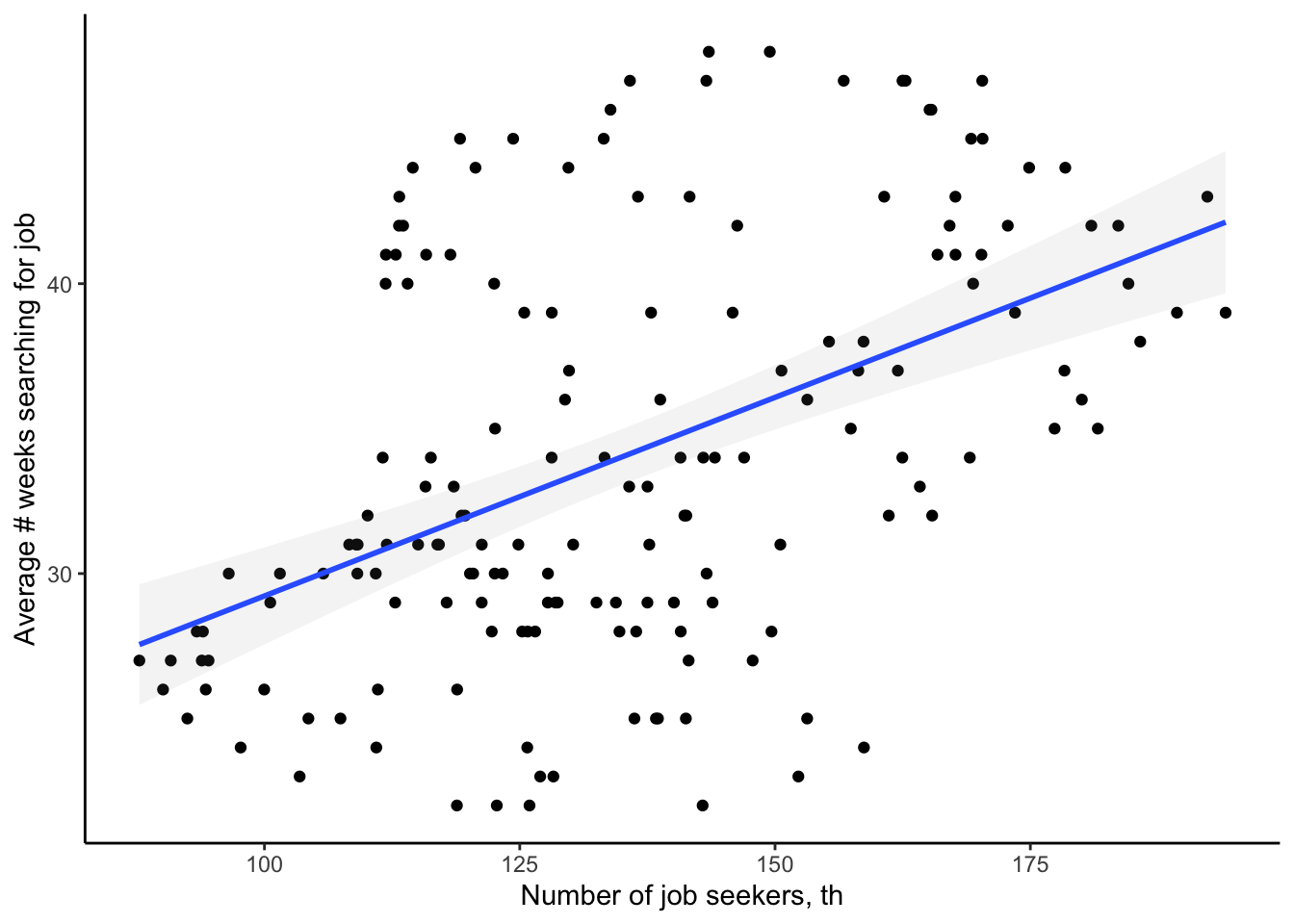
Source: Statistics Finland (2006-2019)
… and when there are more vacancies
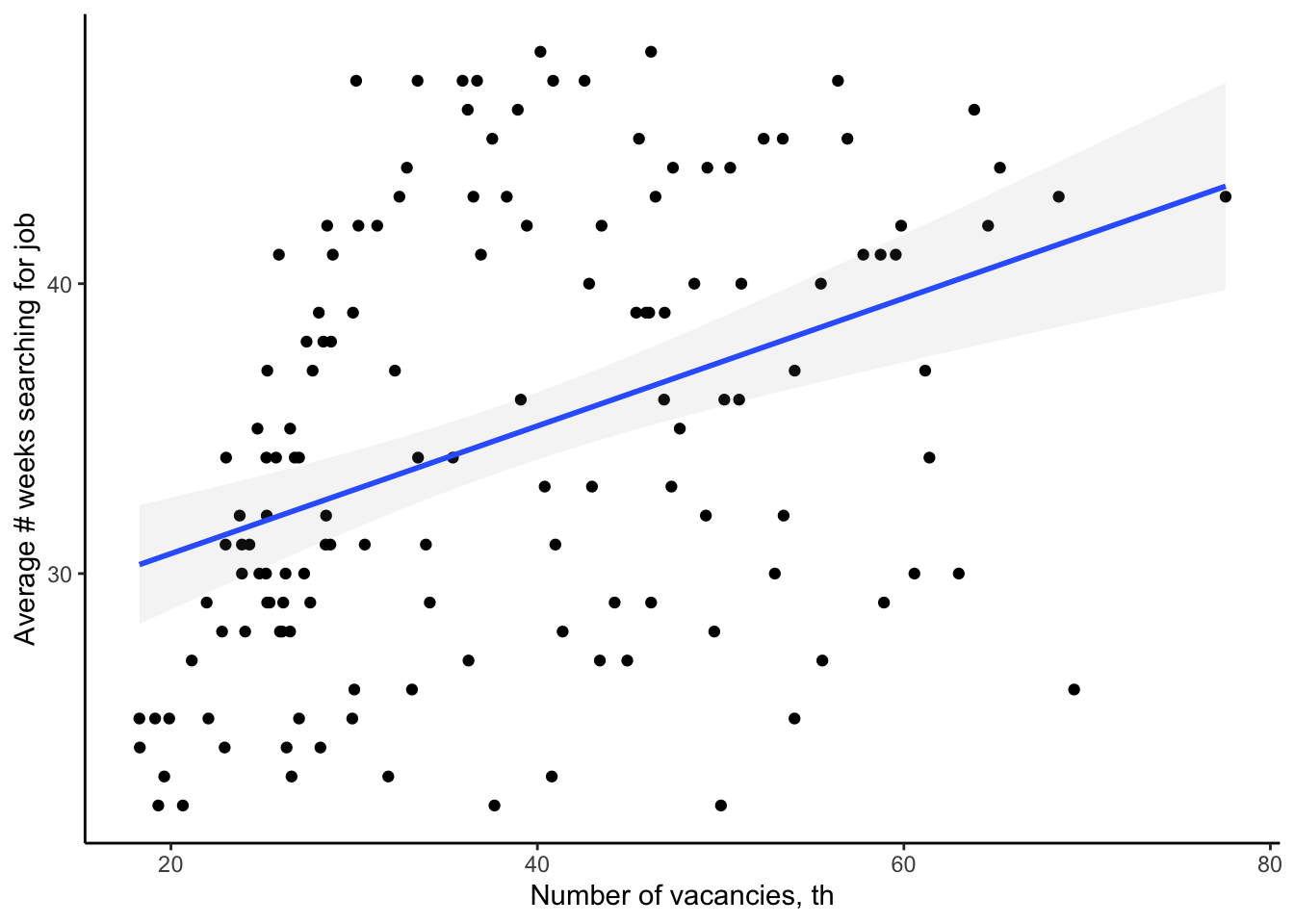
Source: Statistics Finland (2008-2019)
Model
Basic job search model
- Workers do not know precise wage at each job, only CDF \(H(\cdot)\)
- Dynamic model with continuous time \(t\) (period is \(\text{d}t\))
- Key components
- Assume worker receives \(\leq 1\) job offer at wage \(w\) in period \(\text{d}t\)
- If she is employed with wage \(w\), assume her utility over \(\text{d}t\) is \(w~\text{d}t\)
- Exogenous job destruction at rate \(q~\text{d}t\)
- Discount future at rate \(\frac{1}{1 + r~\text{d}t}\)
- Let \(V_e\) and \(V_u\) be discounted utility of employment and unemployment
\[ V_e(w) = \frac{1}{1 + r~\text{d}t} \left(w~\text{d}t + \left(1 - q~\text{d}t\right)V_e(w) + q~\text{d}t~V_u\right) \]
Basic job search model and reservation wage
Optimal job search strategy
- If she receives no offer, she continues looking for a job
- If she receives an offer at wage \(w\), she accepts iff \(V_e(w) > V_u\)
Rewrite employee expected utility
\[ V_e(w) - V_u = \frac{w - r V_u}{r + q} \]
Since we assume \(V_u\) is constant, there is \(w^\star: V_e(w) > V_u ~~ \forall w > w^\star\)
It is easy to see that here \(w^\star = r V_u\)
\(w^\star\) is called reservation wage
Basic job search model and reservation wage
Expected utility \(V = \int_{-\infty}^{w^\star} V_u dH(w) + \int_{w^\star}^\infty V_e(w)dH(w)\)
Assume job offers arrive at an exogenous rate \(\lambda~\text{d}t\)
When unemployed, receive net income \(z \equiv b - c\)
- \(b\) is unemployment benefit, and
- \(c\) is total cost of job search (direct and indirect)
Can write \(V_u = \frac{1}{1 + r~\text{d}t}\left(z~\text{d}t + \lambda~\text{d}t V + (1 - \lambda~\text{d}t) V_u\right)\)
After simplifying and plugging in the expression for \(w^\star\), can show that \[ w^\star = z + \frac{\lambda}{r + q}\int_{w^\star}^\infty \left(w - w^\star\right) dH(w) \]
Basic job search model and unemployment duration
- Hazard rate, or exit rate from unemployment, depends on
- job offer arrival rate \(\lambda\)
- probability of offered wage being above \(w^\star \equiv 1 - H(w^\star)\)
- Hence, hazard rate is \(\lambda \left(1 - H(w^\star)\right)\)
- Average duration of unemployment is \(T_u = \frac{1}{\lambda\left(1 - H(w^\star)\right)}\)
Basic job search model and comparative statics
Using implicit differentiation, can show that reservation wage is
\[ \frac{\partial w^\star}{\partial z} > 0, \quad \frac{\partial w^\star}{\partial \lambda} > 0, \quad \frac{\partial w^\star}{\partial r} < 0, \quad \frac{\partial w^\star}{\partial q} < 0 \]
Therefore, average duration of unemployment is
- increasing in net income in unemployment: \(\frac{\partial T_u}{\partial z} > 0\)
- decreasing in interest rate: \(\frac{\partial T_u}{\partial r} < 0\)
- decreasing in job loss rate: \(\frac{\partial T_u}{\partial q} < 0\)
- ambiguous with respect to job offer arrival rate: \(\frac{\partial T_u}{\partial\lambda} \stackrel{?}{} 0\)
Job search with benefit eligibility
Two types of unemployed: eligible (\(V_u\)) and non-eligible (\(V_n\))
- Non-eligible earns income \(z_n < z\)
- All workers who have worked at least once are eligible
Expected utility of accepting offer same: \(r V_e(w) = w + q\left(V_u - V_e(w)\right)\)
Reservation wage of non-eligible worker satisfies \(V_e(w^\star_n) = V_n\)
Expected utility of non-eligible unemployed worker is \(r V_n = z_n + \lambda \int_{w^\star_n}^\infty \left(V_e(w) - V_n\right) dH(w)\)
Using all of the above, we can write \(w^\star_n\) as
\[ r w^\star_n = (r + q) z_n \color{#8e2f1f}{ - q w^\star} + \lambda \int_{w^\star_n}^\infty \left(w - w^\star_n\right)\text{d}H(w) \]
Can show that \(\frac{\partial w^\star_n}{\partial z} < 0\) and \(\frac{\partial T_n}{\partial z} < 0\)
Other extensions of basic job search model
Job search model with participation choice
Let \(R_I\) be net income of non-participation. Then
- If \(w^\star \leq R_I\), worker decides to not participate
- If \(w^\star > R_I\), but offered wage \(w \leq w^\star\) ,the worker decides to keep looking for jobs
- If \(w > w^\star > R_I\), the worker accepts the job offer
Can be useful to study discouraged workers
Other extensions of basic job search model
Job search model with participation choice
On-the-job search
- Workers can keep searching for jobs while employed
- Let \(\lambda_e\) be offer arrival rate for employed and \(\lambda_u\) - for the unemployed
- Reservation wage is increasing in \(\lambda_u\) and decreasing in \(\lambda_e\)
Other extensions of basic job search model
Job search model with participation choice
On-the-job search
Effort of job search
- Job arrival rate is endogenous and depends on
- state of the labour market \(\alpha\)
- worker’s search effort \(e\)
- Reservation wage is increasing in \(\alpha\) and \(z\)
- Optimal effort is increasing in \(\alpha\) and decreasing in \(z\)
Other extensions of basic job search model
Job search model with participation choice
On-the-job search
Effort of job search
Job search and wealth
- Workers’ value functions depend on their wealth
- Reservation wage increases with wealth
- Optimal search effort decreases with wealth
Other extensions of basic job search model
Job search model with participation choice
On-the-job search
Effort of job search
Job search and wealth
Job search and benefit sanctions
- Unemployment benefits often require active job search
- If fail to meet those conditions, benefits are sanctioned
- Workers that get sanctioned increase their search effort
- Threat of sanctions makes unsanctioned workers increase search effort
Other extensions of basic job search model
Job search model with participation choice
On-the-job search
Effort of job search
Job search and wealth
Job search and benefit sanctions
Job search and non-stationary environment
- Labour market environment is not same at every \(t\)
- Example: benefits often decrease or stop after some time
- reservation wage is decreasing over time
- Example: unemployed workers may receive fewer offers over time
- reservation wage is decreasing over time
- dynamics of average duration of unemployment is unknown
Other extensions of basic job search model
Job search model with participation choice
On-the-job search
Effort of job search
Job search and wealth
Job search and benefit sanctions
Job search and non-stationary environment
See Section 2 in Chapter 5 of Cahuc, Carcillo, and Zylberberg (2014) for discussion of these extensions and references
Equilibrium search models
- Basic model is partial: distribution of wages \(H(\cdot)\) is exogenous
- Add labour demand to the picture to get endogenous \(H(\cdot)\)
- Main implications:
- With on-the-job search, wages rise when switching jobs
- No wage offered below reservation wage
- Wage dispersion \(\uparrow\) with more competition for workers (high \(\frac{\lambda_e}{q}\))
- See Section 4 in Chapter 5 of Cahuc, Carcillo, and Zylberberg (2014)!
Empirical evidence
Identification strategies
- Causal effect of \(z\) on \(T_u\) interesting from policy perspective
- Change in search behaviour of unemployed workers
- Confounding factors: difference in motivation, LM attachment, skills, etc.
- Need to exploit exogenous variation in benefits received
- RCTs: hard to ensure that control group is unaffected by treatment
- Natural experiments: policy changes or market shocks
Lalive, van Ours, and Zweimüller (2006)
Policy change in Austria in 1989
- Benefit replacement ratio \(\uparrow\) for low earnings (\(eRR\))
- Benefit duration \(\uparrow\) for experienced workers (\(ePBD\))
Outcome of interest: duration of unemployment spell
Use difference-in-differences approach
Age \(< 40\) Age \(\geq 40\) Low experience High experience Low experience High experience Low earning eRR eRR eRR ePBD-RR High earning Control Control Control ePBD
Lalive, van Ours, and Zweimüller (2006)
| Before 1989 | After 1989 | Change over time | DiD | |
|---|---|---|---|---|
| ePBD | 16.250 | 18.670 | 2.420 | 1.130 |
| (0.080) | (0.090) | (0.120) | (0.180) | |
| Obs. | 48 294 | 51 110 | ||
| eRR | 17.790 | 20.030 | 2.240 | 0.960 |
| (0.120) | (0.160) | (0.200) | (0.240) | |
| Obs. | 17 160 | 15 310 | ||
| ePBD-RR | 19.010 | 23.550 | 4.530 | 3.250 |
| (0.170) | (0.240) | (0.200) | (0.240) | |
| Obs. | 11 992 | 9 182 | ||
| Control | 15.240 | 16.520 | 1.290 | |
| (0.080) | (0.090) | (0.130) | ||
| Obs. | 33 815 | 38 958 |
Lalive, van Ours, and Zweimüller (2006)
\(ePBD\) increased benefit duration from 30 up to 52 weeks
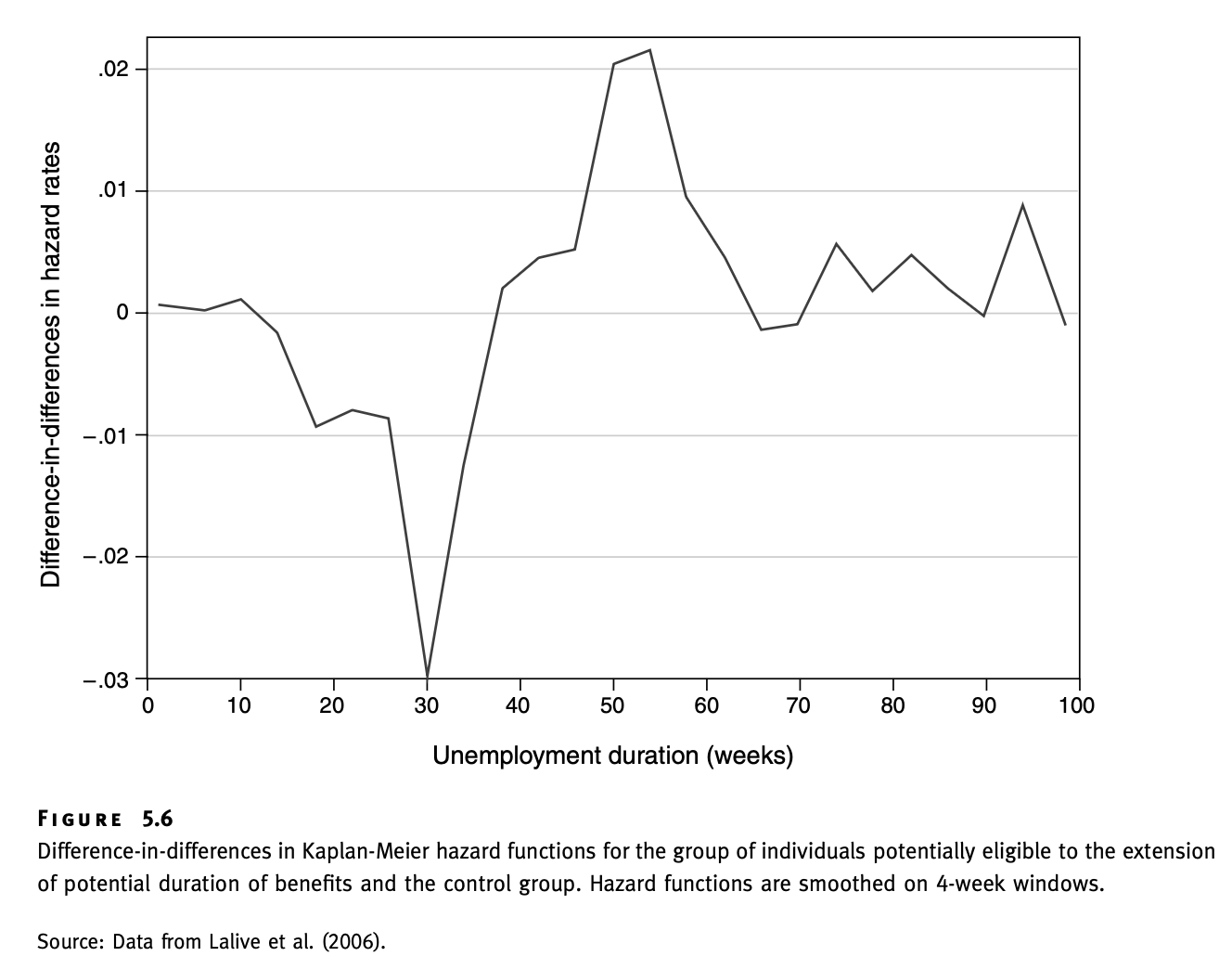
Card, Chetty, and Weber (2007)
Exit unemployment \(\neq\) find a job
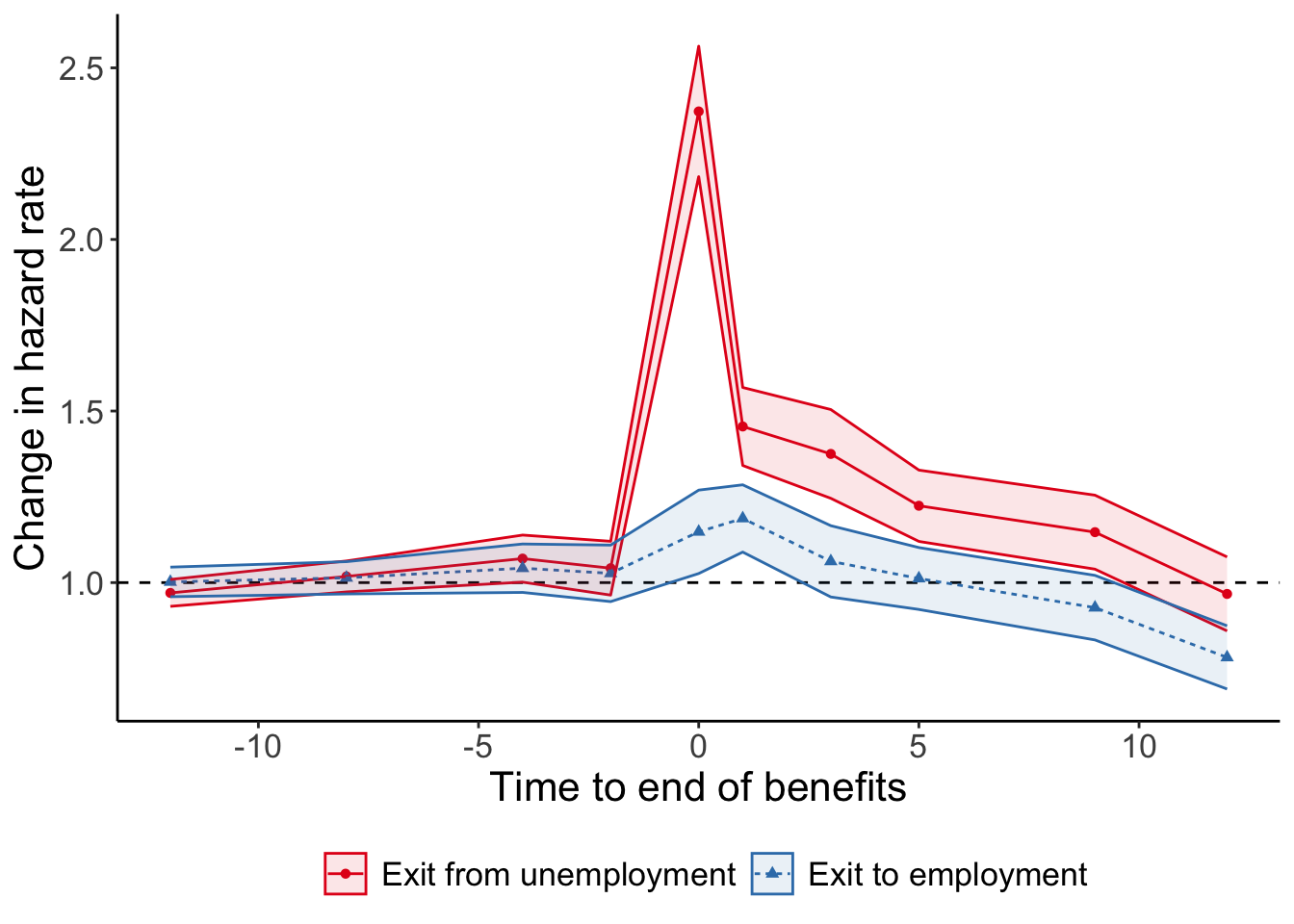
Source: Table 1 of Card, Chetty, and Weber (2007)
Nekoei and Weber (2017)
Generosity of benefits and quality of next job
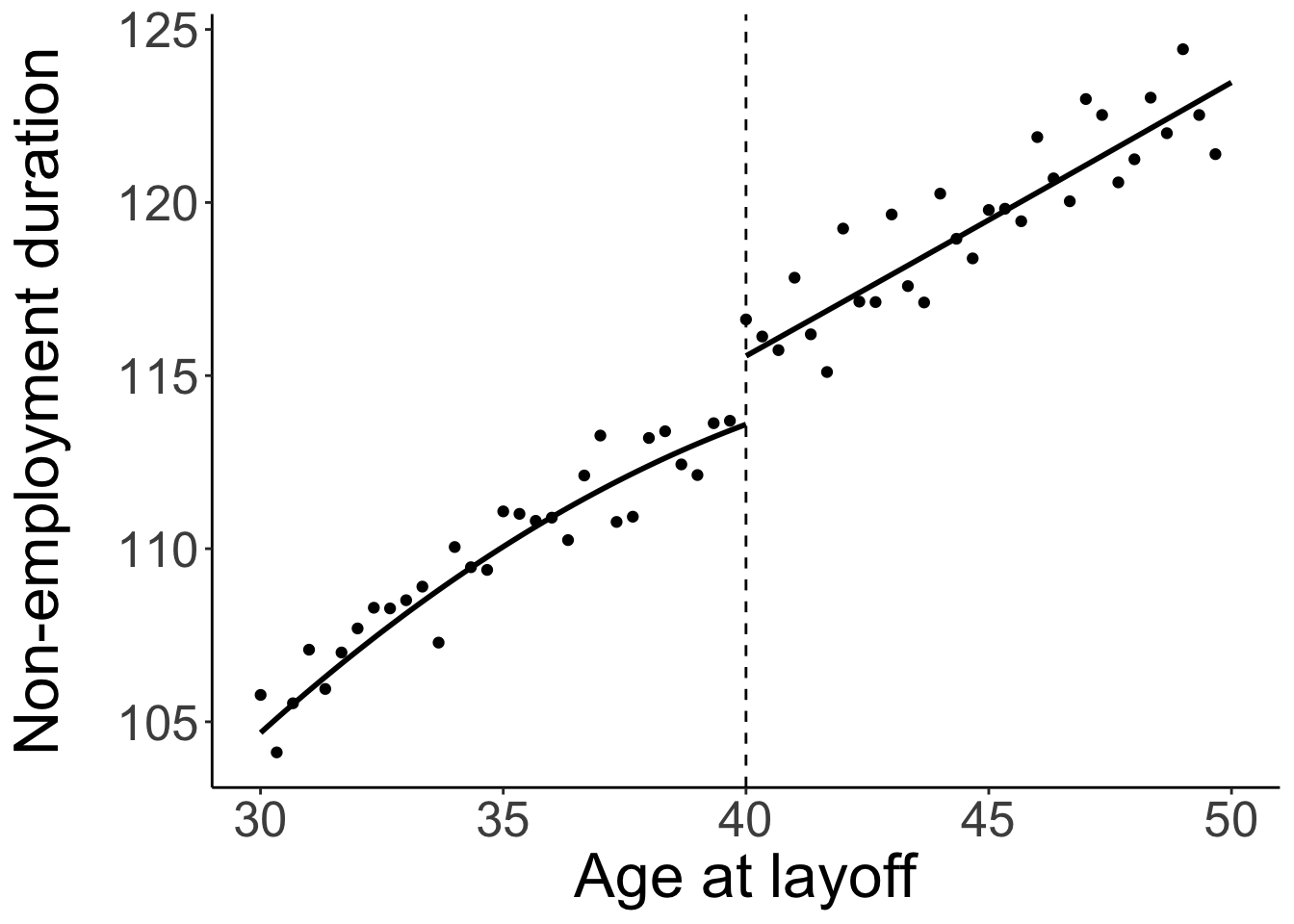
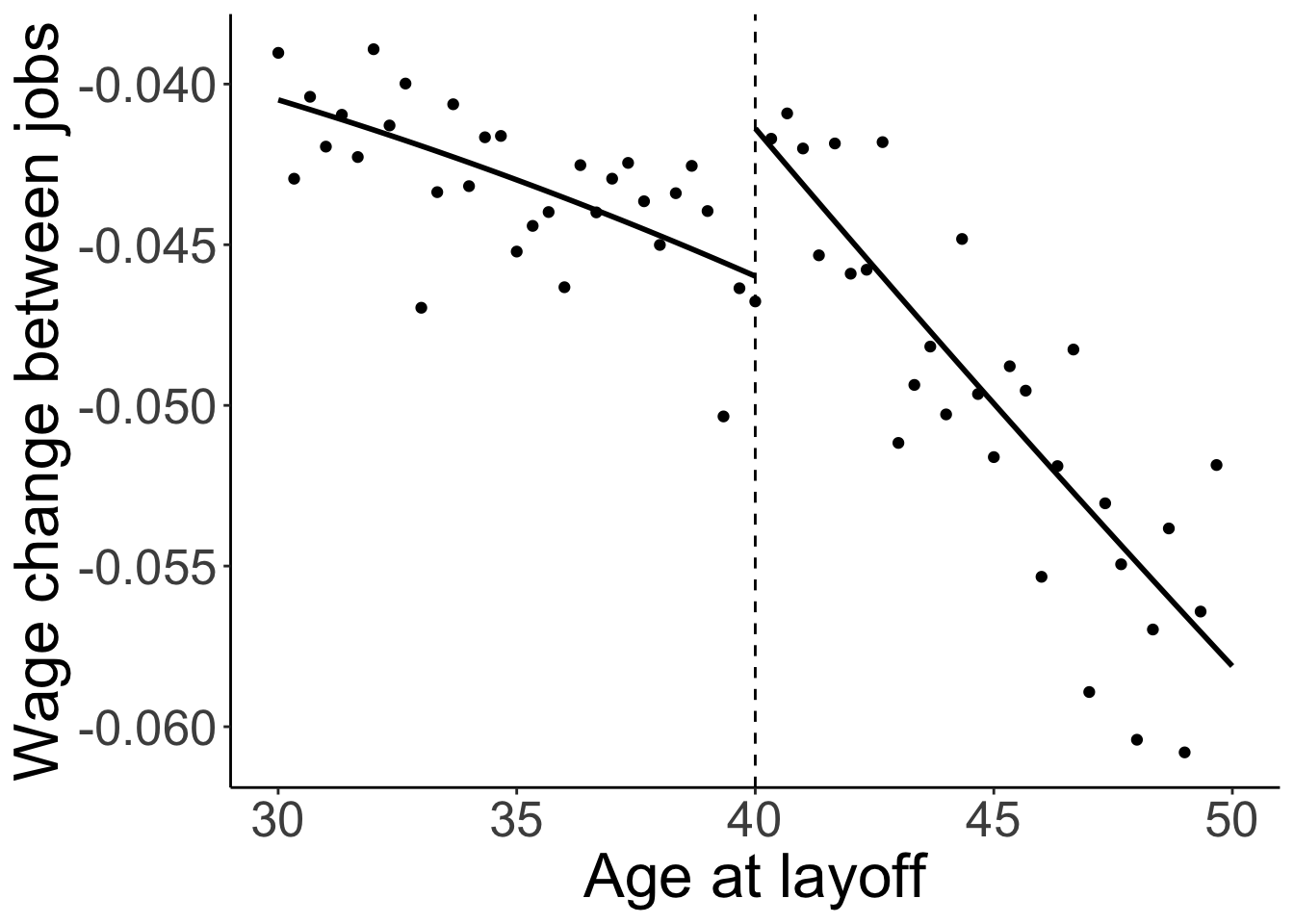
- Regression discontinuity: compare Austrian workers around age 40
- Main finding: wage at next job \(\uparrow\)
- past papers: zero or \(<0\) effect
- Model: opposing forces on wages
- reservation wage \(\uparrow\)
- unemployment duration \(\uparrow\)
- Additional results:
- next job in higher-paying firms
- Policy impact:
- future tax revenue \(\uparrow\)
- current UI spending \(\uparrow\)
Belot, Kircher, and Muller (2019)
Cost of job search and re-employment
- Recommend vacancies based on skill set of jobseeker
- RCT: labs with computer access used for job search activity
- search for jobs in labs 1/week for 12 weeks
- weekly survey about interviews/offers and out-of-lab search
- on week 4, introduce recommendations to a random subsample
- Measure impact on
- breadth of occupations searched and applied for
- number of interviews
- job finding rate
Belot, Kircher, and Muller (2019)
| Dependent variable | ||||
|---|---|---|---|---|
| Breadth of applications | N applications | N interviews | N offers | |
| * p < 0.1, ** p < 0.05, *** p < 0.01 | ||||
| Treatment | 0.030 | 0.010 | 0.440* | -0.130 |
| (0.200) | (0.090) | (0.280) | (0.250) | |
| Treatment x init. broad | -0.430* | -0.050 | -0.070 | |
| (0.220) | (0.120) | (0.240) | ||
| Treatment x init. narrow | 0.490* | 0.080 | 1.030*** | 0.100 |
| (0.290) | (0.130) | (0.550) | (0.560) | |
| Num.Obs. | 305 | 487 | 464 | 253 |
In a similar experiment, Belot, Kircher, and Muller (2022) find
- \(\uparrow \Pr\) finding a stable job (at least 6 months)
- \(\uparrow \Pr\) reaching earnings threshold
Summary
- Job search models labour supply under imperfect information
- Useful in studying unemployment spells and job search behaviour
- Accommodate firm side to characterise equilibrium wage distribution
- Useful in studying wage dispersion (more in next lecture)
- Necessary to assess full impact of policy change
- Empirical studies focus on
- effects of benefits on search behaviour
- duration dependence of search and job-finding rates
- effectiveness of various job search tools
Next lecture: Wage setting on 08 Sep
References
Angrist, Joshua David, and Jörn-Steffen Pischke. 2009. Mostly Harmless Econometrics: An Empiricist’s Companion. Princeton: Princeton University Press.
Belot, Michele, Philipp Kircher, and Paul Muller. 2019. “Providing Advice to Jobseekers at Low Cost: An Experimental Study on Online Advice.” The Review of Economic Studies 86 (4): 1411–47. https://doi.org/10.1093/restud/rdy059.
———. 2022. “Do the Long-Term Unemployed Benefit from Automated Occupational Advice During Online Job Search?” SSRN Electronic Journal. https://doi.org/10.2139/ssrn.4178928.
Cahuc, Pierre, Stéphane Carcillo, and André Zylberberg. 2014. Labor Economics. Second edition. Cambridge, MA: The MIT Press. https://research.ebsco.com/linkprocessor/plink?id=0949c8a9-3435-3a85-a9e3-d47d2c8a57ef.
Card, David, Raj Chetty, and Andrea Weber. 2007. “The Spike at Benefit Exhaustion: Leaving the Unemployment System or Starting a New Job?” The American Economic Review 97 (2): 113–18. https://www.jstor.org/stable/30034431.
Krueger, Alan B., and Andreas Mueller. 2010. “Job Search and Unemployment Insurance: New Evidence from Time Use Data.” Journal of Public Economics 94 (3): 298–307. https://doi.org/10.1016/j.jpubeco.2009.12.001.
Krueger, Alan B., and Andreas I. Mueller. 2012. “The Lot of the Unemployed: A Time Use Perspective.” Journal of the European Economic Association 10 (4): 765–94. https://doi.org/10.1111/j.1542-4774.2012.01071.x.
Lalive, Rafael, Jan van Ours, and Josef Zweimüller. 2006. “How Changes in Financial Incentives Affect the Duration of Unemployment.” The Review of Economic Studies 73 (4): 1009–38. https://www.jstor.org/stable/4123257.
McCall, J. J. 1970. “Economics of Information and Job Search.” The Quarterly Journal of Economics 84 (1): 113–26. https://doi.org/10.2307/1879403.
Mortensen, Dale T. 1970. “Job Search, the Duration of Unemployment, and the Phillips Curve.” The American Economic Review 60 (5): 847–62. https://www.jstor.org/stable/1818285.
Nekoei, Arash, and Andrea Weber. 2017. “Does Extending Unemployment Benefits Improve Job Quality?” American Economic Review 107 (2): 527–61. https://doi.org/10.1257/aer.20150528.
Official Statistics of Finland (OSF). 2025. “Time Use.” Online publication. https://stat.fi/en/statistics/akay.