2. Labour Supply
KAT.TAL.322 Advanced Course in Labour Economics
August 27, 2025
Labour supply
How people choose
- whether to work, and
- how much to work
Static model
Static labour supply
Model
- Utility from consumption of goods (\(C\)) and leisure (\(L\)): \(U(C, L)\).
- Total time endowment \(L_0\)
- Agent chooses \(h\) how much time to work such that \(L = L_0 - h\).
- Budget constraint is \(C \leq wh + Y \Rightarrow C + w L \leq w L_0 + Y\)
- \(w\) is real hourly wage
- \(Y\) is non-labour income
\[ \max_{C, h} U(C, L_0 - h) \quad\text{subject to} \quad C \leq wh + Y \]
Static labour supply
Allocation of time in the data
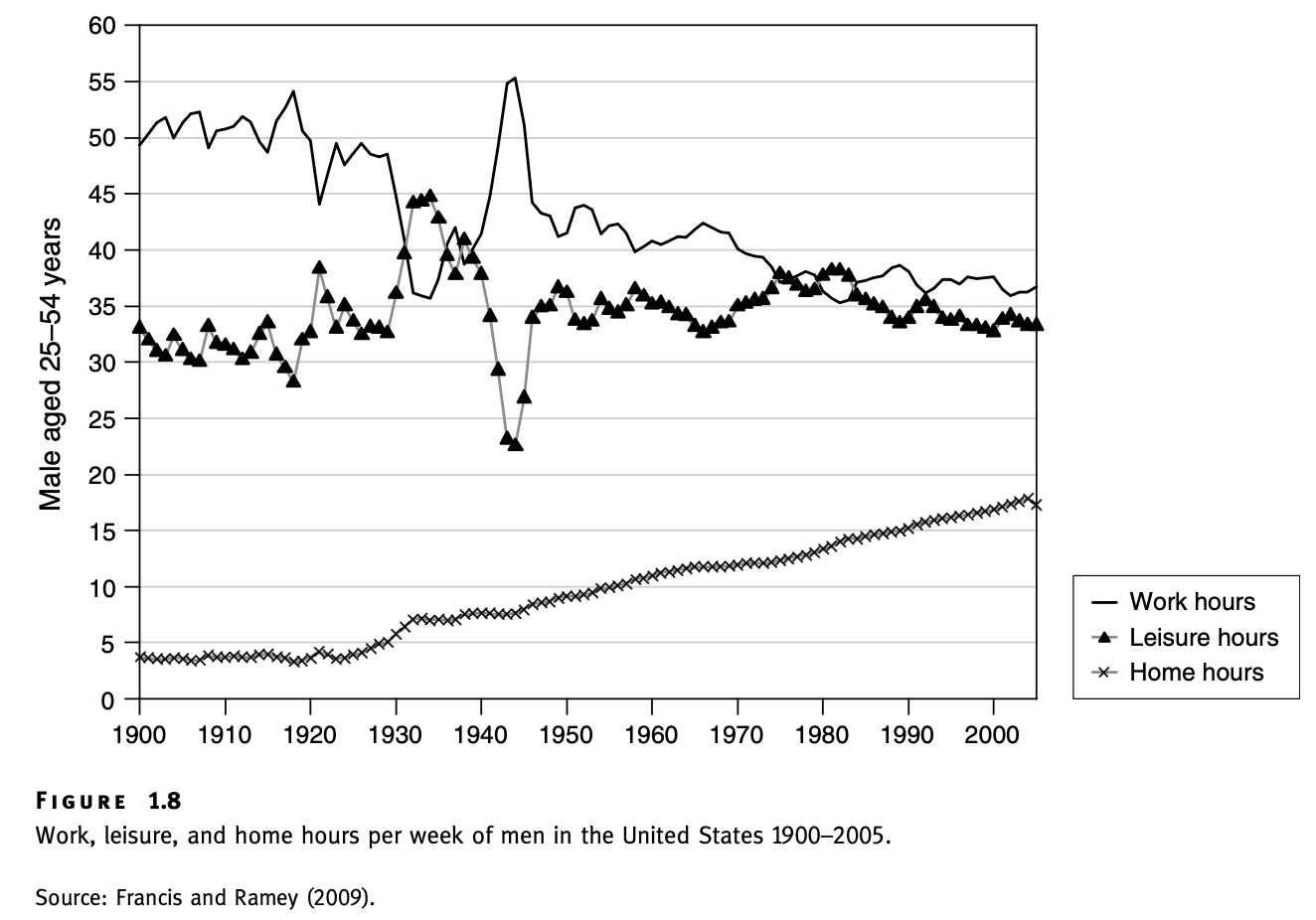
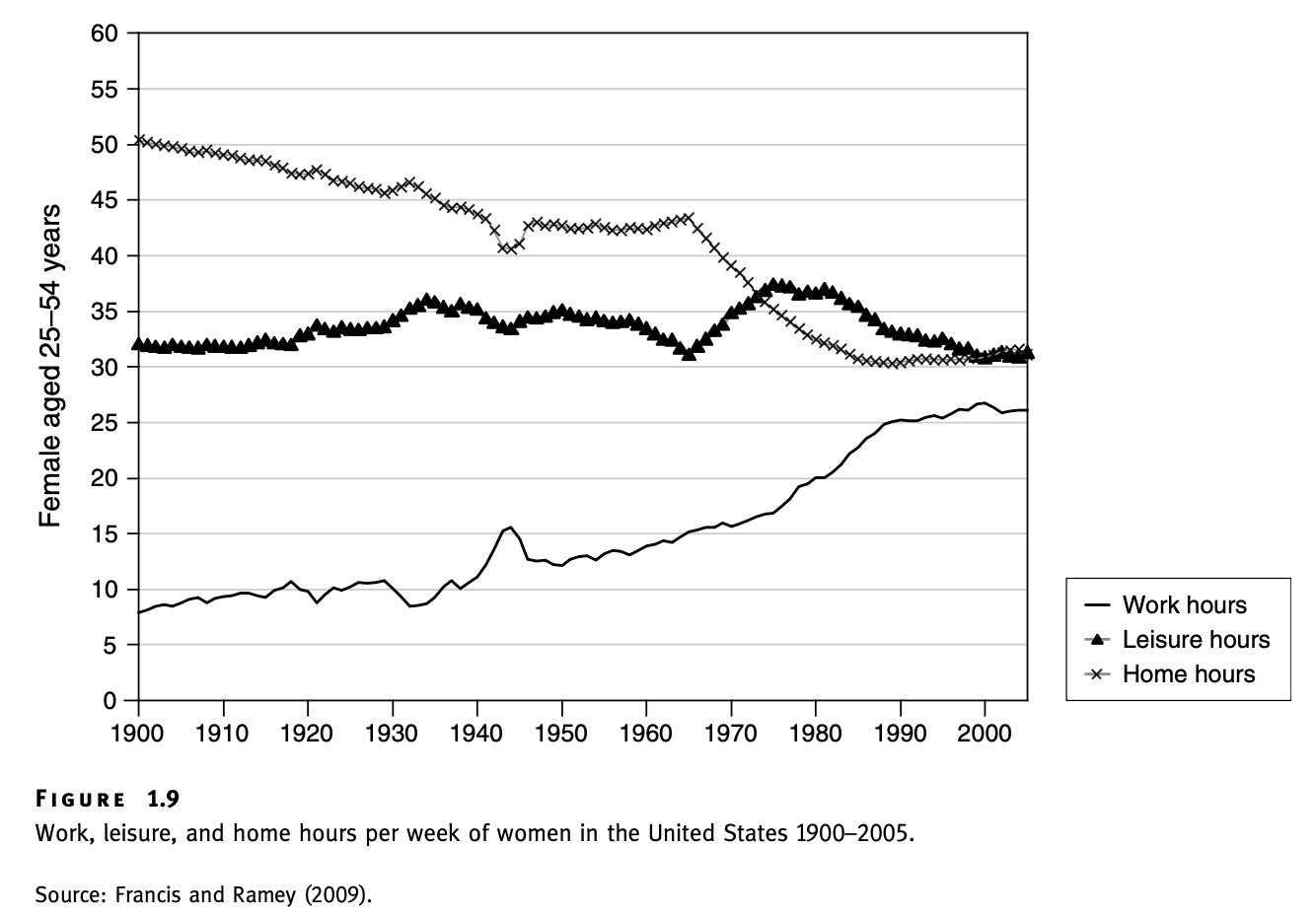
Static labour supply
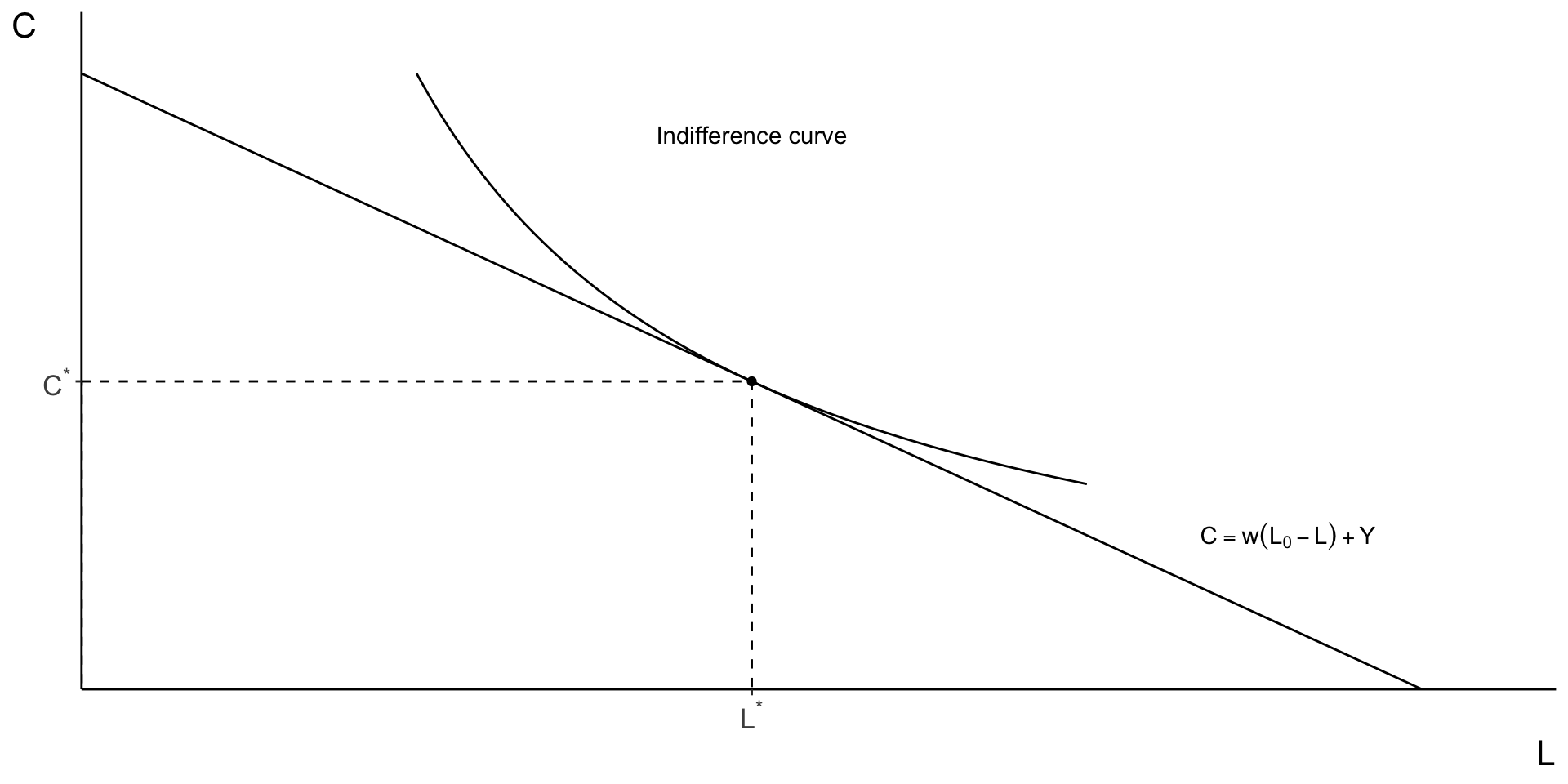
Solution
First-order conditions of the Lagrangian are
\[ U_C(C, L) = \lambda \qquad U_L(C, L) = \lambda w \]
Solution pair \(C^*(w, Y)\) and \(h^*(w, Y)\) satisfies
\[ \frac{U_L(C^*, L^*)}{U_C(C^*, L^*)} = w \quad \text{and} \quad C^* = wh^* + Y \]
Static labour supply
Solution
Static labour supply
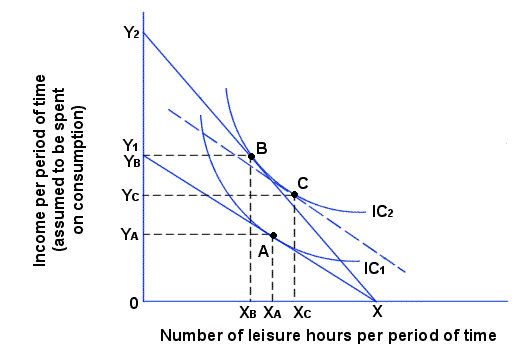
Comparative statics
How does optimal labour supply change with \(w\)?
Marshallian (uncompensated) wage elasticity: \(\varepsilon_{hw} = \frac{\partial \ln h^*}{\partial \ln w}\)
Hicksian (compensated) wage elasticity: \(\eta_{hw} = \frac{\partial \ln \hat{h}}{\partial \ln w}\)
Decomposition into substitution and income effects:
\[ \varepsilon_{hw} = \color{#8e2f1f}{\eta_{hw}} + \color{#288393}{\frac{wh}{Y} \varepsilon_{hY}} \]
Static labour supply
Comparative statics
Source: Wikipedia
Static labour supply
Labour supply curve

Source: Wikipedia
Household model
Intrahousehold labour supply
Unitary model
Household represented by single utility function \(U(C, L_1, L_2)\)
Budget constraint \(C + w_1 L_1 + w_2 L_2 \leq Y_1 + Y_2 + (w_1 + w_2) L_0\)
Simple extension of static model
Consumption depends on total resources only
Not consistent with empirical studies
Intrahousehold labour supply
Collective model
Individual utility functions \(U_1(C_1, L_1), U_2(C_2, L_2)\)
Budget constraint \(C_1 + C_2 + w_1 L_1 + w_2 L_2 \leq R_1 + R_2 + (w_1 + w_2) L_0\)
\[\begin{align} \max_{C_1, C_2, L_1, L_2} U_1(C_1, L_1) \quad\text{s.t.}\quad&\text{budget constraint}\\ & U_2(C_2, L_2) \geq \bar{U}_2 \end{align}\]
Intrahousehold labour supply
Collective model
Chiappori (1992): equivalent to
\[ \max_{C_i, L_i} U_i(C_i, L_i) \quad\text{s.t.}\quad C_i + w_i L_i \leq w_i L_0 + \Phi_i \]
where \(\Phi_i\) describes how resources \(R_1 + R_2\) are shared in the household.
Intertemporal model
Intertemporal labour supply
Model
General utility function \(U(C_0, \ldots, C_T; L_0, \ldots, L_T)\) (intractable)
Separable utility function \(\sum_{t = 0}^T U(C_t, L_t, t)\)
Budget constraint \(A_t = (1 + r_t) A_{t - 1} + B_t + w_t(1 - L_t) - C_t\)
- savings rate \(r_t\)
- total time normalized to one: \(h_t + L_t = 1\)
- assets \(A_t\)
- non-labour income \(B_t\)
Intertemporal labour supply
Solution
\[ L = \sum_t U(C_t, L_t, t) - \sum_t \nu_t \left[A_t - (1 + r_t) A_{t - 1} - B_t - w_t(1 - L_t) + C_t\right] \]
First-order conditions:
\[ \begin{align*}\frac{U_L(C_t, L_t, t)}{U_C(C_t, L_t, t)} = &w_t\\\nu_t = &(1 + r_{t + 1})\nu_{t + 1} \end{align*} \qquad \forall t \in [0, T] \]
Iterating over all periods: \(\ln \nu_t = - \sum_{\tau = 1}^t \ln\left(1 + r_\tau\right) + \ln\nu_0\)
Intertemporal labour supply
Wage elasticities of labour supply
Frisch elasticity \(\psi_{hw}\) (holding \(\nu_t\) constant)
Marshallian elasticity \(\varepsilon_{hw}\) (takes into account \(\nu_t\))
Hicksian elasticity \(\eta_{hw}\) (holding lifetime utility constant)
It is possible to show that \(\psi_{hw} \geq \eta_{hw} \geq \varepsilon_{hw}\)
Interpretation
Transitory changes in wages affect labour supply more than permanent changes.
Intertemporal labour supply
Example
Period utility \(U(C_t, L_t, t) = \frac{C_t^{1 + \rho}}{1 + \rho} - \beta_t \frac{H_t^{1 + \gamma}}{1 + \gamma}\)
FOC: \(H_t^\gamma = \frac{1}{\beta_t} \nu_t w_t \Rightarrow \ln H_t = \frac{1}{\gamma}\left(-\ln \beta_t + \ln \nu_t + \ln w_t\right)\)
- Evolutionary changes along anticipated wage profile \(\frac{\partial \ln H_t}{\partial \ln w_t} = \frac{1}{\gamma} > 0\)
- Transitory changes \(\frac{\partial \ln H_t}{\partial \ln w_t} = \frac{1}{\gamma}\left(1 + \underbrace{\frac{\partial \ln \nu_0}{\partial \ln w_t}}_{<\approx 0}\right) > 0\)
- Permanent changes \(\frac{\partial \ln H_t}{\partial \ln w_t} = \frac{1}{\gamma}\left(1 + \frac{\partial \ln \nu_0}{\partial \ln w_t}\right) \lessgtr 0\)
- Lottery win \(\frac{\partial \ln H_t}{\partial \ln B_t} = \frac{1}{\gamma} \frac{\partial \ln \nu_0}{\partial \ln B_t} < 0\)
Estimations
Empirical specifications
Basic regression equation
\[ \ln H_{it} = \alpha_w \ln w_{it} + \alpha_R R_{it} + \theta X_{it} + v_{it} \]
Interpretation of \(\alpha_w\): Frisch, Marshallian or Hicksian? Depends on \(R_{it}\)!
Empirical specifications
Two-stage budgeting
Solution method of lifecycle labour supply models (Blundell and Macurdy 1999)
- Solve static labour supply model given \(C_t = R_t + w_t H_t\)
- Solve for series \(R_1, \ldots, R_T\) to maximize lifetime utility
\[ \ln H_{it} = \alpha_w \ln w_{it} + \alpha_R \left(C_{it} - w_{it} H_{it}\right) + \theta X_{it} + v_{it} \]
Marshallian wage elasticity: \(\alpha_w\)
Income effect: \(\alpha_R w H\)
Hicksian wage elasticity: \(\alpha_w - \alpha_R wH\)
Empirical specifications
Frisch elasticity
Recall that \(\ln \nu_t = -\sum_{\tau = 1}^t \ln (1 + r_\tau) + \ln \nu_0 \equiv -\ln(1 + r) t + \ln \nu_0\) (if \(r_\tau = r ~ \forall \tau\))
Substitute \(\alpha_RR_{it} = \rho t + \alpha_R\ln \nu_{0, i}\) into basic equation:
\[ \begin{align*} \ln H_{it} &= \rho t + \alpha_w \ln w_{it} + \alpha_R \ln \nu_{0, i} + \theta X_{it} + v_{it} \\ \Delta \ln H_{it} &= \rho + \alpha_w \Delta \ln w_{it} + \theta \Delta X_{it} + \Delta v_{it} \end{align*} \]
Frisch wage elasticity: \(\alpha_w\)
Empirical specifications
Practical issues
Wages and hours worked are endogeneous
Hours (\(H | H > 0\)) and participation (\(H > 0\))
Measurement errors
Measures of \(C_{it}\)
Individual vs aggregate labour supply
Estimates
Observational data
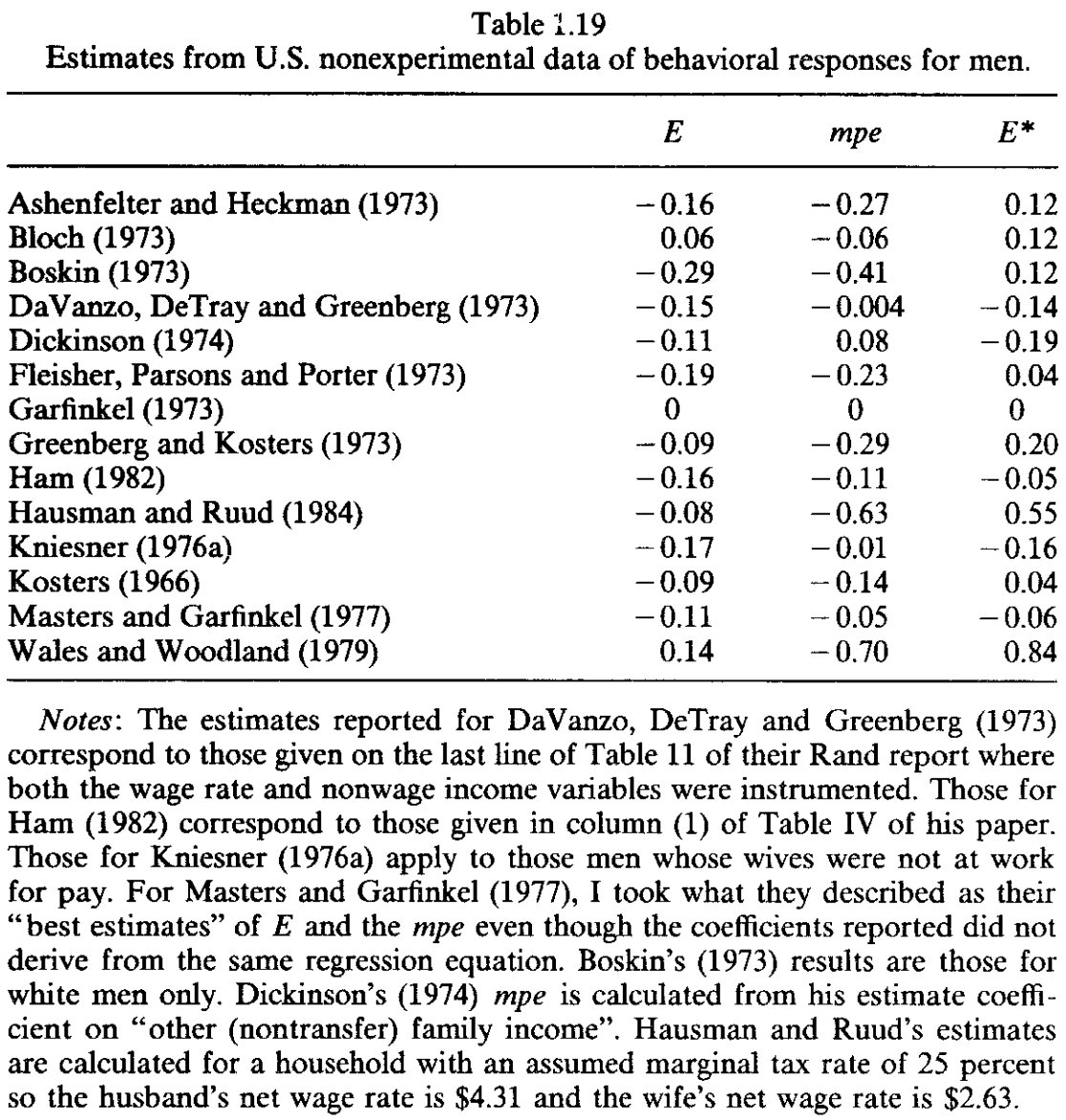
Source: Pencavel (1986)
Estimates
Experimental data: drop in tax rates in the UK 1978-92
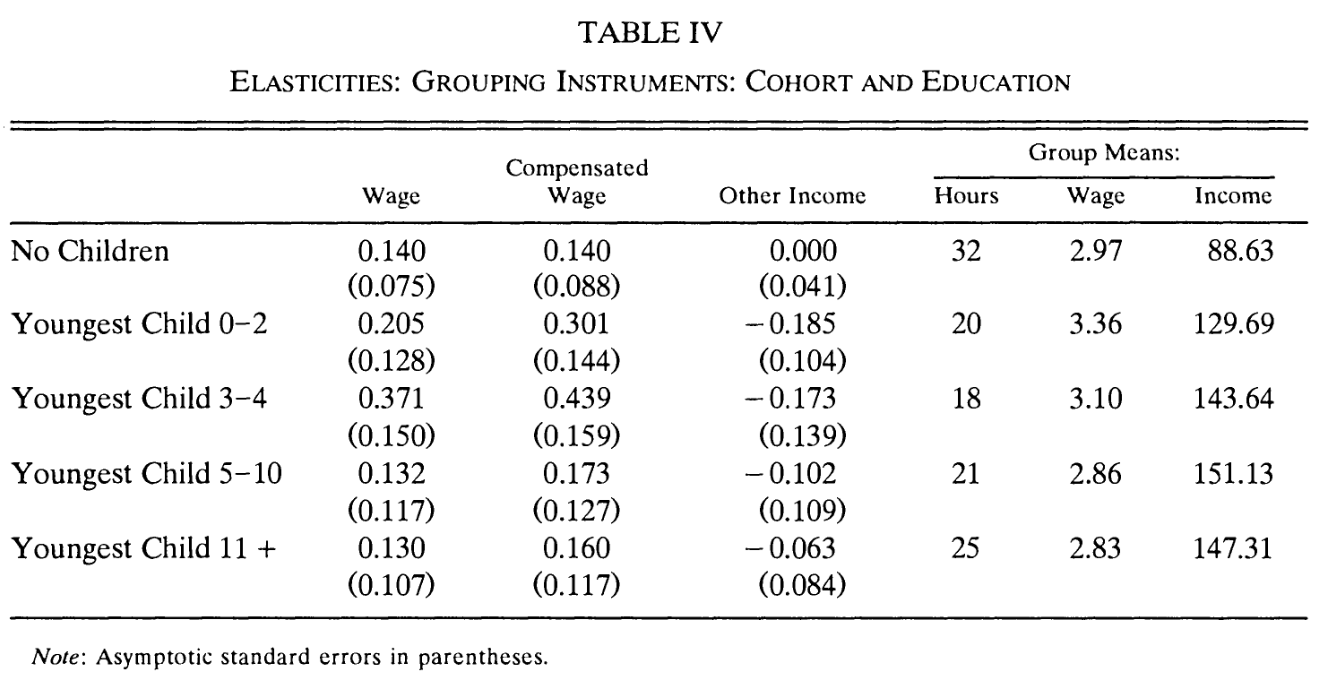
Source: Blundell, Duncan, and Meghir (1998)
Estimates
Intensive vs extensive margin

Source: Chetty et al. (2012)
Also some research on work effort for given hours of work (Dickinson 1999)
Estimates
Measurement errors
Classical measurement error in \(w_{it}\) attenuates the estimate of \(\alpha_w\)
“Denominator bias” \(\downarrow \alpha_w\) if wages are computed as ratio of earning and hours with measurement errors. M. P. Keane (2011) computes average Hicksian elasticity
among all papers: 0.31
among papers with direct measure of \(w_{it}\): 0.43
Estimates
Measurement of consumption
PSID (US) dataset only includes food consumption data
| Consumption measure | Marshall | Hicks | Income | Frisch |
|---|---|---|---|---|
| PSID unadjusted | -0.442 | 0.094 | -0.536 | 0.148 |
| Food + imputed (food prices, demographics) | -0.468 | 0.328 | -0.796 | 0.535 |
| Food + imputed (house value, rent) | -0.313 | 0.220 | -0.533 | 0.246 |
Source: (M. P. Keane 2011, Table 5)
Estimates
Micro vs macro elasticities
Macro elasticities of labour supply typically higher than micro estimates
M. Keane and Rogerson (2012) highlight:
- extensive vs intensive margin
- model misspecification due to human capital accumulation
- aggregation is not straightforward
Estimates
Discrete choice dynamic programming
Incorporate discrete choices into model of labour supply
- labour force participation (Eckstein and Wolpin 1989)
- marriage (Van Der Klaauw 1996)
- fertility (Francesconi 2002)
M. P. Keane and Wolpin (2010) combine all + school and welfare participation choices
Summary
- Standard models of labour supply
- Static model
- Household model
- Intertemporal model
- Estimates of labour supply elasticities
- Typical issues encountered in data
- Variation in estimates and possible extensions
- Mostly covered seminal papers, but many ongoing works
- Tax and benefit policies
- Cross-wage elasticities
Next lecture: Labour Demand on 01 Sep