10. Intergenerational mobility

KAT.TAL.322 Advanced Course in Labour Economics

Nurfatima Jandarova

September 24, 2025

Do children “inherit” their outcomes from parents?

Model of intergenerational mobility

Simplified Becker and Tomes (1979)

  • 2 generations: parent and child

  • Parent earns \(y_{t-1}\) and chooses \(C_{t-1}\) and \(I_{t-1}\)

    \[ y_{t - 1} = C_{t - 1} + I_{t - 1} \]

  • Child receives \((1 + r)I_{t - 1}\) and other income \(E_t\)

    \[ y_t = (1 + r)I_{t - 1} + E_t \]

  • Cobb-Douglas intergenerational utility

    \[ \max_{I_{t - 1}, C_{t - 1}} \left(1 - \alpha\right) \ln C_{t - 1} + \alpha \ln y_t \]

Simplified Becker and Tomes (1979)

FOC wrt \(I_{t - 1}\):

\[ I_{t - 1} = \alpha y_{t - 1} - \frac{(1 - \alpha) E_t}{1 + r} \]

Plug it back to budget equation of child

\[ y_t = \underbrace{\alpha(1 + r)}_{\beta} y_{t - 1} + \alpha E_t \]

If \(E_t \perp y_{t - 1} \cap Var(y_t) = Var(y_{t - 1}) \Rightarrow \text{Corr}(y_t, y_{t - 1}) = \alpha (1 + r)\)

Simplified Becker and Tomes (1979)

Suppose \(E_t = e_t + u_t\), where \(e_t\) is endowment and \(u_t\) is randomness.

\[ y_t = \alpha(1 + r) y_{t - 1} + \alpha e_t + \alpha u_t \]

Endowment is passed down the generations: \(e_t = \lambda e_{t - 1} + v_t\)

Assuming \(y_t\) is stationary,

\[\text{Corr}(y_t, y_{t - 1}) = \delta \beta + (1 - \delta) \frac{\beta + \lambda}{1 + \beta \lambda}\]

where \(\delta = \frac{\alpha^2 \sigma_u^2}{(1 - \beta^2)\sigma_y^2}\).

Simplified Becker and Tomes (1979)

Intergenerational correlation

Even the simple model highlights important channels:

  • Importance \(\alpha\) of child’s future earnings on parent’s utility

  • Return to investments \(r\) (e.g., returns to education)

  • Strength of intergenerational transmission of endowments \(\lambda\)

  • Magnitude of market luck relative to endowment luck \(\delta\)

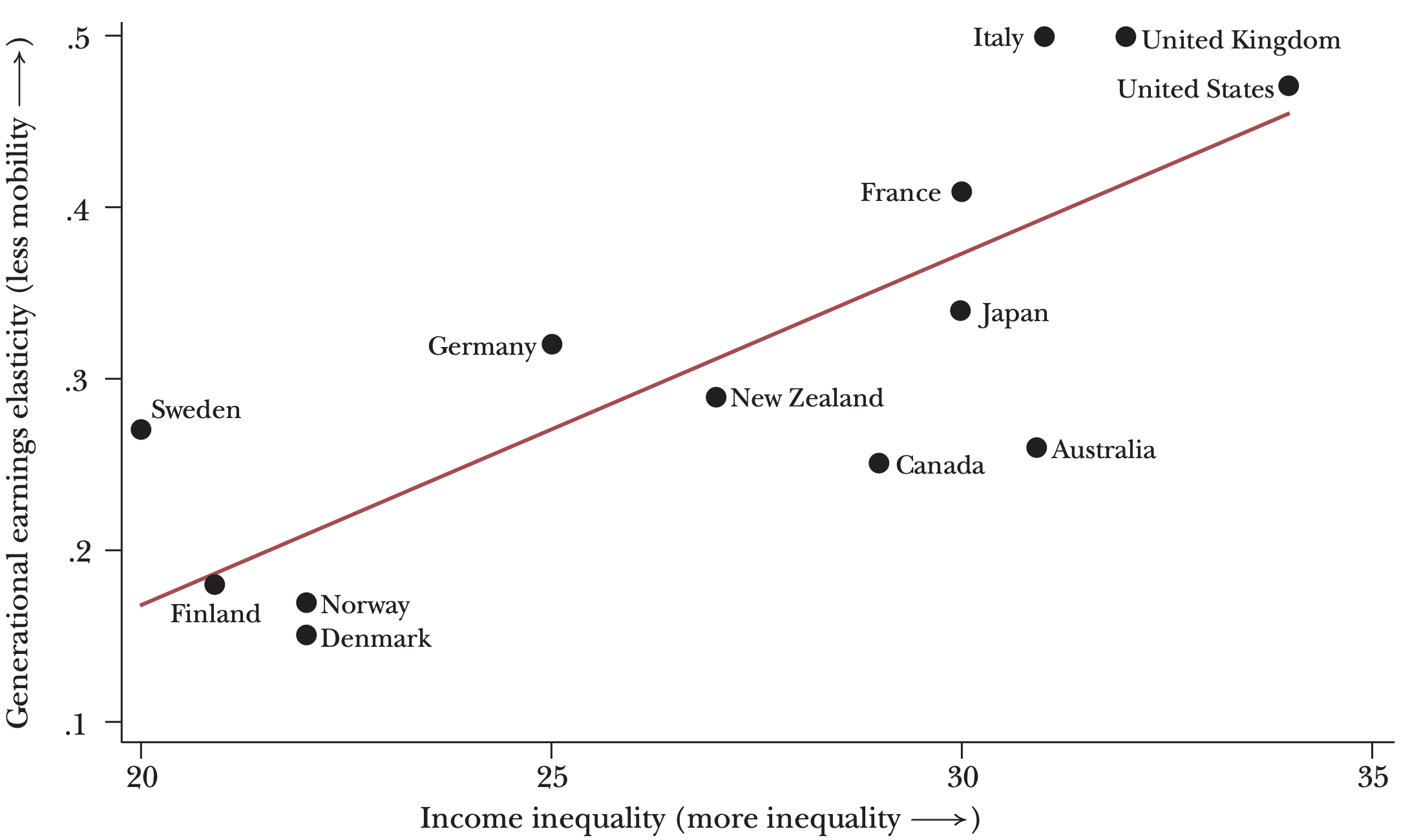
The Great Gatsby curve: \(\uparrow r\) (more inequality) \(\Rightarrow \uparrow \beta\) (lower mobility)

The Great Gatsby curve

Source: Figure 1 (Corak 2013)

Simplified Becker and Tomes (1979)

Limitations

  • Revisited in Becker and Tomes (1986)
    • Bequests of financial assets
    • Assortative mating
    • Fertility and intrahousehold allocation of resources
  • Arbitrary functional forms

Measurement

Basic framework

Simple regression (ignoring process on endowments)

\[ y_t = \beta y_{t - 1} + \varepsilon \]

where \(y_t\) and \(y_{t - 1}\) are log earnings and \(\beta\) is IG elasticity.

Challenges

  • Data sources: cross-sectional, panel, retrospective?
  • Permanent vs transitory earnings
  • Measurement error
  • Interpretation?

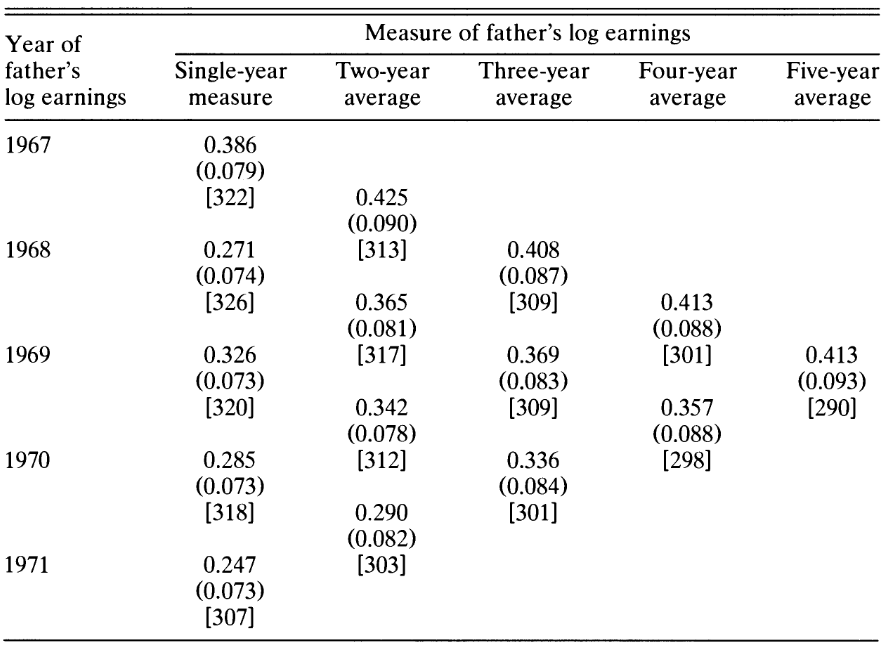
Measurement error

Source: Table 2 (Solon 1992)

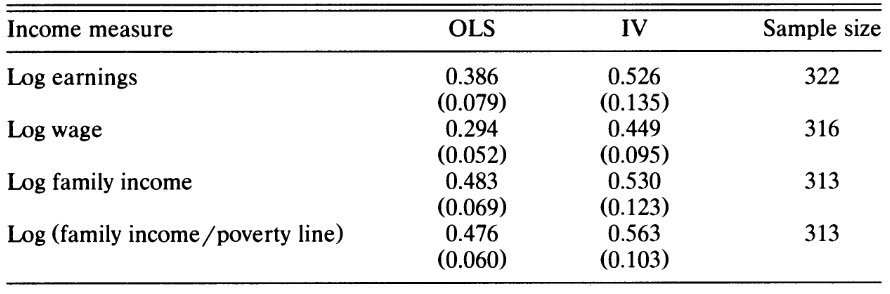
Measurement error

Using father’s education as an instrument for father’s single-year earnings


Source: Table 4 (Solon 1992)

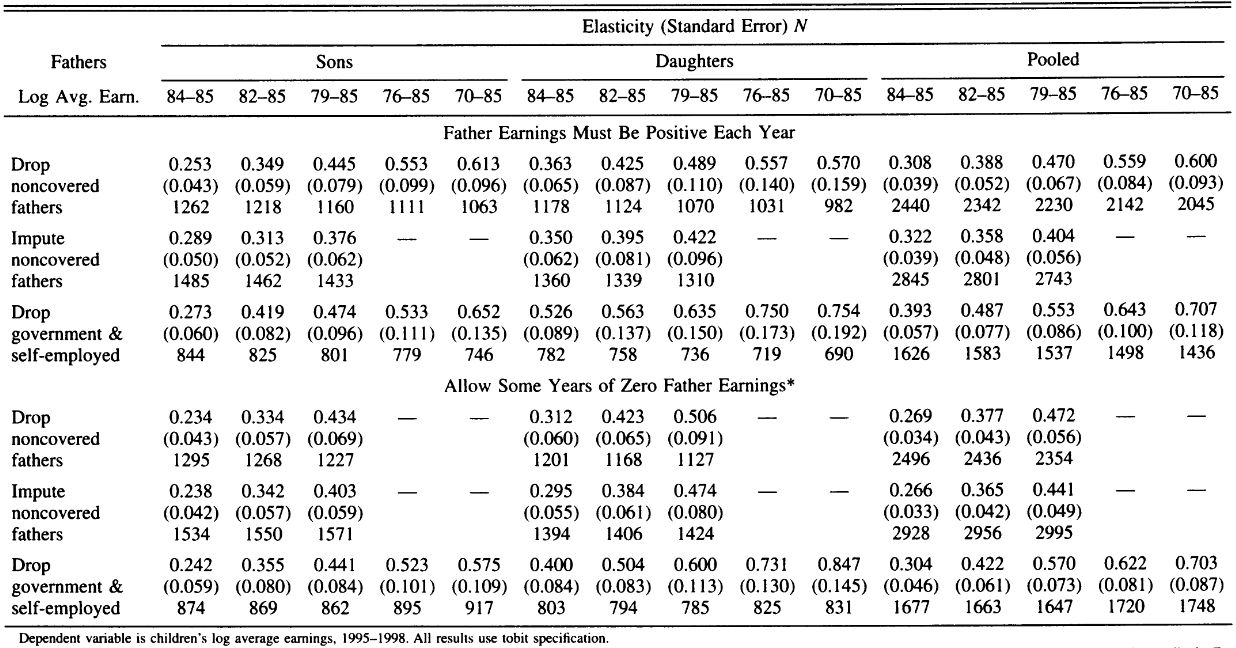
Permanent income (Mazumder 2005)

Source: Table 4 (Mazumder 2005)

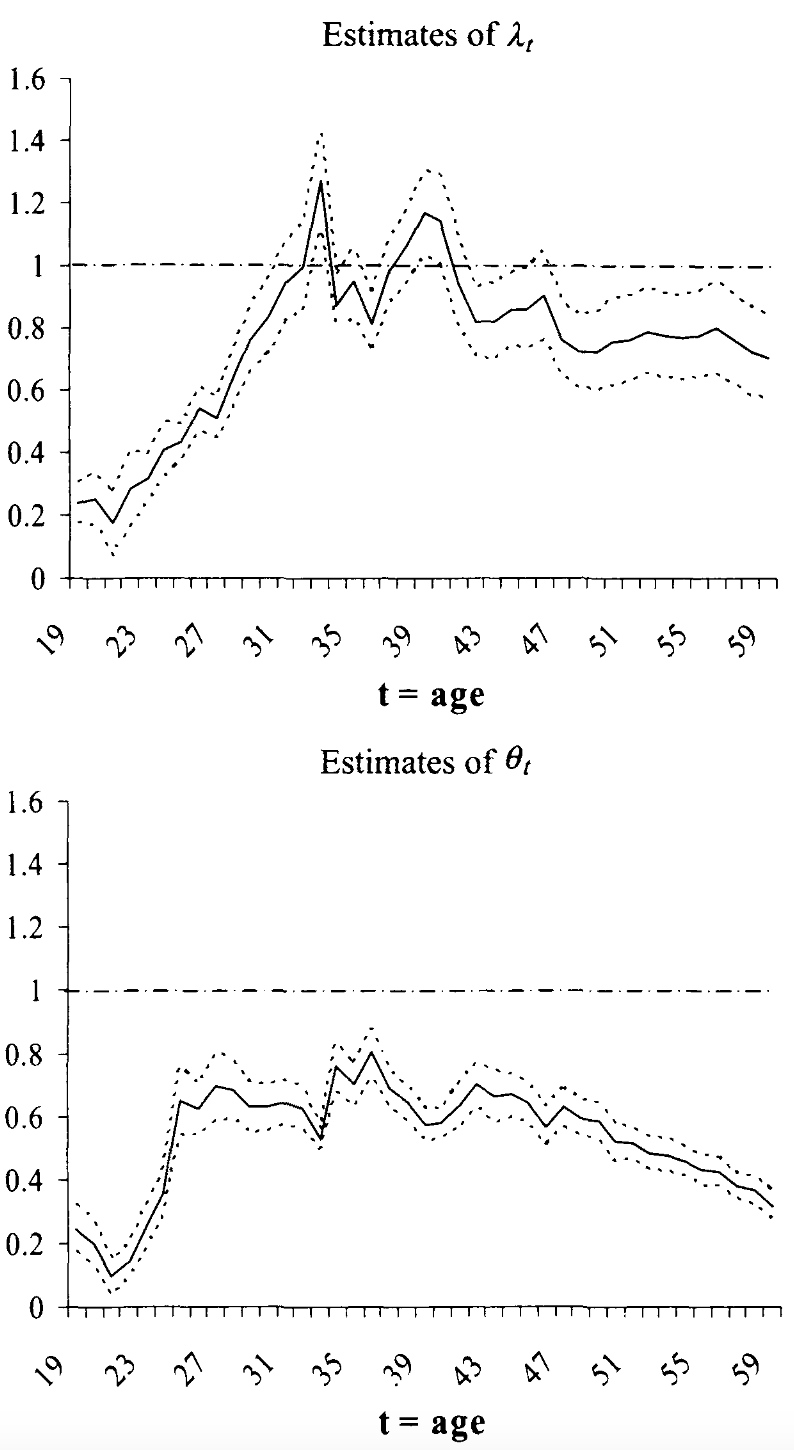
Lifecycle bias (Haider and Solon 2006)

\[ \begin{align} y^\text{parent}_a &= \mu_a y^\text{parent} + v \\ y^\text{child}_{a^\prime} &= \lambda_{a^\prime} y^\text{child} + u \end{align} \]

In this case, IGE elasticity estimator \(\hat{\beta}\) is inconsistent:

\[ \text{plim}~\hat{\beta} = \beta \lambda_{a^\prime} \theta_a \]

where \(\theta_a = \frac{\mu_a \text{Var}(y^\text{parent})}{\mu_a^2 \text{Var}(y^\text{parent}) + \text{Var}(v)}\)

Source: Figure 2 (Haider and Solon 2006)

Mechanisms

Mechanisms

Black and Devereux (2011): recent studies focus on causal mechanisms

  • genetic endowments
  • family environment
  • institutional environment

IG mobility and schooling (Pekkarinen, Uusitalo, and Kerr 2009)

School reform in Finland 1972-77: selective \(\rightarrow\) comprehensive

Source: Figure 1 (Pekkarinen, Uusitalo, and Kerr 2009)

IG mobility and schooling (Pekkarinen, Uusitalo, and Kerr 2009)

Standard IGE elasticity regression

\[ \log(y_\text{son}) = a + b_{jt} \log(y_\text{father}) + e \tag{1}\]

Effect of reform on IGE elasticity

\[ b_{jt} = b_0 + \delta R_{jt} + \Omega D_j + \Psi D_t \tag{2}\]

where \(R_{jt}\) indicates if reform in municipality \(j\) affected cohort \(t\).

Substitute Eq 2 into Eq 1 + main effects

IG mobility and schooling (Pekkarinen, Uusitalo, and Kerr 2009)

(1) (2) (3) (4)
Father's earnings 0.277 0.297 0.298 0.296
(0.014) (0.011) (0.010) (0.014)
Reform -0.063 -0.019
(0.012) (0.021)
Father's earnings x reform -0.055 -0.069 -0.066
(0.009) (0.022) (0.031)
Obs. 20 824 20 824 20 824 20 824
Cohort FE Yes Yes
Region FE Yes Yes
Cohort FE x region FE Yes

Source: Table 3 (Pekkarinen, Uusitalo, and Kerr 2009)

IG spillovers in education (Black, Devereux, and Salvanes 2005)

Reform in Norway: compulsory edu 7 \(\rightarrow\) 9 years

IV approach

\[ \begin{align} E &= \beta E^p + \gamma X + \gamma_p X^p + \epsilon \\ E^p &= \alpha {REFORM}^p + \delta X + \delta_p X^p + v \end{align} \]

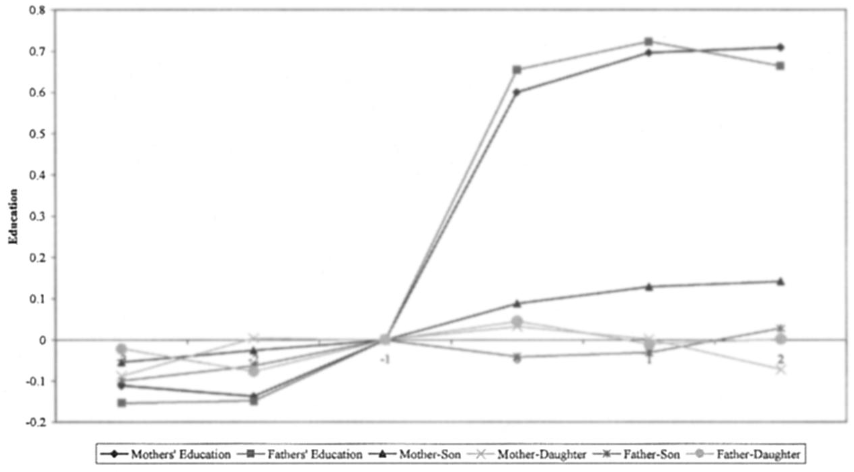
Limited IG spillover of school reform at the bottom

IG spillovers in education (Suhonen and Karhunen 2019)

Expansion of Finnish university system in 1955-75

Source: Figure 1 (Suhonen and Karhunen 2019)

IG spillovers in education (Suhonen and Karhunen 2019)

Child's years of education
Full sample Grandparent nonmissing
OLS IV
(1) (2) (3) (4)
Mother-child sample
Mother's yedu 0.345*** 0.522*** 0.540*** 0.697***
(0.004) (0.133) (0.143) (0.120)
F-stat (IV) 4.1 14.2 21.3
Obs. 1 239 331 1 239 331 1 239 331 628 230
Father-child sample
Father's yedu 0.305*** 0.400** 0.535*** 0.612***
(0.003) (0.161) (0.171) (0.143)
F-stat (IV) 3.7 12.7 19.6
Obs. 1 195 008 1 195 008 1 195 008 710 677
Additional controls Yes Yes

Source: Table 7 (Suhonen and Karhunen 2019)

IG mobility and neighbourhoods (Chetty and Hendren 2018a)

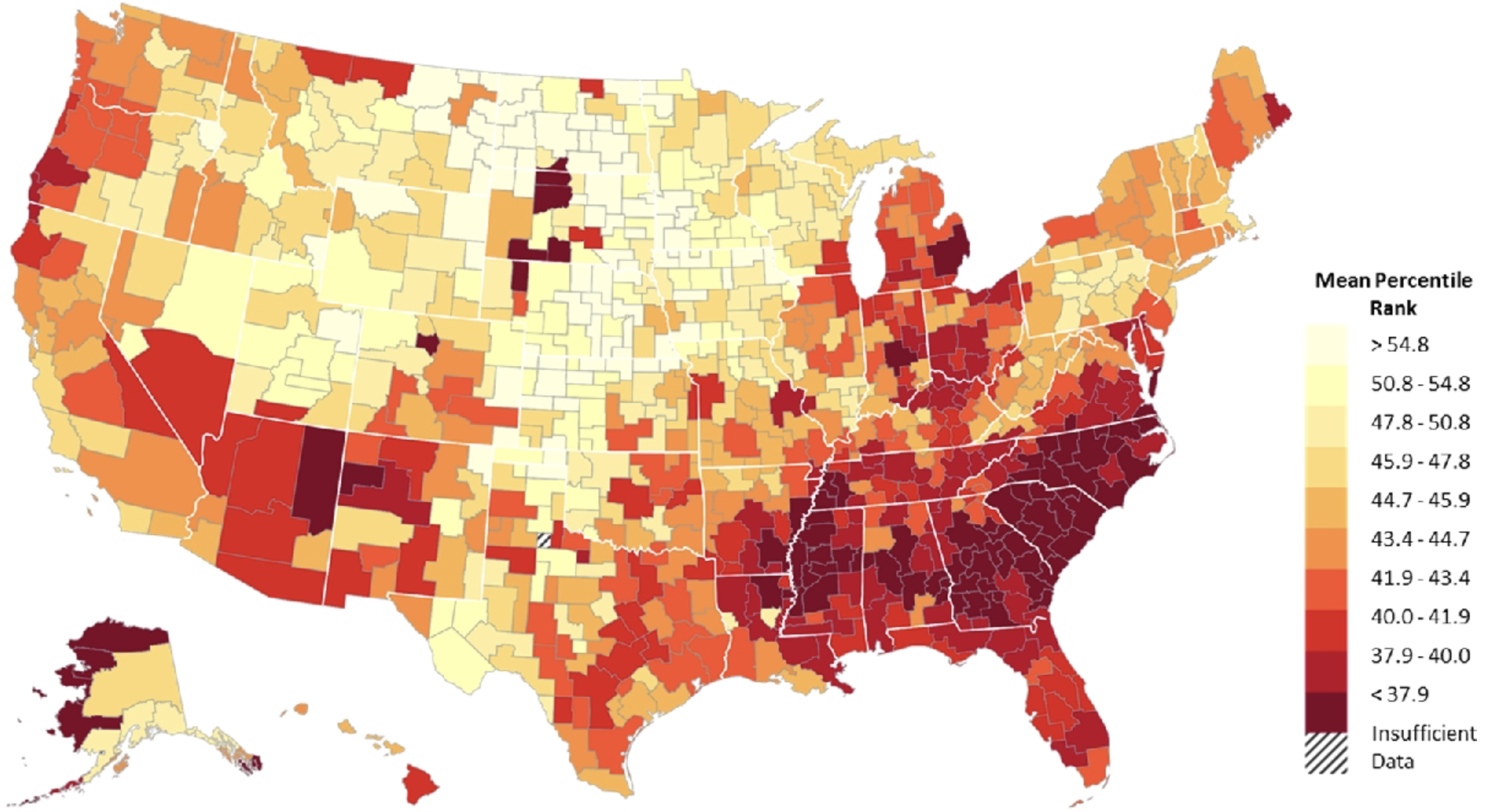
IG mobility varies geographically (Chetty et al. 2014)

Source: Figure II (Chetty and Hendren 2018a)

IG mobility and neighbourhoods (Chetty and Hendren 2018a)

Geographic variation in IG mobility may stem from:

  • selection into neighbourhoods
  • causal effect of neighbourhoods

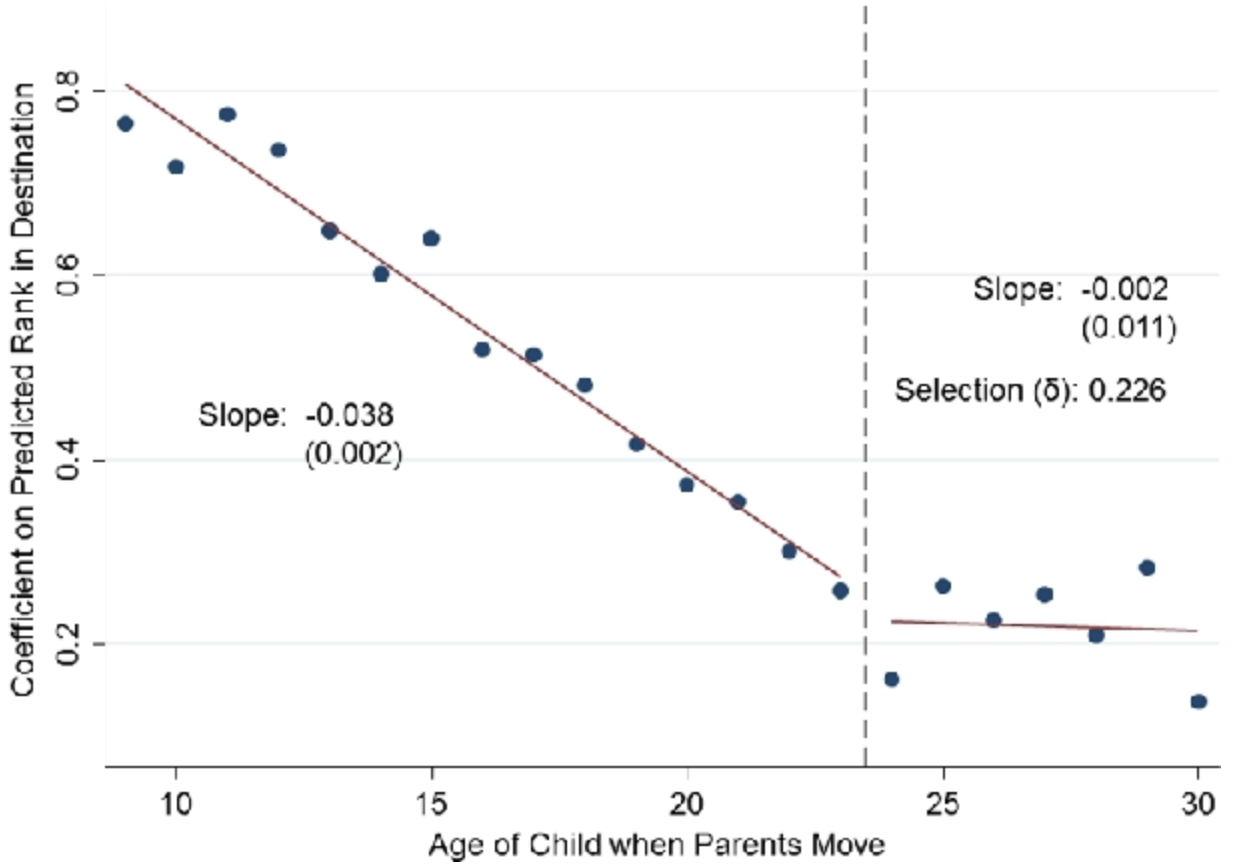
Do children moving to higher mobility area have better outcomes?

Endogenous moving \(\Rightarrow\) exploit timing of move

Identifying assumption

Selection into moving to a better area does not vary with age

IG mobility and neighbourhoods (Chetty and Hendren 2018a)

Source: Figure IV (Chetty and Hendren 2018a)

IG mobility and neighbourhoods (Chetty and Hendren 2018b)

What makes neighbourhoods generate good outcomes?

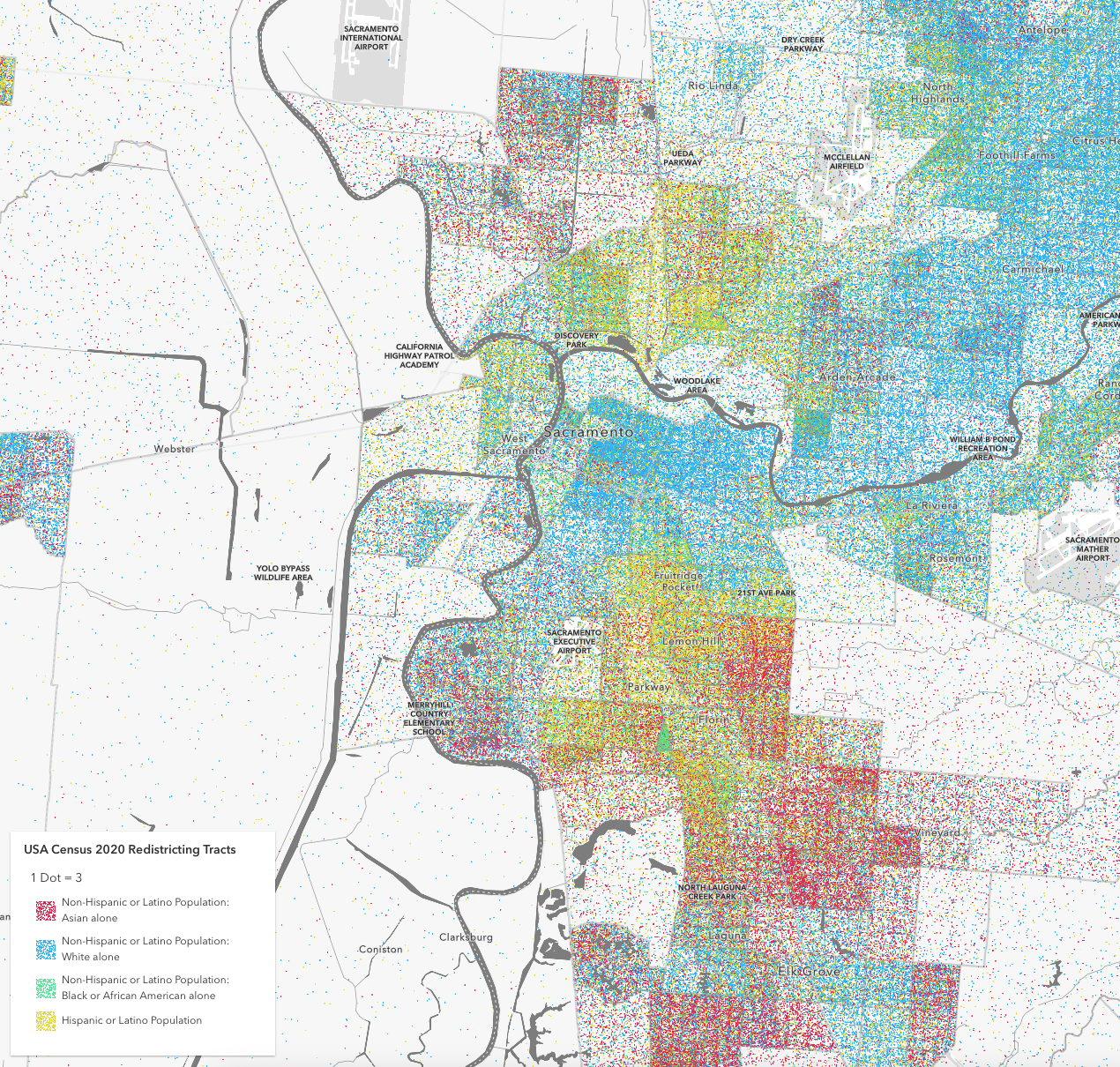
  1. Segregation (maps)
    Racial and income segregation \(\sim\) lower upward mobility
  2. Income inequality
    “Areas with greater income inequality generate less upward mobility”
  3. School quality
    \(\uparrow\) test scores, \(\downarrow\) school dropout rates, \(\uparrow\) # of colleges per capita
  4. Social capital
    \(\uparrow\) participation in community activities, \(\downarrow\) crime rate

Together explain 58% of variation in CZ causal effect

IG mobility and genetics (Rustichini et al. 2023)

How much of IGE elasticity driven by nature vs nurture?

Extension of standard model:

  • genetic transmission and assortative mating

  • skill transmission: genetic factors, parental investments, family environment and idiosyncratic events

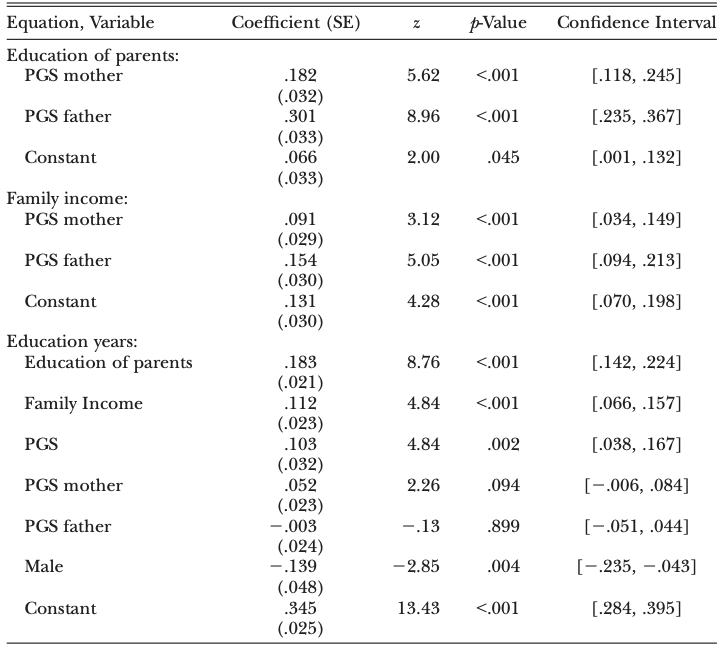
Minnesota Twin Family Study (income, skills, genotypes + parents)

IG mobility and genetics (Rustichini et al. 2023)

Source: Table 3 (Rustichini et al. 2023)

IG mobility and family (Fagereng, Mogstad, and Rønning 2021)

Quasi-random assignment of Korean-born adoptees to Norwegian parents

Dep var: child net wealth
Adoptees Non-adoptees
** p < 0.05, *** p < 0.01
Parent net wealth 0.204*** 0.548***
(0.042) (0.018)
Obs. 2 254 1 206 650

Source: Table 3 (Fagereng, Mogstad, and Rønning 2021)

Mechanisms:

  • not via parents’ education, family income, or location
  • children’s education, financial literacy, direct transfer (overall 40% of \(\beta\))

Multigenerational mobility (Colagrossi, d’Hombres, and Schnepf 2020)

Typical regression of parent-child pairs

\[ \ln y^\text{child} = \beta_{-1} \ln y^\text{parent} + \varepsilon \]

Similar estimation across \(k\) generations

\[ \ln y^\text{child} = \beta_{-k} \ln y^{k \text{ ancestor}} + \vartheta \]

Iterated regression fallacy: \(\beta_{-k} \neq \left(\beta_{-1}\right)^k\)

Multigenerational mobility (Colagrossi, d’Hombres, and Schnepf 2020)

Source: Figure 2 (Colagrossi, d’Hombres, and Schnepf 2020)

Multigenerational mobility (Stuhler 2012)

Possible explanations of iterated regression fallacy:

Latent endowment

\[\begin{align} y_{it} &= \rho e_{it} + u_{it} \\ e_{it} &= \lambda e_{it - 1} + v_{it} \\ \Rightarrow \Delta &= (\rho^2 - 1)\rho^2\lambda^2 \end{align}\]

Multiple endowments

\[\begin{align} y_{it} &= \rho_1 e_{1it} + \rho_2 e_{2it} + u_{it} \\ e_{1it} &= \lambda_1 e_{1it - 1} + v_{1it} \\ e_{2it} &= \lambda_2 e_{2it - 1} + v_{2it} \\ \Rightarrow \Delta &= -\rho_1^2\rho_2^2\left(\lambda_1 - \lambda_2\right)^2 \end{align}\]

Grandparent effect

\[\begin{align} e_{it} &= \lambda_{-1}e_{it-1} + \lambda_{-2}e_{it-2} + v_{it} \\ \Rightarrow \Delta &= \left(\rho^2 - 1\right)\rho^2 \left(\frac{\lambda_{-1}}{1 - \lambda_{-2}}\right)^2 - \rho^2\lambda_{-2}\frac{\left(1 - \lambda_{-2} - \lambda_{-1}\right)\left(1 - \lambda_{-2} + \lambda_{-1}\right)}{\left(1 - \lambda_{-2}\right)^2} \end{align}\]

Other explanations

Parental investments, bequests, etc.

Multigenerational mobility (Barone and Mocetti 2021)

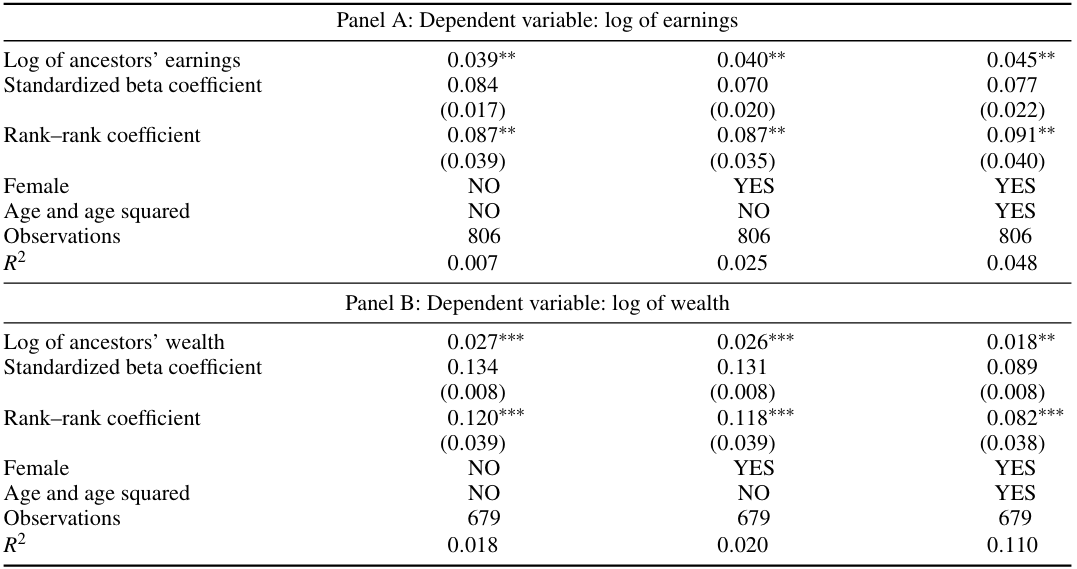
Current individuals in Florence \(\leftrightarrow\) ancestors in 1427 based on surnames

Source: Table 3 (Barone and Mocetti 2021)

Multigenerational mobility (Collado, Ortuño-Ortín, and Stuhler 2023)

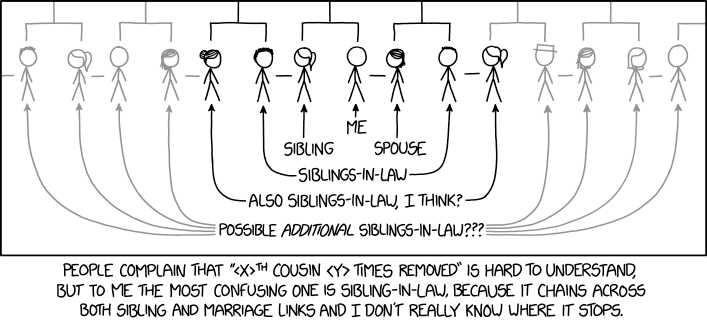
Horizontal approach: Grandparent-grandchild \(\rightarrow\) cousin-cousin

  • blood relationships: intergenerational processes

  • in-law relationships: assortative processes

Swedish registry: “up to 141 distinct kinship moments”

Source: https://xkcd.com/2040

Multigenerational mobility (Collado, Ortuño-Ortín, and Stuhler 2023)

\[\begin{align} y_t &= \beta \tilde{y}_{t - 1} + \gamma \tilde{z}_{t - 1} + e_t + v_t + x_t + u_t \\ \tilde{y}_{t - 1} &= \alpha_y y_{t - 1}^m + \left(1 - \alpha_y\right) y_{t - 1}^f \\ \tilde{z}_{t - 1} &= \alpha_z z_{t - 1}^m + \left(1 - \alpha_z\right) z_{t - 1}^f \end{align}\]

\(\beta\) and \(\alpha_y\) measure direct transmission
\(\gamma\) and \(\alpha_z\) measure indirect transmission

\(u_t\) is white noise (market luck)
\(v_t\) is white noise in latent factor (endowment luck)
\(x_t\) is shared sibling component
\(e_t\) is latent sibling component

Multigenerational mobility (Collado, Ortuño-Ortín, and Stuhler 2023)

\(\beta\) \(\gamma\) \(\alpha_y\) \(\alpha_z\) \(\sigma_y^2\) \(\sigma_u^2\) \(\sigma_z^2\) \(\sigma_x^2\) \(\sigma_e^2\)
Men 0.144 0.664 0.389 0.660 4.648 1.975 2.072 0.180 0.657
Women 0.129 0.566 0.018 0.775 4.465 2.333 1.559 0.244 0.712
Figure 1: Source: Table 4 (Collado, Ortuño-Ortín, and Stuhler 2023)
  1. Indirect transmission dominates direct (\(\beta < \gamma\))
  2. Shared sibling component \(x\) explains ~5%, \(e\) ~ 15% of \(\sigma_y^2\)
  3. Spousal correlation in latent factor \(0.754 = \rho_{z^m z^f} > \rho_{y^m y^f} = 0.489\) in observed characteristics

Summary

  • Vast literature on intergenerational mobility

    • Earlier works concentrated on measuring mobility precisely
    • Later works focus on determinants of mobility
  • Improving access to education promotes mobility

    • The effect may spillover to children
  • Geographic variation in mobility; largely causal

    • Lower segregation, inequality, better schools and social cohesion
  • Genetic endowment and assortative mating important components

  • Multigenerational mobility slower than predicted

References

Barone, Guglielmo, and Sauro Mocetti. 2021. “Intergenerational Mobility in the Very Long Run: Florence 1427–2011.” The Review of Economic Studies 88 (4): 1863–91. https://doi.org/10.1093/restud/rdaa075.
Becker, Gary S., and Nigel Tomes. 1979. “An Equilibrium Theory of the Distribution of Income and Intergenerational Mobility.” Journal of Political Economy 87 (6): 1153–89. https://www.jstor.org/stable/1833328.
———. 1986. “Human Capital and the Rise and Fall of Families.” Journal of Labor Economics 4 (3): S1–39. https://www.jstor.org/stable/2534952.
Black, Sandra E., and Paul J. Devereux. 2011. “Recent Developments in Intergenerational Mobility.” In Handbook of Labor Economics, 4:1487–1541. Elsevier. https://doi.org/10.1016/S0169-7218(11)02414-2.
Black, Sandra E., Paul J. Devereux, and Kjell G. Salvanes. 2005. “Why the Apple Doesn’t Fall Far: Understanding Intergenerational Transmission of Human Capital.” The American Economic Review 95 (1): 437–49. https://www.jstor.org/stable/4132690.
Chetty, Raj, and Nathaniel Hendren. 2018a. “The Impacts of Neighborhoods on Intergenerational Mobility I: Childhood Exposure Effects*.” The Quarterly Journal of Economics 133 (3): 1107–62. https://doi.org/10.1093/qje/qjy007.
———. 2018b. “The Impacts of Neighborhoods on Intergenerational Mobility II: County-Level Estimates*.” The Quarterly Journal of Economics 133 (3): 1163–1228. https://doi.org/10.1093/qje/qjy006.
Chetty, Raj, Nathaniel Hendren, Patrick Kline, and Emmanuel Saez. 2014. “Where Is the Land of Opportunity? The Geography of Intergenerational Mobility in the United States *.” The Quarterly Journal of Economics 129 (4): 1553–623. https://doi.org/10.1093/qje/qju022.
Colagrossi, Marco, Béatrice d’Hombres, and Sylke V Schnepf. 2020. “Like (Grand)parent, Like Child? Multigenerational Mobility Across the EU.” European Economic Review 130 (November): 103600. https://doi.org/10.1016/j.euroecorev.2020.103600.
Collado, M Dolores, Ignacio Ortuño-Ortín, and Jan Stuhler. 2023. “Estimating Intergenerational and Assortative Processes in Extended Family Data.” The Review of Economic Studies 90 (3): 1195–1227. https://doi.org/10.1093/restud/rdac060.
Corak, Miles. 2013. “Income Inequality, Equality of Opportunity, and Intergenerational Mobility.” Journal of Economic Perspectives 27 (3): 79–102. https://doi.org/10.1257/jep.27.3.79.
Fagereng, Andreas, Magne Mogstad, and Marte Rønning. 2021. “Why Do Wealthy Parents Have Wealthy Children?” Journal of Political Economy 129 (3): 703–56. https://doi.org/10.1086/712446.
Gelber, Alexander, and Adam Isen. 2013. “Children’s Schooling and Parents’ Behavior: Evidence from the Head Start Impact Study.” Journal of Public Economics 101 (May): 25–38. https://doi.org/10.1016/j.jpubeco.2013.02.005.
Goldin, Claudia, and Lawrence F. Katz. 2008. The Race Between Education and Technology. Harvard University Press. https://doi.org/10.2307/j.ctvjf9x5x.
Haider, Steven, and Gary Solon. 2006. “Life-Cycle Variation in the Association Between Current and Lifetime Earnings.” The American Economic Review 96 (4): 1308–20. https://www.jstor.org/stable/30034342.
Harden, K. Paige, and Philipp D. Koellinger. 2020. “Using Genetics for Social Science.” Nature Human Behaviour 4 (6): 567–76. https://doi.org/10.1038/s41562-020-0862-5.
Mazumder, Bhashkar. 2005. “Fortunate Sons: New Estimates of Intergenerational Mobility in the United States Using Social Security Earnings Data.” The Review of Economics and Statistics 87 (2): 235–55. https://www.jstor.org/stable/40042900.
Pekkarinen, Tuomas, Roope Uusitalo, and Sari Kerr. 2009. “School Tracking and Intergenerational Income Mobility: Evidence from the Finnish Comprehensive School Reform.” Journal of Public Economics 93 (7): 965–73. https://doi.org/10.1016/j.jpubeco.2009.04.006.
Pop-Eleches, Cristian, and Miguel Urquiola. 2013. “Going to a Better School: Effects and Behavioral Responses.” American Economic Review 103 (4): 1289–1324. https://doi.org/10.1257/aer.103.4.1289.
Rustichini, Aldo, William G. Iacono, James J. Lee, and Matt McGue. 2023. “Educational Attainment and Intergenerational Mobility: A Polygenic Score Analysis.” Journal of Political Economy 131 (10): 2724–79. https://doi.org/10.1086/724860.
Solon, Gary. 1992. “Intergenerational Income Mobility in the United States.” The American Economic Review 82 (3): 393–408. https://www.jstor.org/stable/2117312.
Stuhler, Jan. 2012. “Mobility Across Multiple Generations: The Iterated Regression Fallacy.” SSRN Electronic Journal. https://doi.org/10.2139/ssrn.2192768.
Suhonen, Tuomo, and Hannu Karhunen. 2019. “The Intergenerational Effects of Parental Higher Education: Evidence from Changes in University Accessibility.” Journal of Public Economics 176 (August): 195–217. https://doi.org/10.1016/j.jpubeco.2019.07.001.
Appendices

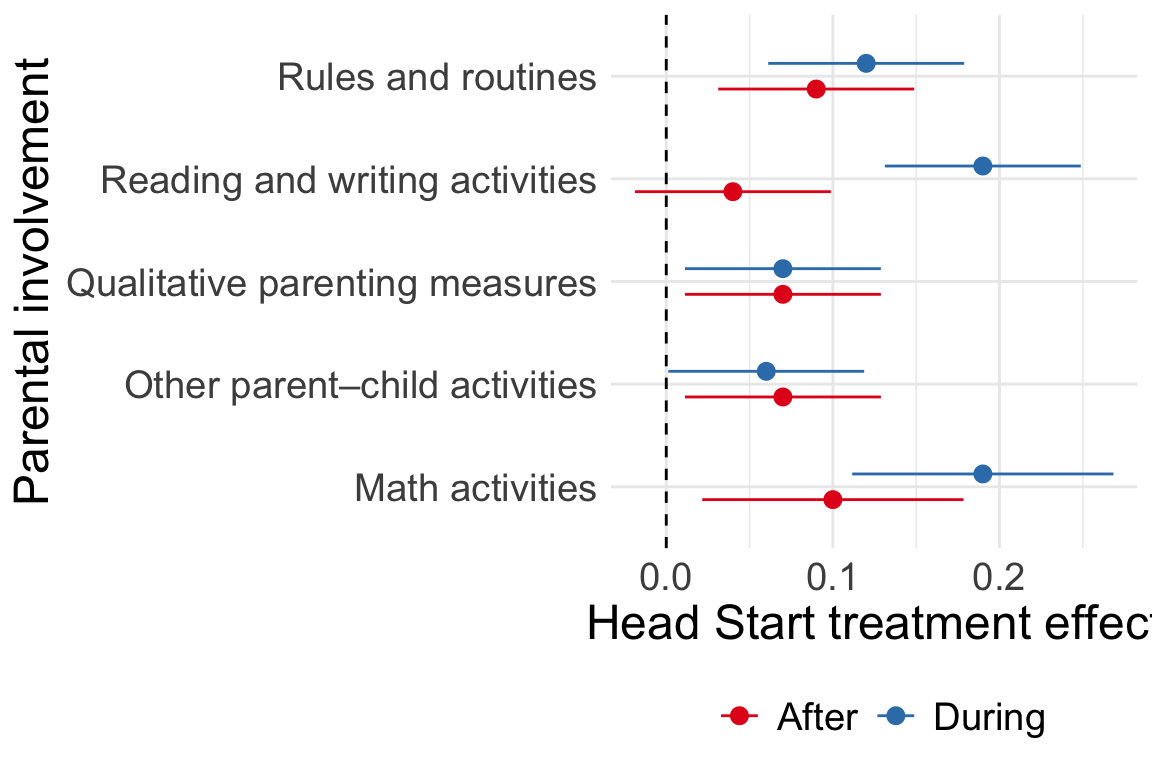
Head Start and absence of offsetting behaviour

Source: Table 2 (Gelber and Isen 2013)

Back

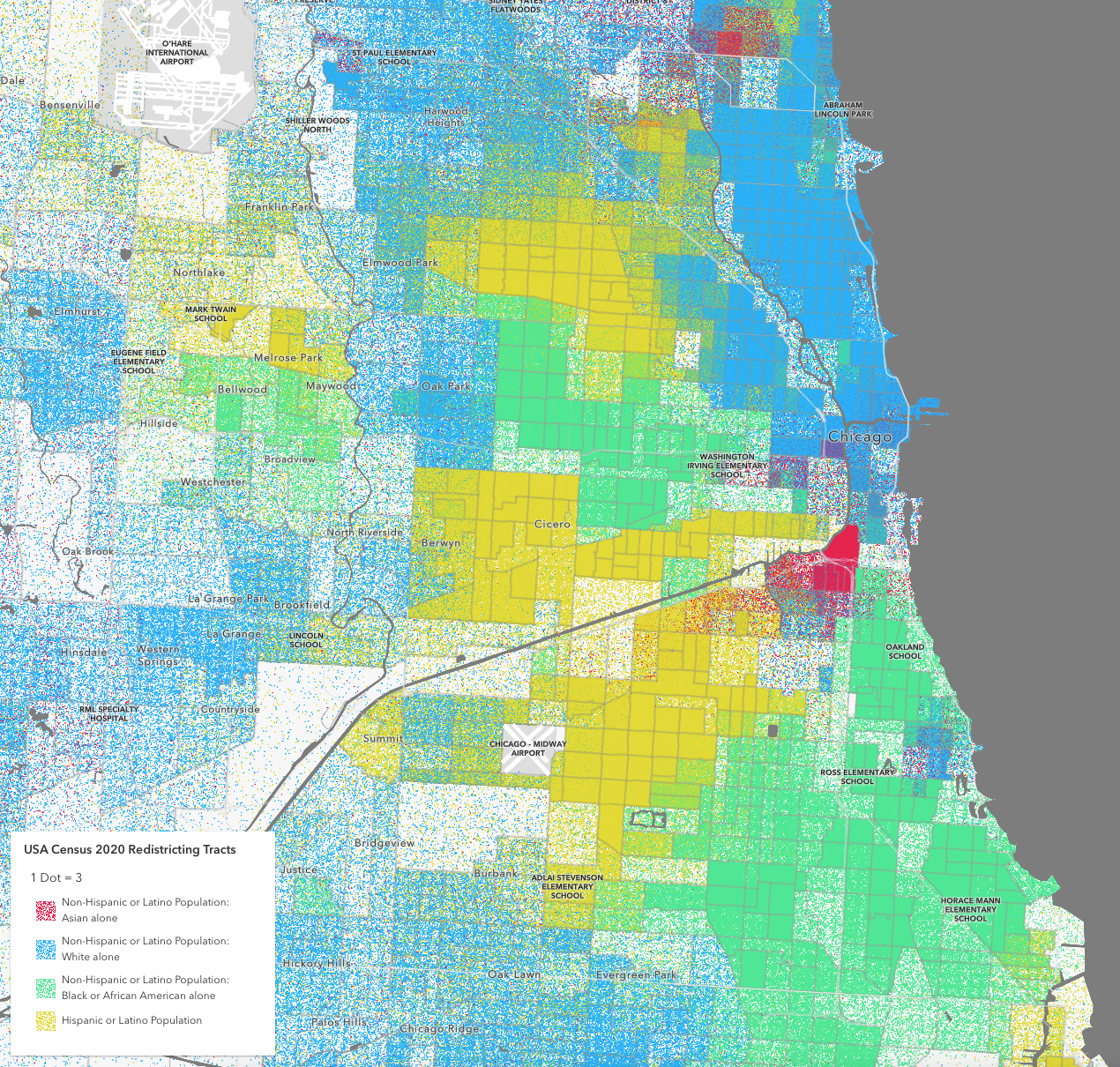
US Racial Dot Map

Chicago

Sacramento

Source: US Census Bureau

Back